
If You Can't Verify It, You Don't Own It
Only 6.6% of developers trust AI for important decisions - but 48% trust it when they can verify it. A practical 7-layer verification stack for AI-built website
Aayush3 min read
If You Can't Verify It, You Don't Own It
A polished result is not necessarily a reliable one. Ownership of AI-built software starts when you can check what was built, why, and how to change it.
Part 2 of 3 - The Verification Layer
Developers trust AI when they can verify it. This post covers context, authoritative sources, specifications and a practical 7-layer verification stack for AI-built websites.
AI can generate code, build interfaces and complete tasks that once required hours of manual work. But there is a difference between getting an AI to produce something and knowing that what it produced is correct.
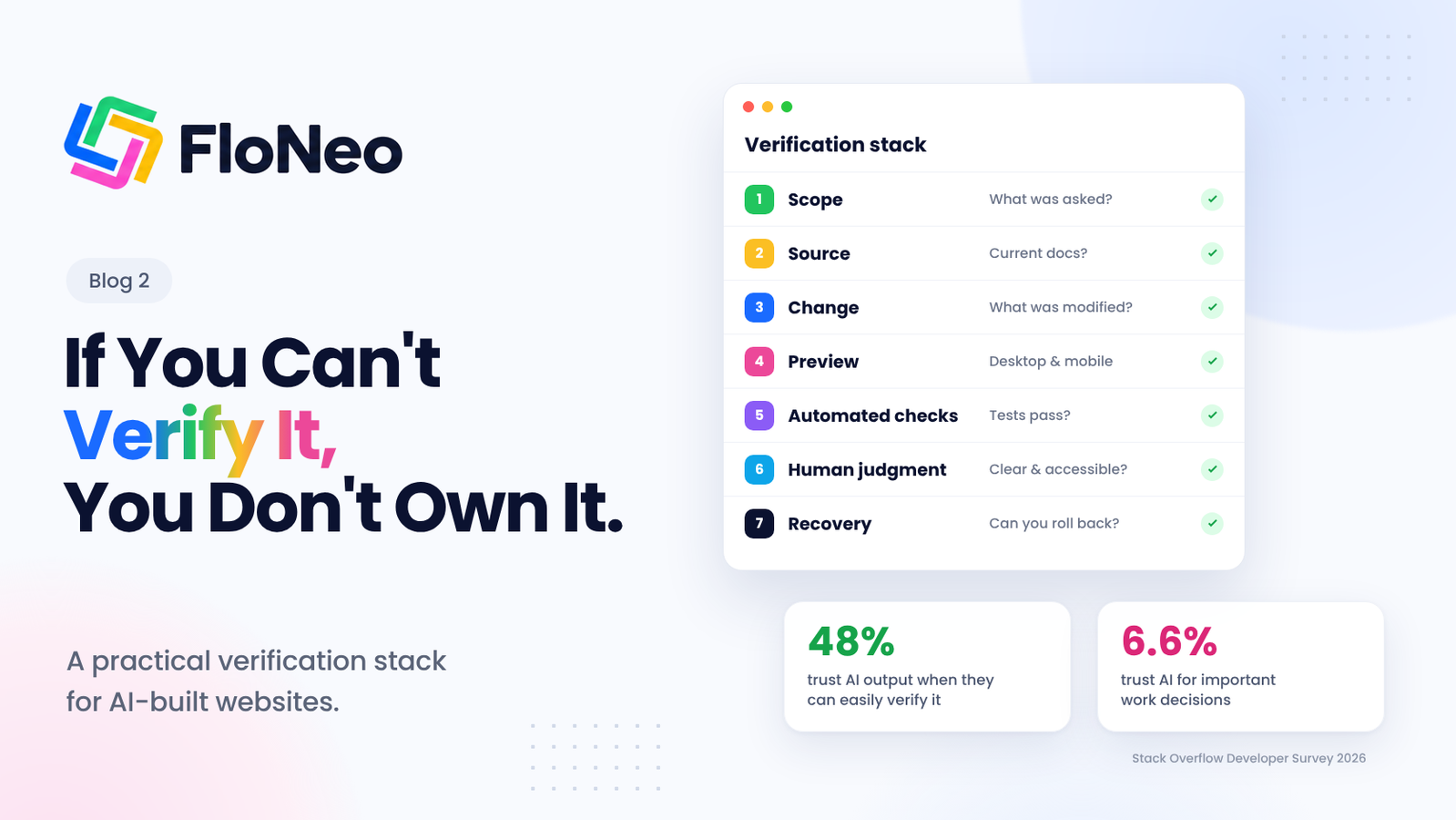
Developers seem increasingly aware of that distinction. Stack Overflow's 2026 Developer Survey found that 48% of respondents trusted AI output when they could easily verify it. Only 6.6% trusted AI for important work decisions. [1]
The takeaway isn't that developers reject AI. They want evidence before relying on it.
That makes AI code verification a fundamental part of building with AI, not a final quality check added after generation.
Trust Is Conditional, Not Automatic
AI-generated output can look convincing while containing incorrect assumptions, outdated dependencies or subtle errors. A website can render correctly in a preview while its contact form fails to submit. An application can compile successfully while using the wrong authentication pattern.
The challenge is that a polished result is not necessarily a reliable one.
Trust becomes easier when people can inspect the result, understand what produced it and test whether it behaves as expected. In other words, the goal isn't to eliminate uncertainty by asking AI to be more confident. It's to make uncertainty easier to detect.
A polished result is not necessarily a reliable one.
Context Is Not the Same as a Longer Prompt
When AI gets something wrong, the instinct is often to provide more instructions. Sometimes that helps. But repeatedly explaining the same project rules is not a sustainable way to work.
Stack Overflow's 2026 research on developer knowledge and context found that respondents considered two sources particularly important for AI at work: [2]
- Project goals and requirements: 85.2%
- Code, repositories and technical documentation: 73.3%
Prior decisions and their rationale also mattered to 44% of respondents.
These findings point towards a better approach: context should be part of the working environment, not just something users squeeze into individual prompts.
GitHub supports this idea through repository instructions and custom agent skills. Teams can give agents persistent guidance, specialised procedures and relevant resources so they can follow established conventions without relying on users to repeat them every time. [3]
For example, a team building an online store might specify its design system, preferred payment integration, accessibility requirements and rules for handling customer data. An agent should be able to consult those instructions when making relevant changes.
More context is not always better. The right context is better. It must be relevant, authoritative and current.
The Agent Experience Problem: Plausible Doesn't Mean Correct
Microsoft's October 9, 2026, Agent Experience (AX) Practitioner Playbook addresses another source of errors: the information agents rely on. [4]
Microsoft describes cases where an agent produces code that looks reasonable or even compiles, but selects the wrong SDK version, uses a deprecated authentication pattern or follows an implementation approach the product team would not recommend.
The problem isn't necessarily the prompt. The agent may be drawing on outdated or incomplete information.
This is why AI code verification must include checking the source of an implementation, not merely whether it runs.
For developers, that means giving agents access to authoritative documentation, current APIs and project-specific guidance. It also means testing their output against meaningful criteria rather than accepting a successful build as proof of correctness.
The same principle applies to non-technical builders: a website that looks right in a preview still needs its links, forms and mobile layout checked.
Keep the Specification, Not Just the Conversation
There is another risk when project intent exists only in a conversation with an AI model: it becomes difficult to distinguish what was requested, what was decided and what was actually implemented.
Spec-driven development offers an alternative. Requirements, design decisions, implementation tasks and tests are documented as connected parts of the process.
That creates a reference point for later changes. If a user asks an agent to modify a checkout page, the agent can be evaluated against the original requirements instead of treating the latest instruction as the entire specification.
A useful specification should answer three questions:
- What should the system do?
- What constraints must it respect?
- How will we know the result is correct?
This makes changes easier to evaluate and reduces the risk of solving one problem while creating another.
A Practical Verification Stack for AI-Built Websites
Verification doesn't need to be complicated, but it should be systematic. Consider an AI-generated website with a contact form.
| Layer | What to check |
|---|---|
| 1. Scope | Was the form supposed to collect a name, email and message? |
| 2. Source | Does the implementation use the intended form service and current documentation? |
| 3. Change | Which fields, components or submission behaviours were modified? |
| 4. Preview | Does the form display correctly on desktop and mobile? |
| 5. Automated checks | Do validation, required fields and submission tests work? |
| 6. Human judgment | Is the experience understandable, accessible and appropriate? |
| 7. Recovery | Can the previous working version be restored if the change causes a problem? |
Each layer answers a different question. A preview checks appearance, not necessarily functionality. Automated tests check defined conditions, not every possible user experience. Human review adds context that individual checks can miss.
Together, they make AI code verification more reliable than simply asking an agent, "Is everything working?"
What This Means for AI Builders
The same philosophy should shape the tools people use to build software.
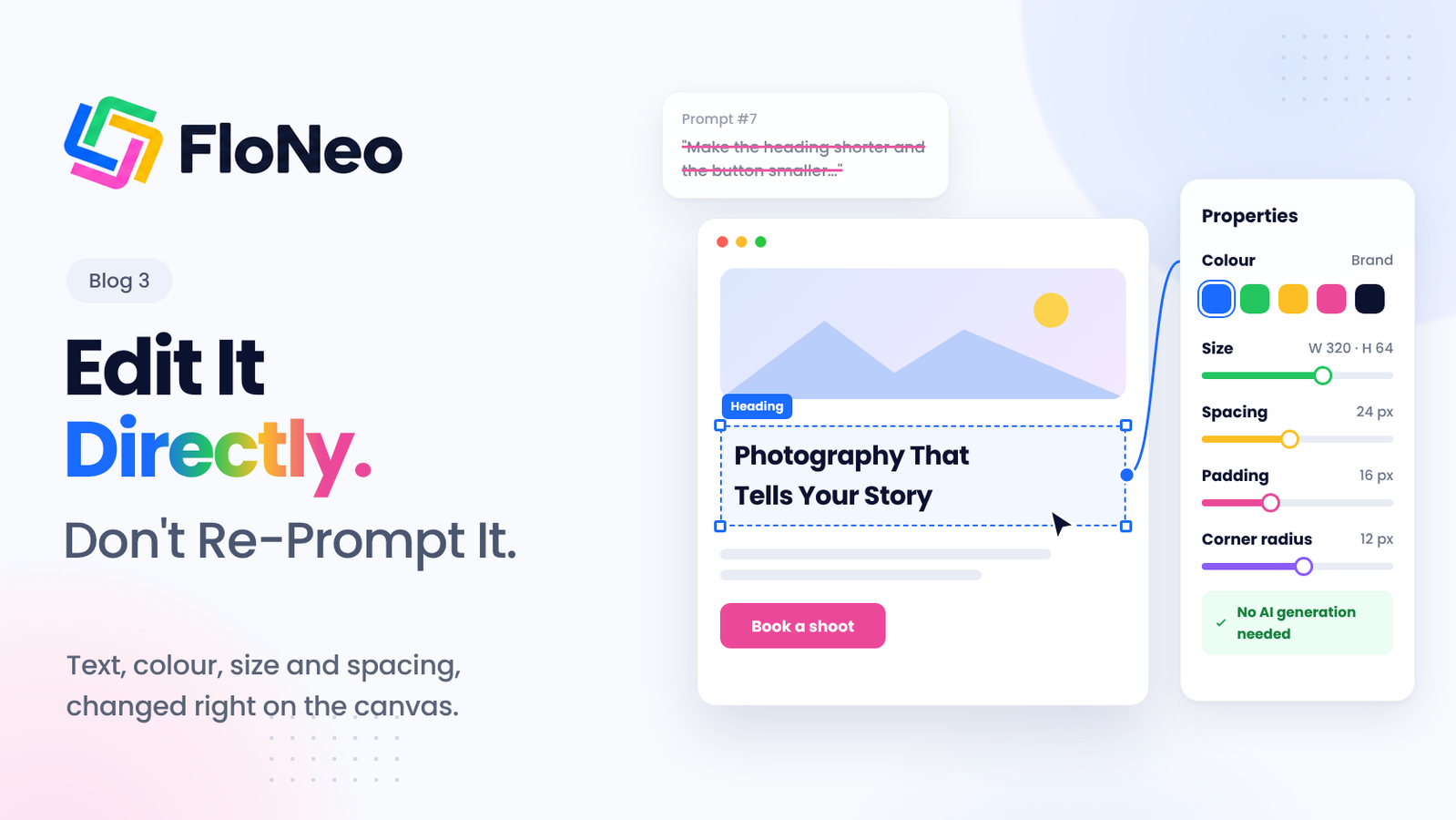
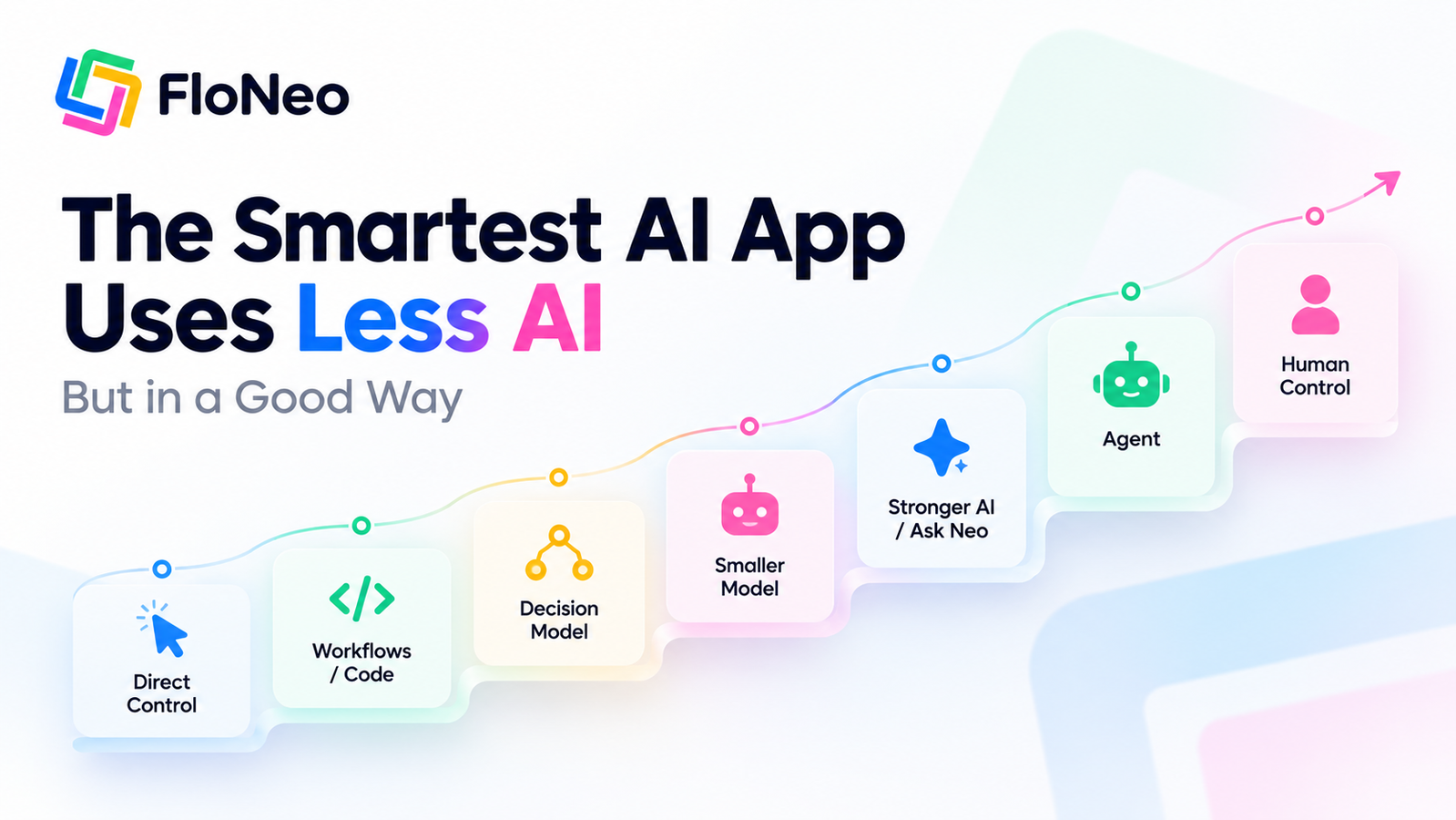
After generation, users should be able to understand and modify what exists rather than treating the AI's output as a black box. The interface, its components and relevant application structures should remain accessible, with direct controls for straightforward changes and AI assistance for tasks that require interpretation.
This is the principle behind FloNeo's approach: AI-powered should not mean AI-dependent. [5]
Changing a button's colour or adjusting spacing is a known, bounded task. Direct visual editing is often the more appropriate way to handle it. Restructuring a page around an unclear business requirement is different; that is where AI assistance can help interpret intent.
The distinction matters because every unnecessary generation cycle creates another opportunity for unintended changes. Keeping simple edits direct makes the system easier to control, while using AI selectively reserves its reasoning capabilities for work that benefits from them.
FloNeo isn't claiming to eliminate the need for testing or human judgment. The point is to keep the result understandable and the user in control of what happens next.
Ownership Begins After Generation
The next stage of building with AI isn't just about generating better first drafts. It is about making the resulting systems easier to inspect, verify, maintain and change.
Research from Stack Overflow highlights the importance of verifiability and relevant context. Microsoft's AX work demonstrates why authoritative information matters. And spec-driven approaches show how documented intent can guide implementation and testing.
Together, they point towards a more useful definition of ownership: not simply having created something, but being able to explain how it works and make informed decisions about its future.
Ownership begins when you can explain what exists, what changed, and how to change it again without asking the model to rediscover the system.
FloNeo launches on 1 November 2026. Join the FloNeo waitlist for free and get early access.
Previous in the Series
Part 1: AI Can Write More Code. Why Aren't Teams Shipping More Software?
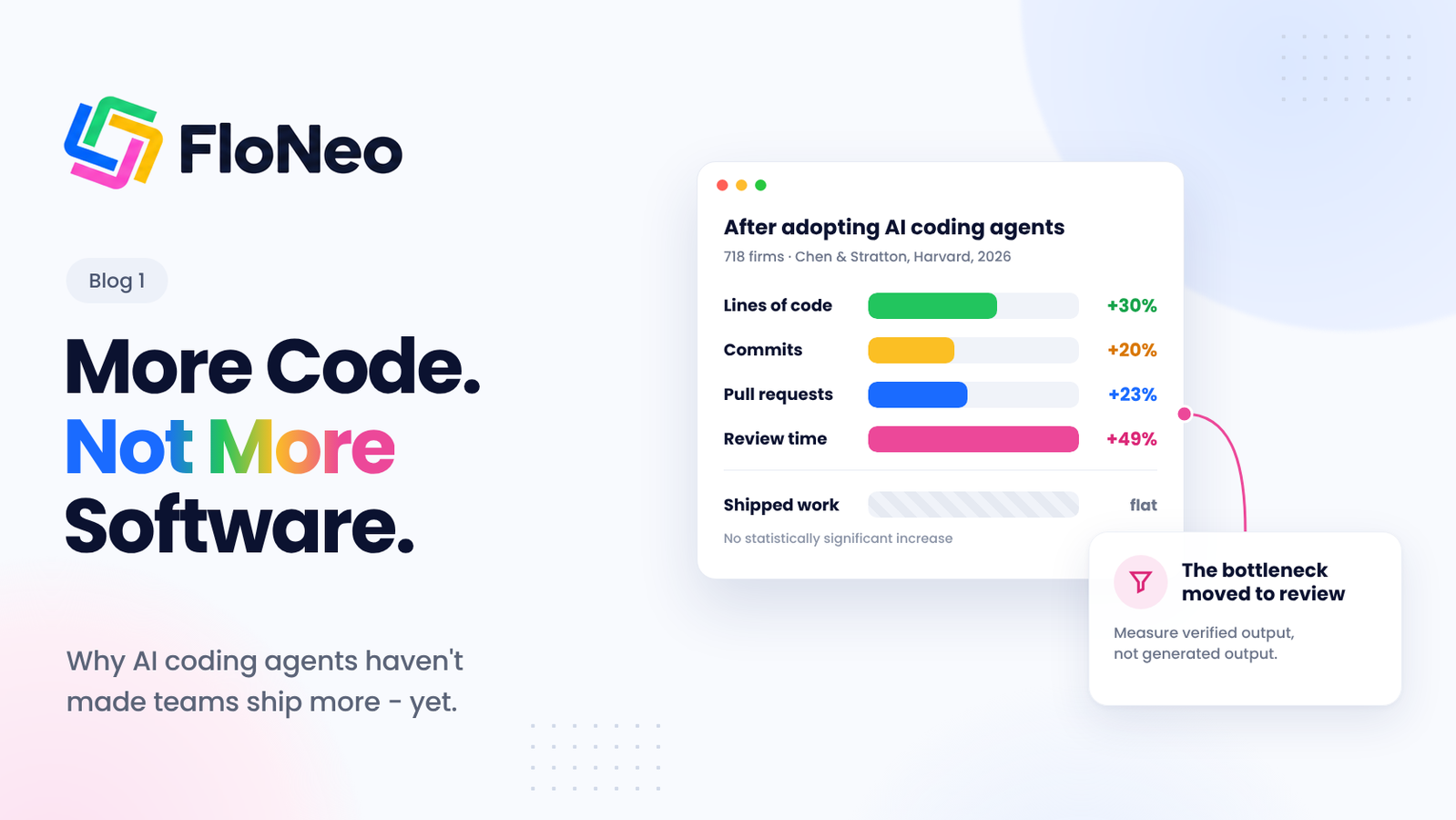
Part 1 looks at a study of 718 firms showing that AI coding agents increased code output without a significant rise in completed software - and why review became the bottleneck.
Editorial note: Replace this placeholder with the live Part 1 URL after publication.
Next in the Series
Part 3: Coming soon
Editorial note: Add the Part 3 title and live URL after publication.
References
- Stack Overflow. 2026 Developer Survey - AI trust.
- Stack Overflow. 2026 Developer Survey - Knowledge and context.
- GitHub Docs. Adding agent skills for GitHub Copilot.
- Microsoft for Developers. Introducing the Agent Experience (AX) Practitioner Playbook (9 October 2026).
- FloNeo. FloNeo - Describe, Generate, Edit, Own.
- FloNeo. How to Build a Website With AI Without Burning Through Credits (Sample Prompt Included).