
AI Can Write More Code. Why Aren't Teams Shipping More Software?
A study of 718 firms found AI coding agents raised lines of code by 30% - but not completed software. Here's where the productivity went, and what to measured
Aayush3 min read
AI Can Write More Code. Why Aren't Teams Shipping More Software?
More lines of code, more commits, more pull requests - and no significant rise in finished work. A new study shows where AI productivity gets stuck.
Part 1 of 3 - The Productivity Gap
Generating code has become fast. Verifying it hasn't. This post looks at what a study of 718 firms found, and why the bottleneck has moved downstream.
AI can generate code faster than ever. But are teams actually shipping more software?
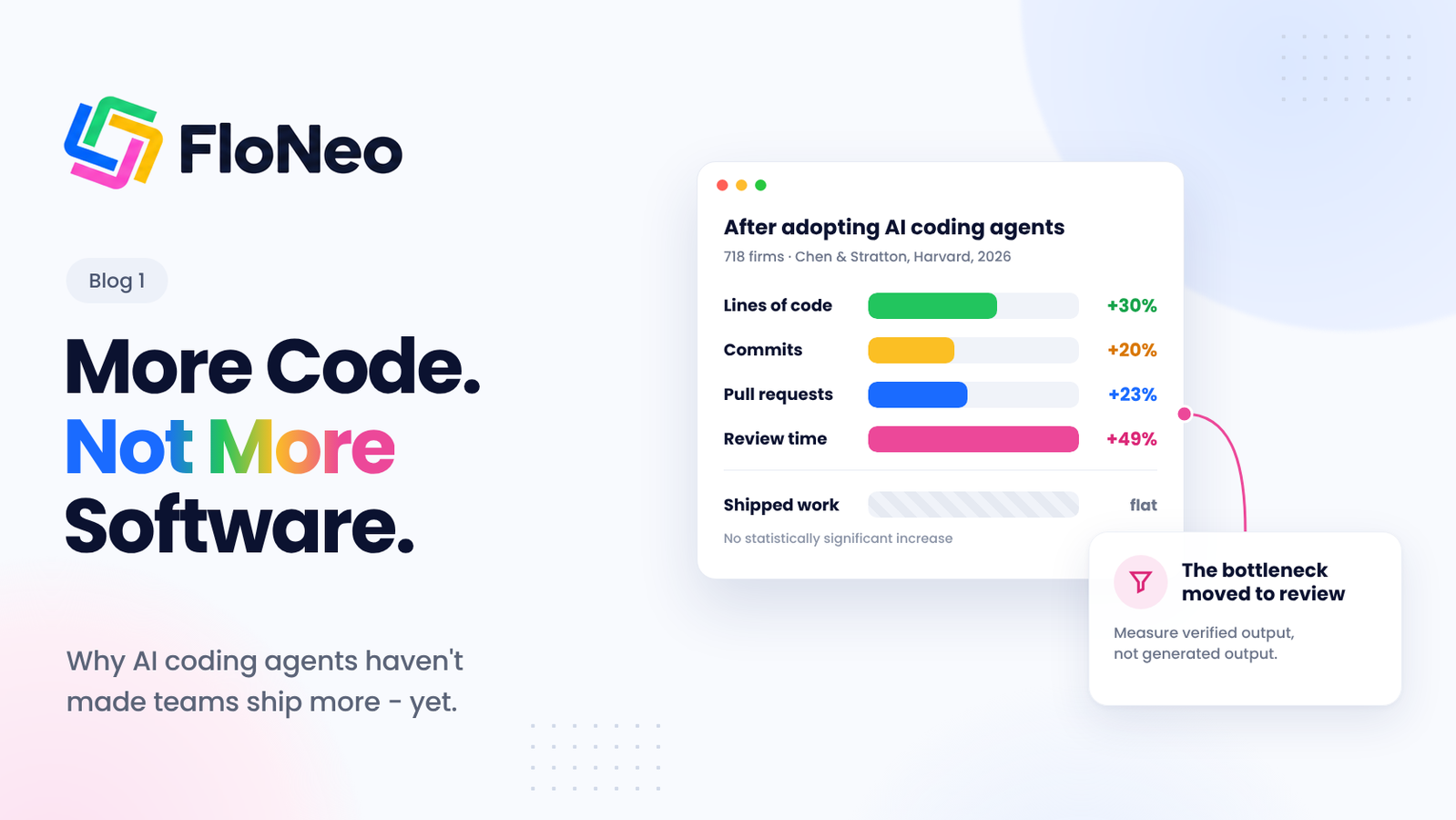
A working paper by Harvard researchers Fiona Chen and James Stratton offers a surprising answer. Analysing engineering data from 718 firms, the researchers found that adopting AI coding agents increased lines of code by 30%, commits by 20% and pull requests by 23%. Yet completed software output did not increase by a statistically significant amount. Pull-request review time, meanwhile, rose by 49%. [1]
The findings expose a measurement problem at the heart of AI coding agent productivity: producing more code is not the same as delivering more working software. It raises a bigger question about how organisations measure productivity when AI takes over more of the implementation work.
What the Harvard-Jellyfish Study Reveals
In Artificial Intelligence in the Firm: Bottlenecks in Software Production, Chen and Stratton examine approximately 300 million work events across 718 firms, using data through March 2026. Their August 2026 working paper investigates how AI coding assistants and agents affect engineering activity and completed work. [1]
For coding agents, the estimated changes include:
| Metric | Change after adoption |
|---|---|
| Lines of code | +30% |
| Commits | +20% |
| Pull requests | +23% |
| Pull-request review time | +49% |
| Review comments per pull request | +35% |
| Pull requests requesting changes | Nearly doubled |
| Resolved Jira issues and epics | No statistically significant increase |
Source: Chen and Stratton's research, Harvard University, 2026.
These results need careful interpretation. This is a working paper, not a peer-reviewed publication, and the findings are based on observational firm-level data. Its defensible conclusion is that gains in code generation do not automatically translate into gains in completed software, and the increased review burden may help explain the gap.
More code is not the same as more working software.
The Bottleneck Moves Downstream
Why does the additional code fail to translate directly into additional output?
Because every change introduces a verification task. Reviewers must establish whether the implementation matches the original intent, fits the existing architecture, handles edge cases, avoids security vulnerabilities and remains maintainable. When agents produce changes faster, they can increase the volume of work waiting for human attention.
The obvious response is to deploy AI agents to review AI-generated code. This can help, but it introduces another question: how do you know the reviewer is reliable? An AI reviewer that produces dozens of comments is not necessarily better than one that identifies a single serious vulnerability. Teams need to evaluate the quality of the findings, not just their quantity.
AI-assisted review can reduce some of the workload, but it cannot make verification unnecessary. Human oversight, automated tests, security checks and clear acceptance criteria remain essential parts of a reliable workflow.
The Developer Skills That Now Matter
As implementation becomes easier to delegate, defining the problem and evaluating the solution become more important.
In its October 2, 2026, guidance, GitHub identified three skills for developers: directing AI agents, critically reviewing their output and keeping technical judgment central. [2]
In practice, this means:
- Define the outcome: Specify what success looks like before asking an agent to build.
- Decompose the work: Break large changes into smaller, manageable steps.
- Set acceptance criteria: Establish how the result will be tested and verified.
- Retain ownership: Understand the changes well enough to accept, modify or reject them.
This is a more useful way to think about AI coding agent productivity than simply counting generated output. The goal is to increase the amount of useful work that reaches completion, not just the amount of work that begins.
The Future of Productivity Is Verified Output
AI has made producing candidate solutions easier. The challenge is turning those solutions into reliable, completed work.
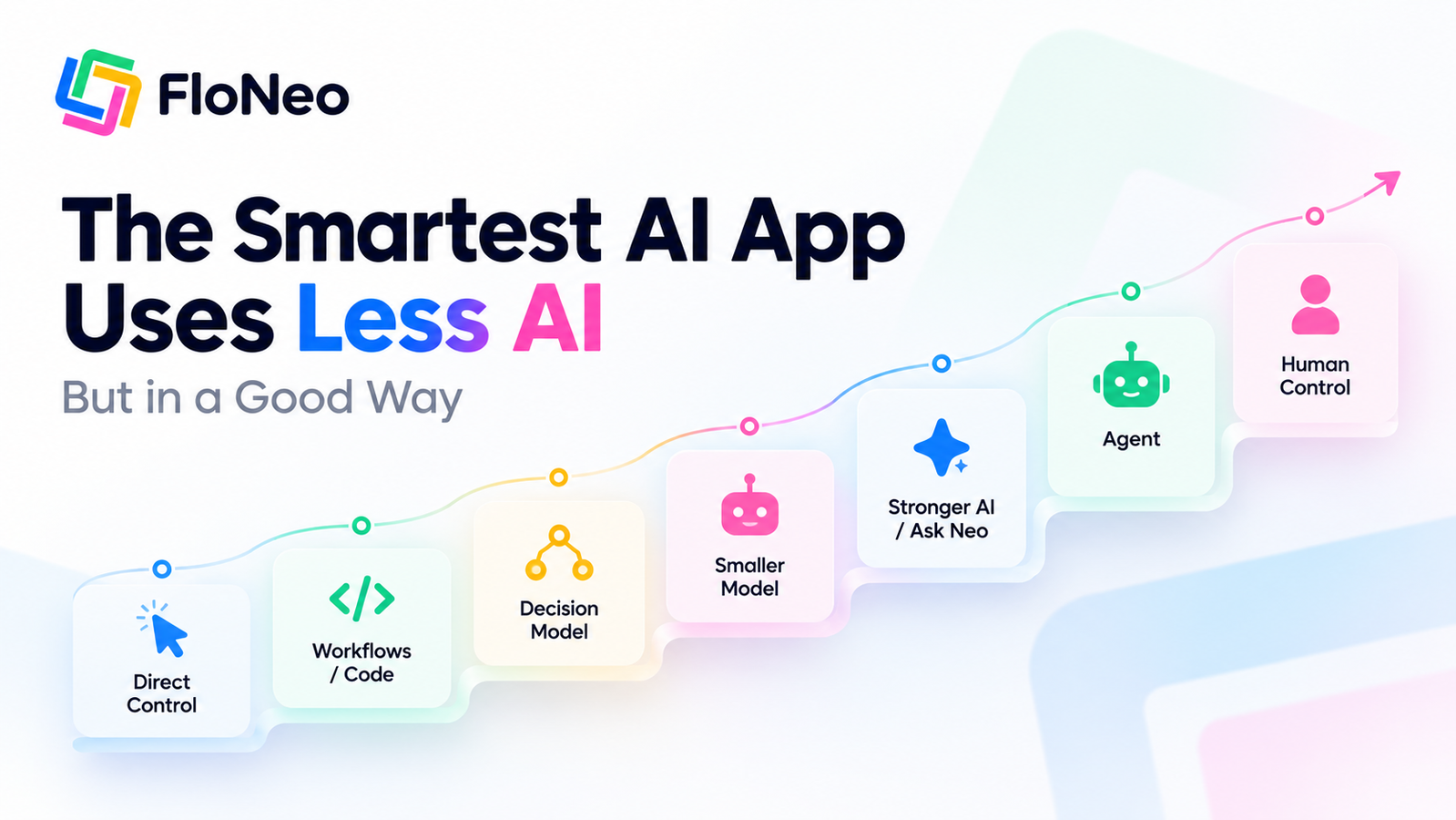
FloNeo's product principle is to use direct visual controls for known changes and AI assistance when a task genuinely requires reasoning. Changing a button's colour is different from restructuring a page around an unclear requirement. [3]
This is not a claim that FloNeo solves enterprise code review. It is an approach to keeping changes focused, understandable and under the user's control.
Smaller changes are easier to inspect. Clear controls reduce unnecessary generation. And the person building the website remains responsible for deciding whether the result is right.
The future builder is not the one that generates the most. It is the one that gets from intent to verified result with the least unnecessary work.
FloNeo launches on 1 November 2026. Join the FloNeo waitlist for free and get early access.
Next in the Series
Part 2: If You Can't Verify It, You Don't Own It
Part 2 looks at what makes AI output trustworthy: verifiability, the right context, authoritative sources, specifications and a practical verification stack for AI-built websites.
Editorial note: Replace this placeholder with the live Part 2 URL after publication.
References
- Fiona Chen and James Stratton, Harvard University. Artificial Intelligence in the Firm: Bottlenecks in Software Production (working paper, August 2026).
- GitHub Blog. AI is changing developer work. Here are three skills to strengthen. (2 October 2026).
- FloNeo. FloNeo - Describe, Generate, Edit, Own.
- FloNeo. How to Edit an AI-Generated Website Without Re-Prompting with Floneo.