
The Smartest AI App Uses Less AI - But in a Good Way
More inference does not automatically mean better software. LTNC starts with the lowest level of intelligence that can reliably solve each task.
Aayush4 min read
AI applications have spent the last few years moving in one direction: More AI. More capable models. More context. More agents. More reasoning.
But there is a problem with that approach. Not every problem needs more intelligence.
Imagine telling an AI app builder to move a button to the right. The builder could send the request through a language model, have the model interpret the instruction, determine which component is being referenced, generate a change, and then apply it.
Or, if the application already understands its own interface and the user's intent is precise, it could simply make the change.
The second approach uses less AI. But it isn't any less intelligent. This is the core of FloNeo's Low Token No Code (LTNC) philosophy.
The Right Tool Can Beat the Strongest Model
The point is to avoid using generative intelligence to rediscover things the system already knows. That's the core idea behind Low Token No Code AI. A good AI application should have more than one way to solve a problem.
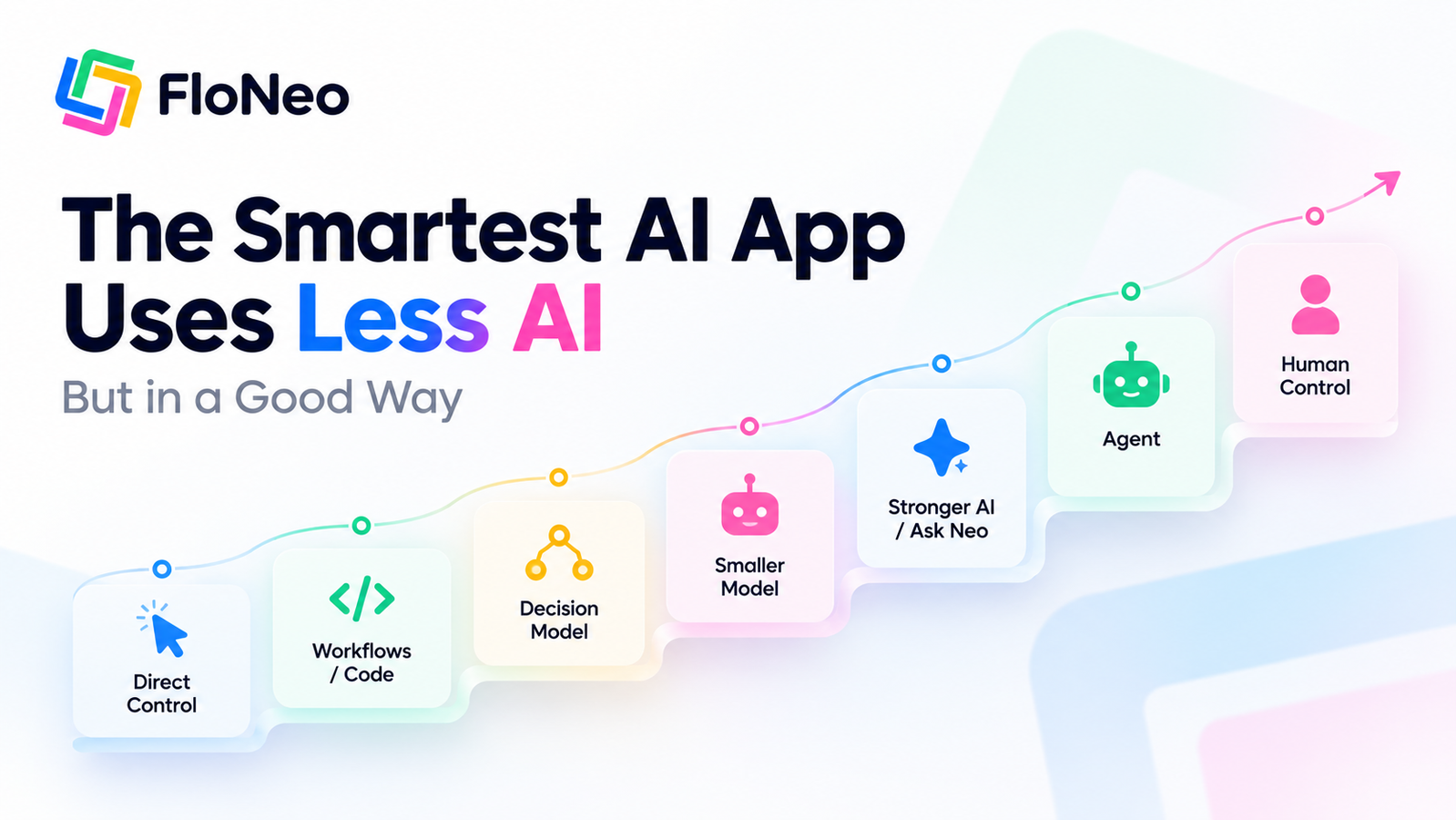
- Move a component → Direct control → The intent is already known.
- Apply a fixed validation → Rule / workflow → The logic is deterministic.
- Classify an incoming request → Decision model → The answer space is bounded.
- Write a simple description → Efficient model → Deep reasoning isn't necessary.
- Resolve an ambiguous product problem → Frontier model / Ask Neo → Context and reasoning matter.
- Modify several connected systems → Agent → Multiple steps need coordination.
- Approve a sensitive change → Human → Accountability matters.
Don't Make AI Rediscover the Rules
Consider a simple business rule: Orders above ₹50,000 require approval.
If the application already knows this rule, why should an AI model interpret every new order and decide whether it exceeds ₹50,000?
A workflow can check it. The database can store it. The application can enforce it. The result is faster, predictable, and doesn't require an inference call.
Now imagine a different question: “Which of these customers might need human attention based on the details of their interaction?” That's less deterministic. A decision model may be appropriate.
And if the question becomes: “Why are these customers behaving differently, and what should we change about our retention strategy?” Now deeper reasoning may genuinely be valuable.
The mechanism should change as the problem changes. That sounds obvious in traditional software. AI makes it easy to forget.
Agents Are Powerful. That's Exactly Why They Shouldn't Be Everywhere.
Agents make this distinction even more important. An agent can reason, call tools, inspect results, retry failed actions, and continue through multiple steps. But every additional step can create more inference.
A Stanford Digital Economy Lab study of agentic coding found that runs of the same task could vary by as much as 30x in total token consumption, and higher token usage did not necessarily translate into higher accuracy.
In other words: More AI work does not automatically mean better work.
Microsoft's AI resource-governance guidance recommends controls such as token ceilings and per-task cost thresholds to contain runaway agent loops and resource exhaustion.
That changes how we should think about autonomy. An agent shouldn't be the default destination simply because it can do something. It should be used when delegating the sequence of work creates more value than the inference it consumes.
The Intelligence Budget
Here is a new way to think about AI applications: every task has an intelligence requirement. Some require almost none. Some require a little. Some require substantial reasoning. The application should allocate accordingly.
Think of it as an intelligence ladder: Known → Deterministic → Bounded → Generative → Reasoning → Autonomous
The mistake is jumping straight to the top. A smarter system starts at the lowest level that can reliably solve the problem and escalates only when necessary. This can improve both cost strategy and reliability.
What Low Token No Code Actually Means
This is where Low Token No Code AI becomes a product philosophy rather than a token-saving trick.
Low Token No Code does not mean: “Don't use AI.”
It means: “Don't use AI when the application already has a better way to do the job.”
That could mean direct manipulation. It could mean a workflow. It could mean ordinary application logic. It could mean a specialized decision model. It could mean a smaller language model. And when the problem genuinely requires deeper reasoning, it could mean a frontier model or Ask Neo.
The intelligence isn't removed. The unnecessary inference is.
This is also why the principle applies particularly well to AI app builders. An app builder shouldn't regenerate or reinterpret an entire application every time something changes. If it understands the application's structure, it can make the smallest appropriate change. If a workflow already contains the logic, it shouldn't ask AI to recreate that logic. If a user makes a precise visual edit, the system shouldn't turn that into a reasoning problem. If the task is genuinely ambiguous, that's when AI earns its place.
The Goal Isn't Less AI. It's Better AI.
The AI industry has spent years asking how to make models more capable. The next question is increasingly about how to use that capability intelligently.
McKinsey describes AI “tokenomics” as extending beyond individual model prices into model selection, routing decisions, orchestration patterns, agent behaviour, workflow design, infrastructure use, and the elimination of waste across AI-enabled processes.
That is the shift. The smartest application isn't the one that invokes the most powerful model for every task. It is the one that understands the difference between a task that needs intelligence and a task that simply needs execution.
Because sometimes the best AI decision is to use a smaller model. Sometimes it's to use a rule. Sometimes it's to let an agent work. And sometimes, the smartest thing an AI application can do is use no AI at all.
Use the cheapest reliable intelligence that can do the job — including no AI at all.
What This Looks Like Inside FloNeo
For FloNeo, LTNC is expressed through the product itself.
A builder can change a precise UI element directly, use the database as the source of truth for structured data, use workflows for known logic, bring Ask Neo in when the problem needs context and reasoning, delegate a larger bounded task when agentic execution is useful, and keep the application visible and controllable throughout.
An AI-built application should not become an AI-dependent application. AI can help build the system. The system should still remain yours to understand and control.
Get First Access to FloNeo
Want to experience LTNC instead of just reading about it?
Get First Access to FloNeo: https://floneo.co/waitlist
Free registration. Be among the first to experience FloNeo when early access opens.
Series Complete
Part 1 — From Jev to LTNC: How FloNeo Thinks About Intelligence Routing — Jev reveals a larger architecture shift: route each task to the intelligence it actually needs.
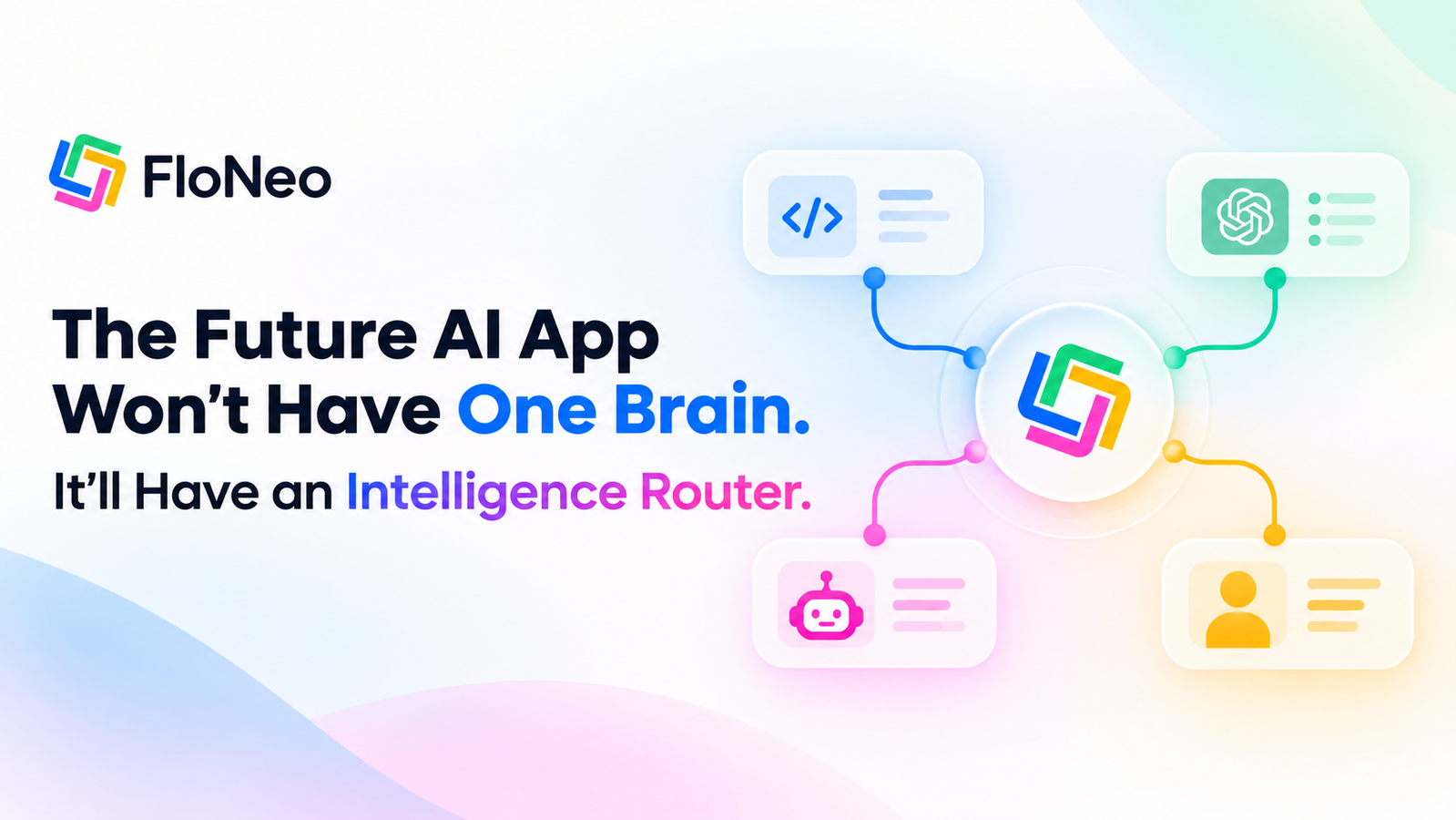
Part 2 — The Future AI App Won't Have One Brain. It'll Have an Intelligence Router. — The application increasingly decides whether work belongs with code, a model, an agent, or a human.
Part 3 — The Smartest AI App Uses Less AI - But in a Good Way — The smartest app starts with the lowest reliable level of intelligence and escalates only when necessary.
References
Stanford Digital Economy Lab — How Do AI Agents Spend Your Money? — https://digitaleconomy.stanford.edu/publication/how-do-ai-agents-spend-your-money-analyzing-and-predicting-token-consumption-in-agentic-coding-tasks/
Microsoft Learn — Resource Governance and Abuse Prevention — https://learn.microsoft.com/en-us/security/zero-trust/catalog-ai-defense-capabilities/resource-governance-abuse-prevention
McKinsey & Company — The cost of intelligence: How CIOs can manage AI demand at scale — https://www.mckinsey.com/capabilities/quantumblack/our-insights/the-cost-of-intelligence-how-cios-can-manage-ai-demand-at-scale
TypeSafe AI — Introducing System One Models & Jev — https://typesafe.ai/blog/introducing-system-one-models-and-jev
FloNeo — How FloNeo's 4-Layer Architecture Makes AI Prototyping Ultra-Affordable — https://floneo.co/blog/how-floneos-4-layer-architecture-makes-ai-prototyping-ultra-affordable