
From Jev to LTNC: How FloNeo Thinks About Intelligence Routing
Jev exposes a bigger shift in AI architecture: the smartest app routes each task to the right kind of intelligence instead of defaulting to one giant model.
Aayush3 min read
Jev does not try to be a better chatbot. That is exactly why it matters to FloNeo.
Jev's arrival makes a point that sits directly inside FloNeo's Low Token No Code (LTNC) philosophy: an AI application should not make the biggest language model the default mechanism for every operation. The smarter system is the one that knows when to use AI, which AI to use, when ordinary software is enough, and when a human should remain in control.
For the last few years, we have treated the large language model as the brain of an AI application. Need an answer? Ask the model. Need something classified? Ask the model. Need a decision? Ask the model. Need an agent to figure out what to do next? Ask the model. The same general-purpose intelligence has increasingly been expected to handle everything from writing a paragraph to deciding whether a workflow should continue.
Jev takes a different approach.
Released by TypeSafe AI in September 2026, Jev is designed not to generate text, but to make structured probabilistic decisions that software can use directly. Give it application state and defined questions, and it returns typed choices, scores, or Boolean answers with probabilities attached.
That matters to FloNeo because LTNC is built around the same larger question: Why make AI reinterpret a task when the application already has a cheaper, clearer, or more reliable way to do it?
This Is What We've Been Doing So Far
Think about how conventional software works. A database stores information. A rules engine applies deterministic logic. A search system retrieves information. A user interface handles interaction. We don't expect the database to suddenly start writing emails. We don't ask the authentication system to summarize a customer complaint.
But AI applications have often blurred these boundaries. A general-purpose LLM can technically perform many of these tasks, so we started using it for many of them. Jev represents a different idea: making fast, structured decisions inside software. It deliberately gives up string generation to optimize for a narrower interface.
Suppose an AI agent receives a support request. It may need to decide: Is this urgent? Which team should handle it? Should the agent continue? Should a human review it? None of those questions necessarily require the system to write an essay. The application needs a decision.
Vercel's examples include routing requests, scoring priorities, evaluating proposed actions, and deciding whether a workflow should continue, retry, stop, or ask for human review. Vercel also recommends keeping permissions, policy, and actual tool execution in application code rather than letting a model own them.
From Jev to LTNC
This is where Jev becomes more than a model story. It becomes an architecture story. And it is where FloNeo positions itself.
LTNC is not simply about reducing token counts after the fact. It is about designing the application so intelligence is used deliberately.
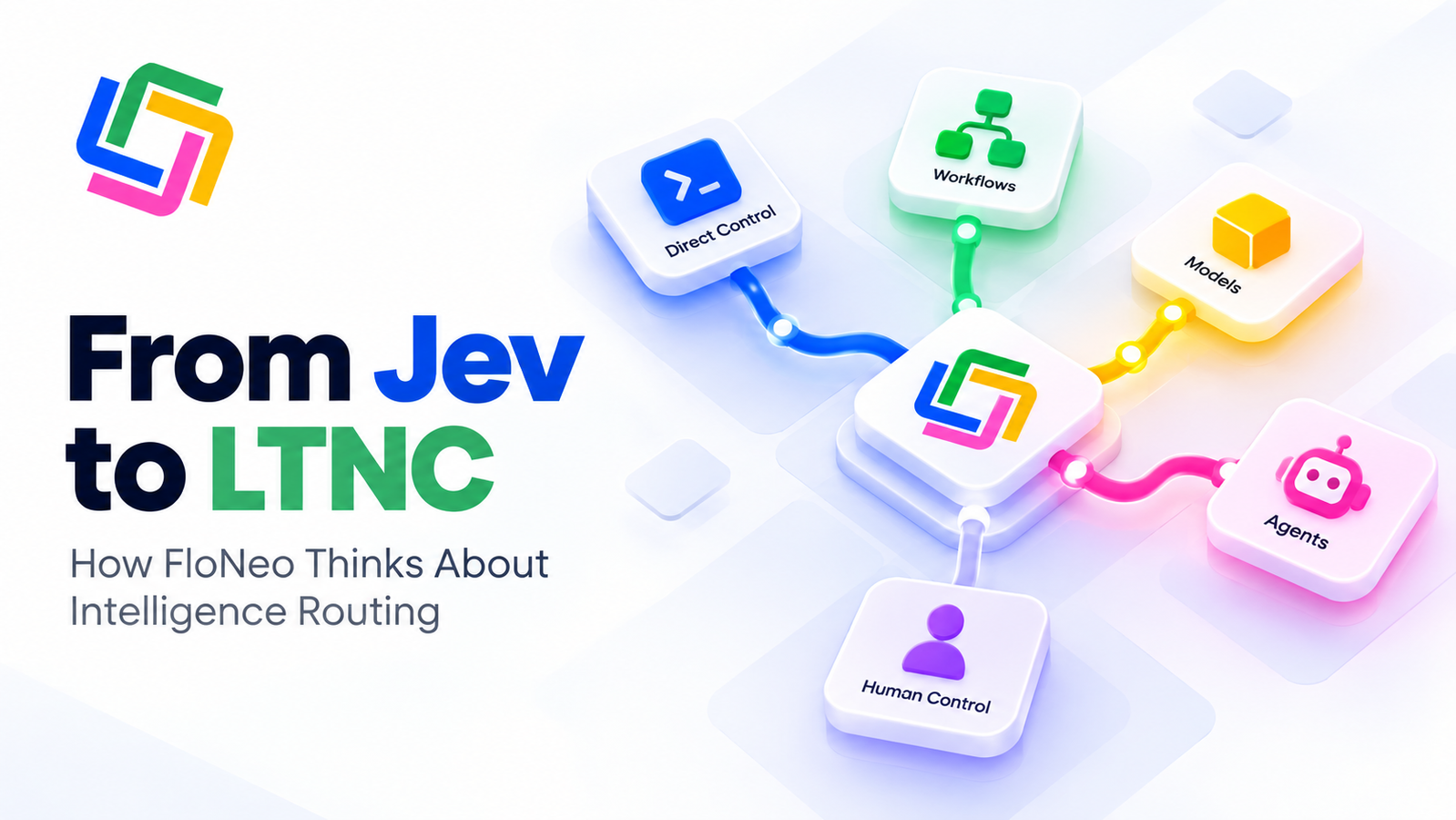
A single request inside an AI application could be handled in very different ways:
- Move a component exactly where the user specified → Direct control → The desired state is already known.
- Apply a fixed approval threshold → Code / workflow → The logic is deterministic.
- Decide whether a request is high priority → Specialized decision model → The answer space is bounded.
- Draft a simple description → Efficient language model → Deep reasoning is unnecessary.
- Resolve an ambiguous product or workflow problem → Frontier model / Ask Neo → Context and reasoning matter.
- Carry out several connected changes → Agent → Multiple steps need coordination.
- Approve a sensitive or uncertain action → Human → Accountability matters.
The application does not need to ask the most powerful model to do all seven. That is the practical meaning of intelligence routing.
The Need for Specialized Models
Jev's early reception suggests the AI stack may be beginning to look less like one giant brain and more like a collection of different capabilities.
Vercel reported that Jev reached nearly 13% of paid AI Gateway teams within 24 hours, making it the fastest-adopted model launch in the gateway's history. That does not prove Jev will dominate the market. It does show that developers are willing to adopt a narrower model when it solves a specific software problem.
General-purpose LLMs are not becoming obsolete. Different models can coexist because they solve different problems. Vercel's guidance is a good example: keep explicit business rules in code; use Jev for bounded decisions; keep tool permissions and execution in the application; use a generative model where language generation is actually required.
Specialization does not replace the general-purpose model. It gives the application more than one kind of intelligence to work with.
The Real Breakthrough May Be the Router
Imagine an application receiving 1,000 requests. Sending all 1,000 to the most capable frontier model might work. But it could also mean paying for expensive reasoning where a rule, direct operation, smaller model, or specialized decision system would have been enough. A router can decide where each task should go.
Microsoft Foundry's model router is already moving in this direction. Its September 2026 updates add per-request routing metadata showing the serving model, routing mode, attempted models, fallback behaviour, and routing latency.
Vercel's September AI Gateway data also shows how fluid the model market has become. Open-weight models represented 56% of gateway token volume in August, while the average token cost had fallen to less than half what it was five months earlier.
More models, falling costs, and increasingly varied capabilities make choosing the right intelligence a product problem — not merely a model-selection problem. The shift is from model selection to intelligence orchestration.
The Cost Question Makes This Architecture Practical, Not Theoretical
AI applications increasingly pay for intelligence by the request, token, or amount of agent work performed. Gartner forecasts that AI coding costs could surpass the average developer salary by 2028 as token consumption and consumption-based pricing expand.
Stanford researchers studying agentic coding found that runs on the same task could vary by as much as 30x in total token use, and higher token usage did not necessarily produce higher accuracy.
So the question is not: Can the frontier model handle the task? It is: Does this task actually need the frontier model?
A Practical Intelligence Architecture for FloNeo
Layer 1 — Direct interaction
If the user already knows exactly what should happen, let them do it directly. Move the button. Change the label. Adjust spacing. Update a known property. There is no reason to turn a precise instruction into a reasoning problem.
Layer 2 — Deterministic application logic
If the application already knows the rule, use the rule. Orders above ₹50,000 require approval. A workflow can check it. The database can store it. The application can enforce it. AI does not need to rediscover the rule for every order.
Layer 3 — Bounded decision intelligence
Some tasks are not deterministic but still have a defined answer space: priority, category, route, continue or stop, approve or escalate. A specialized decision model such as Jev represents one possible mechanism for this class of problem.
Layer 4 — Generative intelligence
If the application needs to produce language, an efficient generative model may be enough. Not every description, summary, or rewrite requires the most capable reasoning model available.
Layer 5 — Deep reasoning
When a request is genuinely ambiguous or spans multiple parts of the application, a stronger reasoning model can earn its cost. This is where Ask Neo becomes important inside FloNeo: understand the goal, inspect relevant context, clarify what is uncertain, and help decide what needs to change.
Layer 6 — Agentic execution
If the desired outcome is clear but execution spans several connected actions, an agent can carry out the bounded task. The agent should operate inside defined scope, permissions, and validation.
Layer 7 — Human control
Some decisions should end with a person. If the action is sensitive, high-risk, low-confidence, or carries accountability that should not be delegated, the correct route is human approval.
What This Means for FloNeo
This is the technical heart of Low Token No Code. LTNC does not mean 'Don't use AI.' It means 'Don't use AI when the application already has a better way to do the job.'
That can mean direct manipulation, a workflow, ordinary application logic, a specialized decision model, a smaller language model, a frontier model through Ask Neo, an agent, or a human.
The intelligence is not removed. The unnecessary inference is.
An app builder should not regenerate or reinterpret an entire application every time something changes. If it understands the application's structure, it can make the smallest appropriate change. If a workflow already contains the logic, it should use the workflow. If a user makes a precise visual edit, it should use direct control. And if the task is genuinely ambiguous, that is when AI earns its place.
The smarter application is the one that knows what kind of thinking each task requires. Eventually, users may not even care which model handled the request. They will experience a system that knows when to act, when to think, when to delegate, and when to ask.
The Beginning of the Intelligence Stack
Jev does not mean we are moving beyond LLMs. It suggests we may be moving beyond the idea that an AI application should have only one kind of intelligence. Some tasks need language. Some need reasoning. Some need classification. Some need routing. Some need deterministic rules. Some need an agent. And some do not need AI at all.
If the application already knows exactly what the user wants, making a model interpret that request again can add latency, cost, and uncertainty for no real gain. The future may not belong to the application with the biggest model behind it. It may belong to the application that knows which intelligence to use, when to use it, and when not to use AI at all. And that is exactly where FloNeo's LTNC philosophy fits.
Get First Access to FloNeo
FloNeo is being built around this combination of AI intelligence, direct control, workflows, and human control.
Get First Access to FloNeo: https://floneo.co/waitlist
Free registration. Be among the first to experience FloNeo when early access opens.
References
TypeSafe AI — Introducing System One Models & Jev — https://typesafe.ai/blog/introducing-system-one-models-and-jev
Vercel — Where does Jev fit in an AI agent loop? — https://vercel.com/i/jev-agent-control
Vercel — Jev is the fastest-adopted model in AI Gateway history — https://vercel.com/blog/ai-gateway-jev-model-launch
Vercel — When should you use Jev instead of a chat model? — https://vercel.com/i/when-to-use-jev
Microsoft Foundry — What's new in model router — https://learn.microsoft.com/en-us/azure/foundry/foundry-models/whats-new-model-router
Vercel — AI Gateway Production Index — https://vercel.com/blog/ai-gateway-production-index-september-2026
Gartner — AI coding costs and token consumption — https://www.gartner.com/en/newsroom/press-releases/2026-06-24-gartner-predicts-ai-coding-costs-will-surpass-average-developer-salary-by-2028-as-token-consumption-surges
Stanford Digital Economy Lab — How Do AI Agents Spend Your Money? — https://digitaleconomy.stanford.edu/publication/how-do-ai-agents-spend-your-money-analyzing-and-predicting-token-consumption-in-agentic-coding-tasks/
FloNeo — How FloNeo's 4-Layer Architecture Makes AI Prototyping Ultra-Affordable — https://floneo.co/blog/how-floneos-4-layer-architecture-makes-ai-prototyping-ultra-affordable