
AI Regulation or Not? What the 2026 Rules Mean for Anyone Building With AI
AI rules are tightening in the EU, US and India. What's actually in force, and what it means if you build websites or apps with AI.
Aayush6 min read
This week, the fear of AI regulation wiped trillions off tech stocks. Here's what the rules actually say, and what they mean if you build websites or apps with AI.
The short version
AI is no longer unregulated. The EU's transparency rules are already in force, India now requires AI-generated content to be labelled, and the US is fighting over who gets to write the rules. If you build with AI, the safest habit is simple: stay in control of what you publish, and be open about where AI was used.
On Thursday, 5 November, the tech-heavy Nasdaq fell more than 5% and over $2 trillion in market value disappeared. The trigger wasn't a product failure or a bad earnings report. It was fear. After the US midterm elections, investors worried that a new Congress and state governments would crack down on AI and the data centres that power it. [1]
That single day captures the biggest question in technology right now: should AI be regulated, and if so, how much?
For most people building a website, a portfolio or a small business app with AI, that debate can feel far away. It isn't. The rules being written today decide what AI tools are allowed to do, what they must tell users, and who is responsible when something goes wrong.
Here's where things actually stand, without the hype.
Where AI Regulation Stands in November 2026
| Region | What's happening | What it means |
|---|---|---|
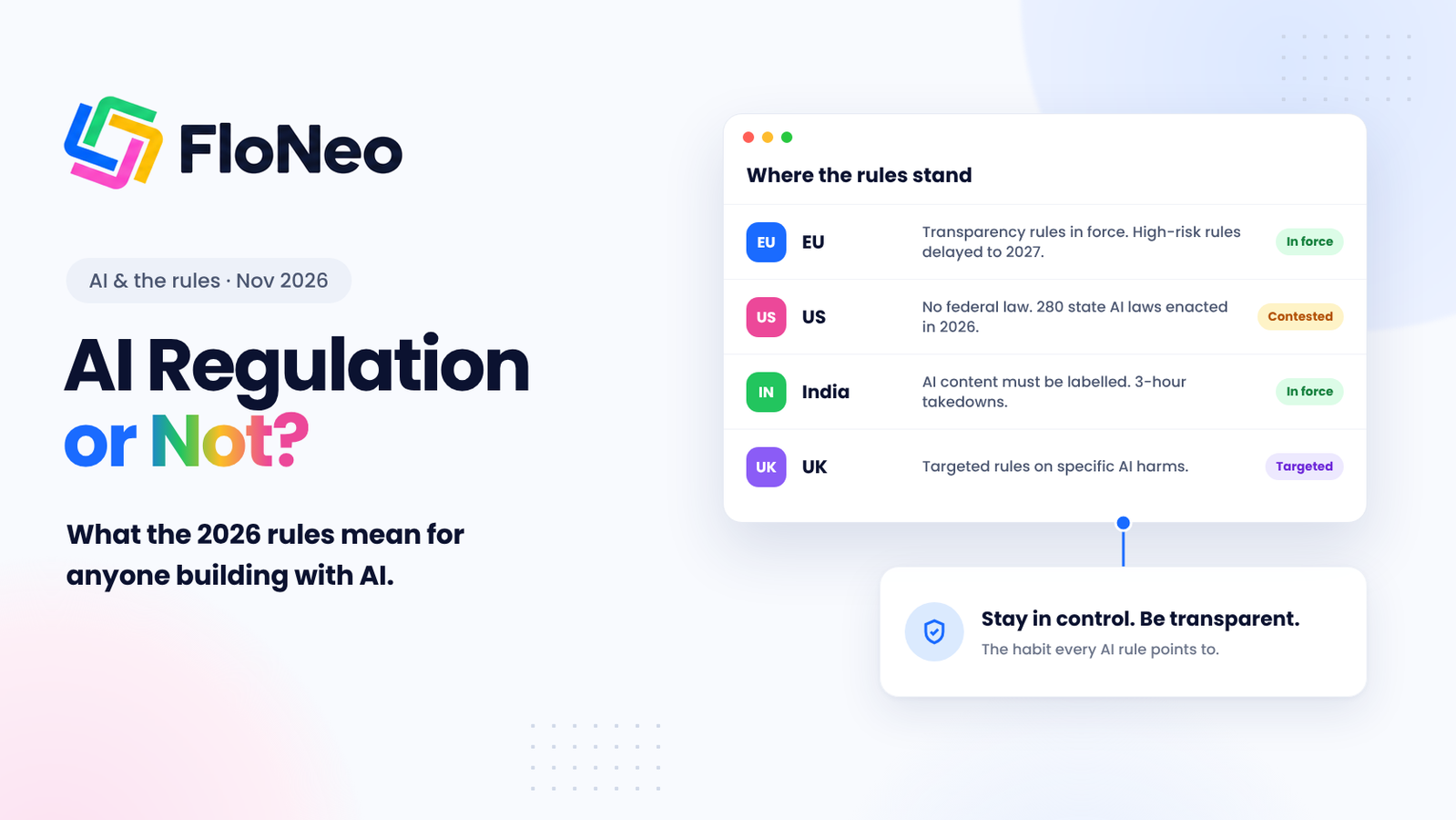
| European Union | The AI Act's transparency rules have applied since 2 August 2026. The AI Omnibus pushed stand-alone high-risk obligations back to 2 December 2027. New bans on AI that generates intimate imagery or child abuse material apply from 2 December 2026. [2][3] | If people interact with AI or see AI-generated content, they generally need to be told. Stricter rules for high-risk uses are delayed, not cancelled. |
| United States | There is no single federal AI law. A December 2025 executive order pushed to override state AI rules, while states introduced 1,539 AI bills in 2026, 280 of which were enacted by early October. [4][5] | A patchwork of state rules, with the midterm results expected to bring more scrutiny, not less. |
| India | Amended IT Rules, in force since 20 February 2026, require permitted AI-generated content to be clearly labelled and carry provenance markers. Platforms must act on takedown orders within three hours. [6] | Large platforms must ask users whether content is synthetic and label it. Labels and markers cannot be stripped out. |
| United Kingdom | From June 2026, creating or supplying a tool that generates non-consensual intimate images became a criminal offence. [5] | Targeted rules aimed at specific harms rather than one broad AI law. |
The pattern is clear. No major market is leaving AI completely alone. The disagreement is about how far rules should go and who should write them.
The Case for Regulation
Supporters of regulation point to real harms that are already here: deepfakes, AI-generated abuse imagery, automated decisions in hiring and lending that nobody can explain, and content that looks real but isn't.
Their argument is straightforward. When a technology can produce convincing content at scale, people deserve to know when they're looking at it. And when AI makes decisions that affect someone's job, credit or education, a human should be accountable for the outcome.
The EU's approach reflects this: light rules for most uses, stricter rules where the stakes are high, and clear disclosure when AI is involved.
The Case Against Heavy Regulation
Critics worry that broad, fast-moving rules will slow innovation, favour large companies that can afford compliance teams, and lock in today's technology before anyone understands tomorrow's.
That concern isn't theoretical either. Even the EU, the world's most ambitious AI regulator, decided to delay its high-risk rules after businesses said they weren't ready. [2] In the US, the fight over whether states or the federal government should set the rules is itself a sign that nobody has found the right balance yet.
For startups and small businesses, the fear is simple: rules written for Big Tech end up landing on everyone.
So, Regulation or Not?
The honest answer is that the debate is moving past "whether" and towards "how". The direction is the same almost everywhere, whatever the speed:
- Transparency: tell people when AI is involved.
- Accountability: a human must be responsible for what AI produces.
- Traceability: be able to show what was generated, what changed and why.
You don't need to be a lawyer to see what that means for anyone building with AI. The tools that keep you in control will age well. The ones that turn you into a passenger won't.
AI that you can't explain, check or undo is exactly what regulators are worried about.
What This Means If You Build Websites or Apps With AI
Most small websites and apps aren't "high-risk" under any of these laws. But good habits now will save you trouble later. Here's a practical checklist.
- Tell visitors when they're talking to AI. If your site has a chatbot or AI assistant, say so clearly.
- Label AI-generated images and media where it matters. Especially realistic images of people or places, and anything that could be mistaken for real.
- Keep a human in charge of what goes live. Review AI-generated pages before publishing. Don't let AI push changes you haven't seen.
- Know what changed. If you can't tell which parts of your site AI rewrote, you can't stand behind them.
- Be careful with personal data. Contact forms, bookings and sign-ups collect personal information. Be clear about what you collect and why.
- Take extra care with high-stakes uses. If AI helps decide who gets hired, approved or admitted, expect stricter rules, and keep a human decision-maker.
- Keep simple records. Note which tools you used and what they generated. It's easier now than when someone asks later.
This isn't legal advice, and rules differ by country. But these habits line up with where regulation is heading almost everywhere.
Where FloNeo Stands
We built FloNeo around one idea that turns out to matter more every month: AI should build with you, not instead of you.
In FloNeo, AI generates the first version, but you stay in control of what happens next. Known changes are made directly on the canvas, so you can see exactly what changed. When you use AI for a bigger change, you see the expected credit cost before it runs. Nothing is a black box. [7]
That's not a compliance feature. It's simply what building with AI should feel like: transparent, reviewable and yours.
Whatever the regulators decide next, the builders who understand and control their own work will be in the best position.
FloNeo launches on 16 November 2026. Join the free waitlist before 8 November to get early access.
References
- NPR / KPBS. Fears about an AI crackdown after midterms sparks a $2 trillion rout in tech stocks (5 November 2026).
- Gibson Dunn. EU AI Act Omnibus Agreement: Postponed High-Risk Deadlines and Other Key Changes.
- Mondaq. EU Digital Omnibus On AI Enters Into Force.
- Akin Gump. President Trump Unveils AI EO Advancing Federal Preemption of State Laws.
- TLT. TLT's AI Brief: November 2026.
- Hogan Lovells. India introduces mandatory labelling for AI and 3-hour takedown for illegal content.
- FloNeo. FloNeo - Describe, Generate, Edit, Own.