
SEO Should Be Compiled Into Your Website, Not Bolted On Later
Most technical SEO is system behavior, not copywriting. See the 9-layer stack an AI website builder should generate, validate, and monitor by default.
Aayush5 min read
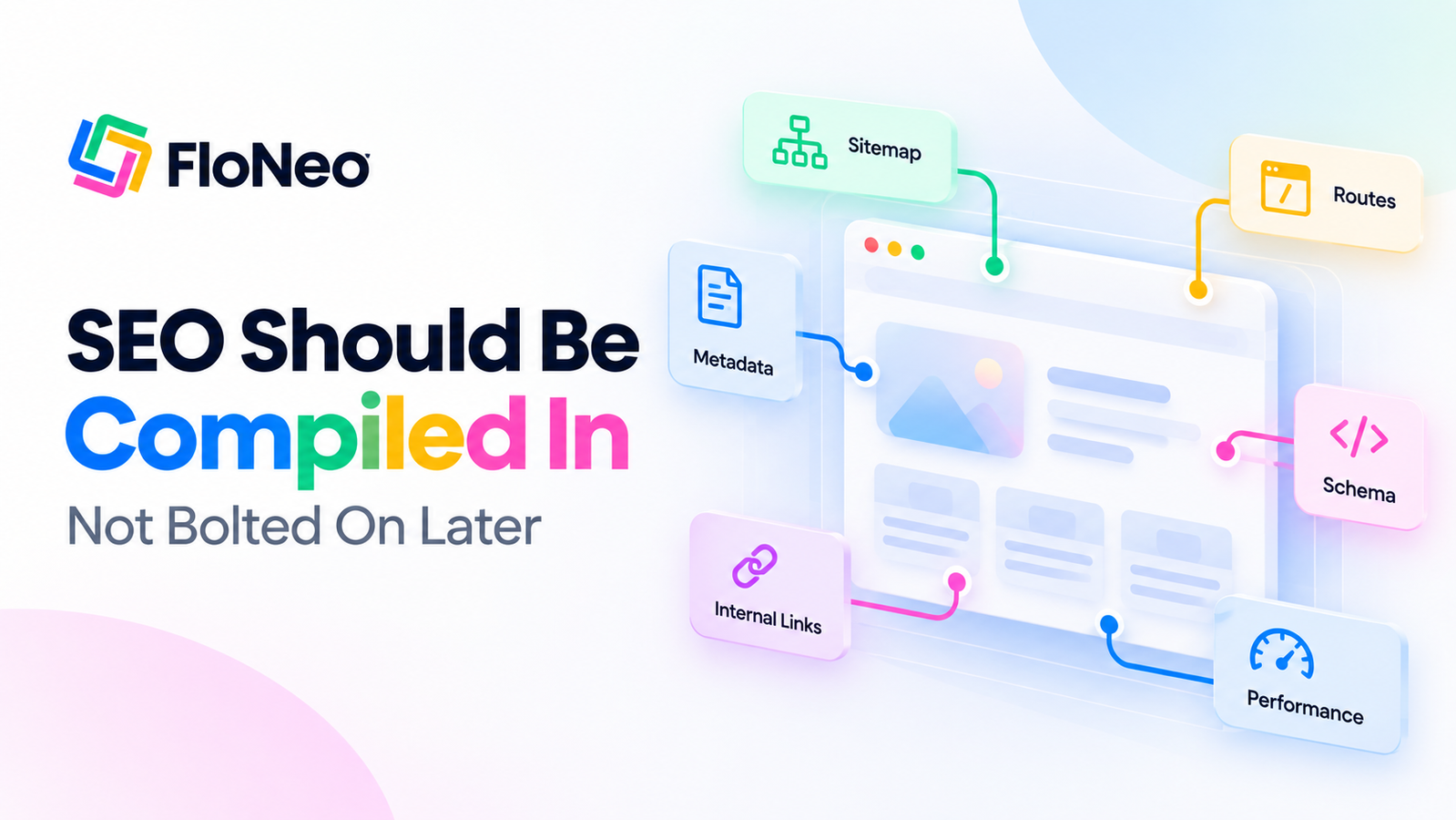
AI can build a website in minutes. Search readiness should be part of what the builder generates, not a repair job someone inherits after launch.
Part 2 of 3 - The Technical Architecture
Building a website and building a website that search engines can reliably discover, understand, and index are two different problems. The next generation of AI website builders has to close that gap at the system level.
AI can build a website in minutes.
But building a website and building a website that search engines can reliably discover, understand, and index are two different problems.
That is the gap the next generation of AI website builders needs to close.
A technical SEO AI website builder should not generate the interface first and leave SEO for a marketer to fix later. Search readiness should be part of the website's underlying architecture:
- routes;
- status codes;
- links;
- metadata;
- structured data;
- performance;
- content quality; and
- monitoring.
Those things should be generated or validated as part of the build itself.
SEO should be a build output, not a post-launch repair job.
Google's minimum technical requirements are surprisingly simple: Googlebot must not be blocked, the page must return a successful HTTP response, and it must contain indexable content. Meeting those requirements makes a page eligible for indexing; it does not guarantee indexing or ranking. [1]
So what should an AI builder actually generate?
The 9-Layer SEO Stack
Think of technical SEO less like a checklist for marketers and more like a stack that sits underneath the website.
| Layer | What the builder should generate | Best mechanism |
|---|---|---|
| 1. Rendering | SSR, static generation, or prerendering for public search-sensitive pages | Deterministic + route-aware |
| 2. URLs & status | Stable routes, redirects, correct 200/404/410 responses | Deterministic |
| 3. Crawlability | Real links, sitemap, robots policy | Deterministic |
| 4. Metadata | Titles, descriptions, canonicals, robots directives | Rules + AI assistance |
| 5. Semantics | Headings, landmarks, descriptive links, image metadata | Rules + AI assistance |
| 6. Structured data | Valid JSON-LD based on actual page data | Rules + AI classification |
| 7. Performance | Image sizing, scripts, caching, Core Web Vitals checks | Deterministic |
| 8. Content quality | Useful, original, accurate content | AI + human judgment |
| 9. Observability | Indexing, crawl, and search-performance monitoring | Deterministic + AI analysis |
The important part is that not every layer needs AI.
In fact, one of the biggest mistakes an AI builder can make is using a language model for something a rule can prove.
1. Rendering: Give Crawlers Something Useful to Receive
Google does render JavaScript.
But an app-shell page that initially sends little more than an empty <div> and a JavaScript bundle creates unnecessary processing complexity. Google documents a crawl -> render -> index process for JavaScript pages and explicitly says server-side or prerendering remains a good idea because it can improve speed for users and crawlers, while not every bot executes JavaScript. [2]
That does not mean SSR automatically ranks better.
It means a technical SEO AI website builder should understand that a public landing page and a logged-in dashboard have different requirements.
Search-sensitive routes can be rendered or prerendered appropriately.
Deeply interactive private surfaces do not need to be treated the same way.
The builder should make that distinction from the route model it already owns.
2-3. URLs, Status Codes, and Discovery: Infrastructure, Not Copywriting
A generated website needs a real route model.
A real page should return 200.
A permanently moved page should redirect appropriately.
A missing page should not become a fake 200 page with an error message inside it.
Google specifically warns about these soft 404 situations. [3]
Then comes discovery.
Important pages should be connected through actual crawlable <a href> links, while the sitemap should represent the URLs the site actually wants discovered. Google recommends crawlable links and documents sitemaps as a discovery mechanism. [4][5]
None of this requires a frontier model.
The builder already knows its route graph.
So generate it.
This is the first major shift in how we should think about AI website builder SEO:
A route graph is an SEO asset.
If the builder knows the routes, it should be able to derive:
- which pages are public;
- which pages need links;
- which pages belong in the sitemap;
- which routes redirect;
- which routes return errors; and
- which surfaces should never be indexed.
That is application logic, not prompt engineering.
4-6. Metadata, Semantics, and Structured Truth
This is where AI can help - but it should not be in charge of everything.
The system can detect that a page is missing a title or canonical deterministically.
AI can then suggest a better title based on the page's actual purpose.
The same principle applies to semantics and structured data.
If the builder knows that a page represents an article, product, event, or organization, it can map that structured information into appropriate JSON-LD.
But the data should come from the application's actual model, not from the language model inventing facts.
Google says structured data can help it understand page content and can make pages eligible for richer search appearances, but correctly marked-up data does not guarantee a rich result. [6]
Structured data should come from structured truth - not AI imagination.
That gives us a useful architecture split:
| SEO task | What should happen |
|---|---|
| Is the title missing? | Rule detects it |
| Is the canonical malformed? | Validator catches it |
| Which schema type matches this known content model? | Rule/classification can map it |
| How could the title better match the page's search intent? | AI can assist |
| What factual values belong in JSON-LD? | Use actual application data |
There is already movement in this direction.
Framer automatically generates a sitemap for published sites and a robots.txt file, exposes canonical controls, and supports JSON-LD structured data. [7][8][9][10]
The point is not that Framer has "SEO features."
The point is that these are increasingly becoming builder responsibilities.
7. Performance: Don't Generate a Beautiful Bottleneck
An AI builder can produce a visually impressive page while quietly shipping:
- enormous images;
- excessive JavaScript;
- layout shifts;
- slow interaction; and
- unnecessary third-party scripts.
That is still a badly engineered website.
The current Core Web Vitals targets for a good experience are:
- LCP: 2.5 seconds or less;
- INP: 200 milliseconds or less; and
- CLS: 0.1 or less. [11]
These are useful engineering targets.
They are not a promise of rankings, and they are not a reason to chase a perfect Lighthouse score at the expense of the actual product.
A builder can check much of this mechanically.
No prompt required.
That is another important boundary:
If a machine can measure the failure exactly, don't ask a language model to guess whether it exists.
8. Content Quality Is Where AI Actually Earns Its Keep
Technical infrastructure can make a page crawlable.
It cannot make a useless page useful.
This is where AI becomes valuable:
- understanding search intent;
- identifying thin or repetitive sections;
- suggesting internal links;
- improving explanations;
- helping structure a page for a real audience; and
- turning raw product information into useful content.
But the easier it becomes to generate 1,000 pages, the more important it becomes to ask whether all 1,000 deserve to exist.
Google's guidance focuses on helpful, reliable, people-first content. The problem is not simply that AI wrote something. The problem is scaled, low-value content produced because a system can generate it cheaply. [12]
So AI should help answer questions such as:
- What does this audience actually need to know?
- What information is missing?
- Is this page meaningfully different from another page?
- What evidence or examples would make this more useful?
- Which existing page should this link to?
That is a much better use of intelligence than asking AI whether a canonical tag exists.
9. Observability: SEO Should Become a Build Signal
The final layer is knowing what happened after publishing.
Which pages are indexed?
Which are failing?
Which URLs are orphaned?
Which pages have performance problems?
Which sections are generating search visibility?
This is where SEO starts looking less like marketing maintenance and more like software observability.
Vercel's current SEO Starter is a useful signal. It includes page-specific metadata, canonical and sharing metadata, sitemaps, robots controls, redirects, 404 handling, structured-data examples, and automated HTTP SEO checks in its testing workflow. [13]
That direction is much more interesting than another SEO dashboard.
SEO checks can run like build checks.
An AI website builder could eventually make search readiness part of a publish gate:
- Are public routes returning the expected status?
- Are important pages crawlable?
- Are titles, canonicals, and indexing directives present?
- Does the sitemap match the route model?
- Is the structured data valid and grounded in real page data?
- Are obvious performance problems present?
- Are preview or internal surfaces accidentally indexable?
- Are there orphaned public pages?
If those checks are deterministic, run them deterministically.
Then use AI to explain the failure, prioritize the fixes, or improve the parts that require interpretation.
The Bigger Idea: Compile Intent Into a Search-Ready System
This is ultimately what a technical SEO AI website builder should do.
When someone describes a website, the builder should not only translate that intent into screens and components.
It should compile the intent into:
routes + HTML + links + metadata + canonicals + schema + sitemap + indexing rules + performance constraints + validation
Then AI can step in where interpretation is genuinely required.
Need a title? AI can help.
Need to determine whether a route should be in the sitemap? That's a system rule.
Need to decide whether a canonical is valid? Validate it.
Need to identify an orphan page? Check the graph.
Need to suggest a better explanation for a target audience? That's where AI earns its tokens.
This is the Low Token No Code principle applied to SEO:
Use AI for search strategy. Use automation for search hygiene.
That distinction matters even more as search itself evolves.
Google's current guidance for generative AI features says existing SEO fundamentals still matter: pages need to be indexed and eligible for normal Search before they can appear in generative AI features such as AI Overviews or AI Mode. [14]
So there is no need to build one website for humans, another for Google, and another for AI search.
Build one clean system.
Make it understandable.
Make it crawlable.
Make it useful.
And make SEO part of the thing the builder generates - not something someone has to bolt on after the AI says:
"Your website is ready."
Where FloNeo Fits
This is also where FloNeo's architecture and LTNC philosophy become relevant.
Not every SEO task requires intelligence.
FloNeo's broader approach is to keep the system visible and structured, then use AI where interpretation creates value instead of turning every operation into a model call.
Applied to SEO, that means:
- route structure can drive sitemap generation;
- deterministic checks can catch missing or malformed search infrastructure;
- application data can drive structured markup;
- direct controls can expose metadata and indexing settings; and
- AI can help with intent, wording, content quality, and ambiguous recommendations.
That is a cleaner division of work.
The same philosophy is described in FloNeo's published article, How FloNeo's 4-Layer Architecture Makes AI Prototyping Ultra-Affordable: route work appropriately, use focused context, and avoid unnecessary generation.
Previous in the Series
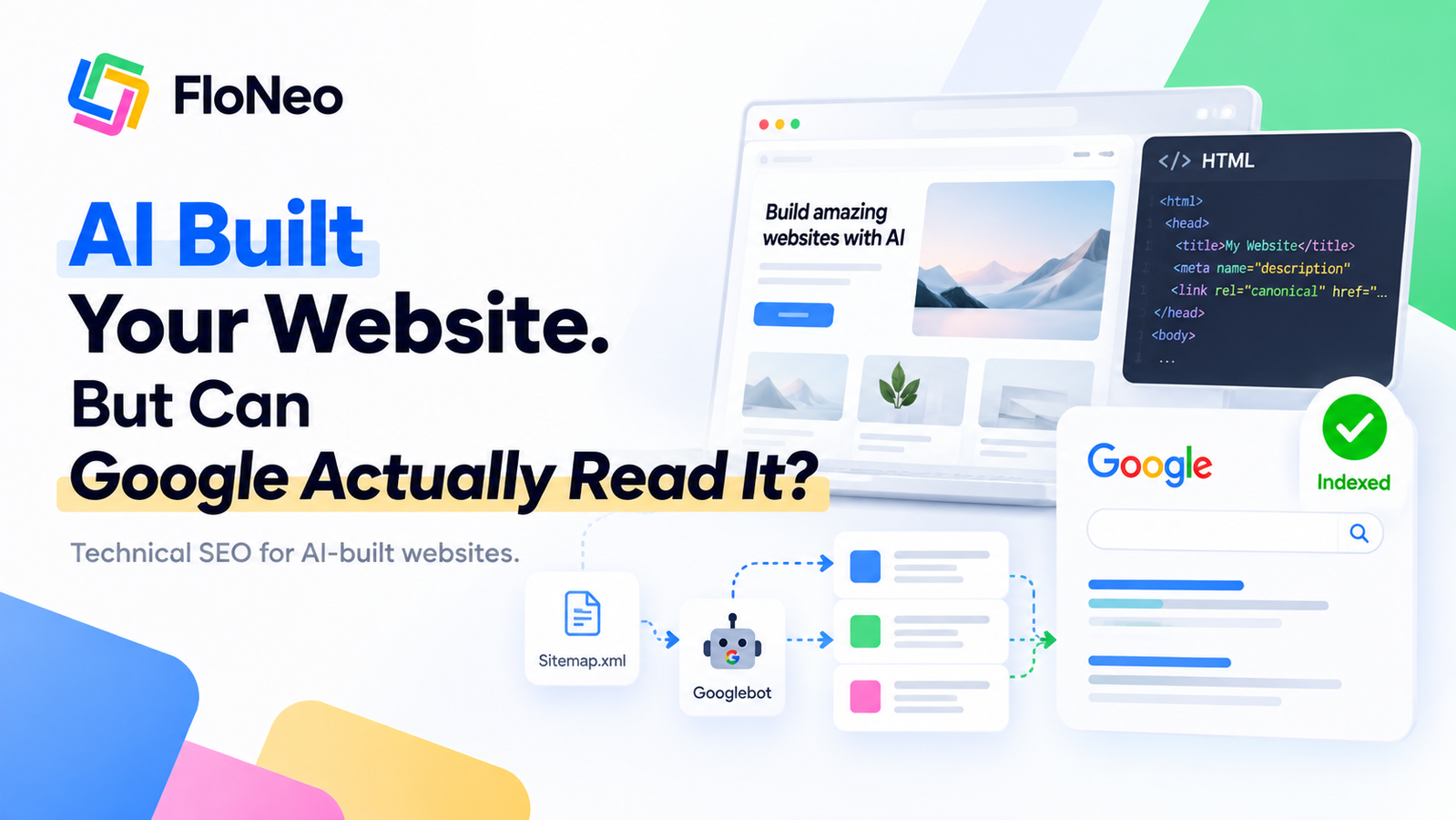
Part 1: AI Built Your Website. But Can Google Actually Read It?
Part 1 explains the technical wake-up call: crawlability, JavaScript rendering, app shells, links, sitemaps, status codes, and indexing controls.
Editorial note: Replace this placeholder with the live Part 1 URL after publication.
Next in the Series
Part 3: How FloNeo Thinks About SEO: AI for Strategy, Automation for the Rules
Part 3 turns the architecture into the product thesis: what should be automated, what should use AI, and what an SEO-aware AI app builder should expose to the user.
Editorial note: Replace this placeholder with the live Part 3 URL after publication.
References
- Google Search Central. Google Search technical requirements.
- Google Search Central. Understand the JavaScript SEO basics.
- Google Search Central. How HTTP status codes affect Google Search.
- Google Search Central. Make your links crawlable.
- Google Search Central. Learn about sitemaps.
- Google Search Central. General structured data guidelines.
- Framer. How to access your sitemap.
- Framer. Access your robots.txt file.
- Framer. Set up a custom canonical URL.
- Framer. Structured data through JSON-LD.
- web.dev. Web Vitals.
- Google Search Central. Creating helpful, reliable, people-first content.
- Vercel. SEO Starter.
- Google Search Central. Optimizing your website for generative AI features on Google Search.
- FloNeo. How FloNeo's 4-Layer Architecture Makes AI Prototyping Ultra-Affordable.