

AI Built Your Website. But Can Google Actually Read It?
AI can generate a beautiful site in seconds, but search visibility depends on crawlability, rendering, status codes, links, indexing controls, & useful content
Aayush4 min read
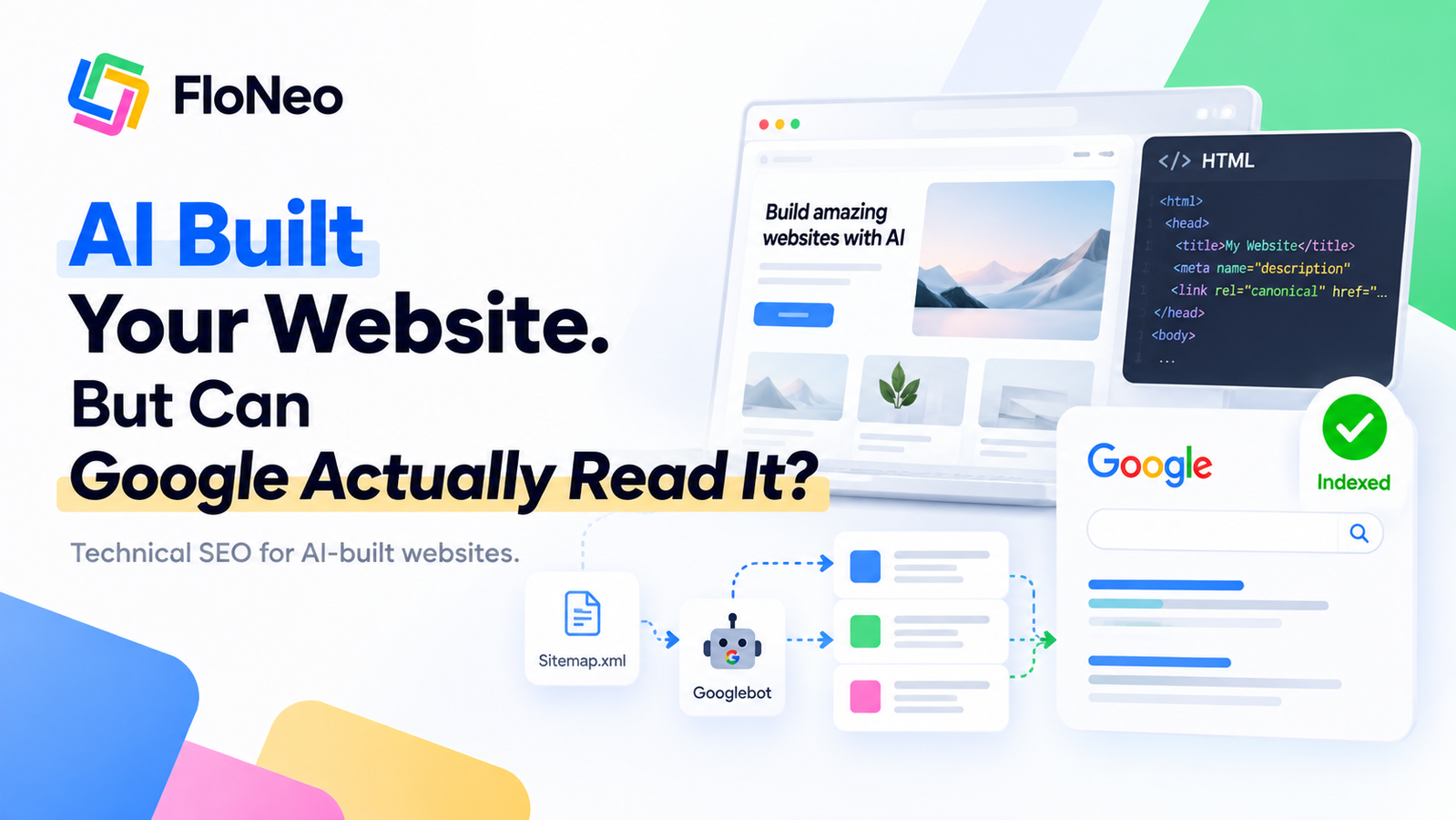
Your AI builder can generate a beautiful homepage in 60 seconds. That does not mean the page is search-ready.
Part 1 of 3 - The Technical Wake-Up Call
AI website builders have made page creation dramatically faster. Search engines still have to discover, fetch, render, understand, and decide whether to index what was generated. Built is not the same thing as searchable.
Your AI builder can generate a beautiful homepage in 60 seconds.
But that doesn't mean it will appear in search results.
Beyond a good-looking website, Googlebot still has to receive something worth indexing.
That is the technical wake-up call for AI website builder SEO.
For years, building a website and making it discoverable were treated as related but separate jobs. You could build the site first, then hand it to an SEO specialist to deal with crawling, metadata, sitemaps, redirects, and everything else.
AI website builders change the first half of that equation. They can create pages, layouts, content, and application logic almost instantly.
But search engines still have to understand what was built.
That is what AI website builders now need to take seriously.
Google Doesn't See Your Website the Way You Do
When you open a website, you see the finished product: the headline, images, navigation, buttons, and content.
Google Search has a process for getting there.
For JavaScript-powered websites, Google describes three broad stages:
Crawl -> Render -> Index
First, Googlebot needs to discover and fetch the URL.
Then Google processes the page, including executing JavaScript where necessary.
Finally, it decides what content can be stored and potentially shown in Search. [1]
This matters because a browser can successfully turn an application into a beautiful page even when the initial response contains very little meaningful content.
Imagine the server initially sends:
<body>
  <div id="root"></div>
  <script src="/app.js"></script>
</body>
A browser can download app.js, execute it, and eventually display a complete homepage.
But the first response itself contains almost no information about what that page is.
Now compare that with a response containing actual page content:
<main>
  <h1>Payroll software for GCC finance teams</h1>
  <p>Automate payroll, approvals and compliance workflows.</p>
  <a href="/features/payroll">Explore payroll automation</a>
</main>
The second response gives crawlers useful information immediately.
Google can render JavaScript, so this does not mean JavaScript websites cannot appear in Search. Google explicitly documents how JavaScript sites can be made discoverable. [1]
But rendering adds another processing stage.
So the useful question is not:
"Does the page look right in Chrome?"
It is:
"What does the crawler actually receive, and what must happen before the page becomes understandable?"
The App-Shell Problem
This is one of the easiest ways an AI-generated website can look perfect to a person and still create technical SEO problems.
A client-rendered application may initially deliver an app shell: a root element, scripts, and other resources. The actual page content arrives only after JavaScript executes.
If everything works, the visitor sees the finished page.
But search systems still need to crawl, render, and process that application before they can fully understand it.
That is why server-side rendering (SSR) and prerendering can be useful for public, search-sensitive pages.
They can put meaningful HTML closer to the initial response instead of making every important piece of content dependent on client-side execution.
The important point is not:
"SSR automatically ranks better."
It doesn't.
The better question is:
What does the crawler receive before the application becomes interactive?
That is a much more useful question for AI website builder SEO.
A Website Has to Be Discoverable, Not Just Beautiful
Rendering is only one part of the problem.
Google also needs ways to discover the other pages on your website.
This is where something as simple as an HTML link becomes surprisingly important.
Google recommends crawlable links that use a real <a> element with an href pointing to a resolvable URL. [2]
So this:
<a href="/pricing">Pricing</a>
is fundamentally different from a visual card that only triggers navigation through an onClick handler.
A user may experience both as "a clickable thing."
A crawler does not necessarily treat them the same way.
For an AI website builder, navigation therefore cannot be only a visual design decision.
The generated system needs to understand:
- which pages exist;
- how they connect;
- which routes are public;
- which pages should be discoverable; and
- which links should be represented as real crawlable URLs.
Google also recommends that important pages be reachable through links from other pages on the site. [2]
That means an AI builder should be able to reason about the route graph, not merely generate a menu that looks correct.
Sitemaps Help Discovery - They Do Not Guarantee Indexing
A sitemap provides another discovery mechanism.
Google describes sitemaps as files that help search engines understand which pages, videos, images, or other files exist on a site and how they relate. [3]
But a sitemap is not a magic indexing switch.
Submitting a URL in a sitemap does not guarantee:
- indexing;
- ranking; or
- visibility.
For an AI website builder, the interesting part is that the builder already knows which routes it created.
So generating a correct sitemap.xml should not require a separate manual SEO job later.
The builder already has the route model.
Use it.
Then Come Status Codes and Indexing Controls
A URL can exist without being a valid search result.
Suppose an AI builder creates:
/pricing/about/contact
What happens when someone requests:
/something-that-does-not-exist
A correctly configured site should distinguish between real pages, moved pages, and missing pages.
| Situation | Expected behavior |
|---|---|
| Real page | 200 response |
| Permanently moved page | 301 redirect |
| Missing page | 404 or appropriate missing-resource response |
Google specifically warns about soft 404s: situations where a page effectively says "not found" but the server still returns a successful status code. [4]
An AI builder that generates routes but mishandles HTTP behavior can create SEO problems even when every screen looks perfect.
This is not copywriting.
It is application architecture.
robots.txt and noindex Are Not the Same Thing
Another common technical mistake is treating robots.txt and noindex as interchangeable.
They are not.
| Control | What it does |
|---|---|
robots.txt | Controls whether crawlers may request specific URLs or paths |
noindex | Tells Google not to include an accessible page in Search |
sitemap.xml | Helps crawlers discover URLs |
Google explicitly notes that blocking a URL in robots.txt is not the correct way to guarantee that the URL stays out of Search.
If you want to prevent indexing, Google recommends using noindex while still allowing the crawler to access the page and see the directive. [5]
This matters for AI-generated sites because they often have multiple environments and page types:
- production pages;
- preview deployments;
- dashboards;
- internal tools;
- staging pages;
- authentication surfaces.
An AI website builder should know which ones belong in Search and which ones do not.
That should be part of the system, not an afterthought.
"It Looks Right in Chrome" Is Not the Test
A website can pass the most obvious human test:
Open it -> it looks great -> ship it.
Search readiness requires a different test:
- Can Google discover it?
- Can Google fetch it?
- Can Google render it?
- Can Google understand it?
- Should Google index it?
And even passing all five does not guarantee rankings.
Indexing eligibility and ranking are separate things.
A technically sound page can still fail to perform because the content is thin, repetitive, unhelpful, or simply not relevant enough.
Google's current guidance emphasizes useful, reliable, people-first content and warns against creating large amounts of low-value content primarily to manipulate search rankings. [6]
So the technical foundation is necessary.
It is not the whole SEO equation.
The Bigger Picture: From AI-Generated Pages to Search-Ready Systems
AI website builder SEO should not begin with:
"What keywords should the AI put on the page?"
It should begin much earlier.
When an AI builder creates a website, it already has information about the site's:
- routes;
- pages;
- components;
- content;
- relationships; and
- public/private surfaces.
That information can be used to generate the technical search infrastructure alongside the website itself:
- Crawlable routes and internal links
- Appropriate HTTP status codes
- XML sitemaps
robots.txtrulesnoindexcontrols where needed- Search-friendly rendering for public pages
- Clear page structure and semantic HTML
That is the real opportunity.
The next generation of AI website builders should not just generate pages. They should generate pages that are technically ready to be discovered, understood, and indexed.
That is also where FloNeo's broader building philosophy becomes relevant: the system underneath the interface matters just as much as the first generated screen.
FloNeo's published article, How FloNeo's 4-Layer Architecture Makes AI Prototyping Ultra-Affordable, explores the same idea from an architecture and control perspective: understand the structure, route work appropriately, and avoid treating every change as another opaque generation.
Next in the Series
Part 2: SEO Should Be Compiled Into Your Website, Not Bolted On Later
Part 2 turns the technical SEO checklist into a full build architecture: rendering, URLs, status codes, crawlability, metadata, semantics, schema, performance, content quality, and observability.
Editorial note: Add the live Part 2 URL after publication.
References
- Google Search Central. Understand the JavaScript SEO basics.
- Google Search Central. Make your links crawlable.
- Google Search Central. Learn about sitemaps.
- Google Search Central. How HTTP status codes affect Google Search.
- Google Search Central. Block Search indexing with noindex.
- Google Search Central. Creating helpful, reliable, people-first content.
- FloNeo. How FloNeo's 4-Layer Architecture Makes AI Prototyping Ultra-Affordable.