
How FloNeo Thinks About SEO: AI for Strategy, Automation for the Rules
Most SEO problems do not need another AI prompt. See how FloNeo uses rules for what can be proven and AI only where judgment actually adds value.
Aayush1 min read
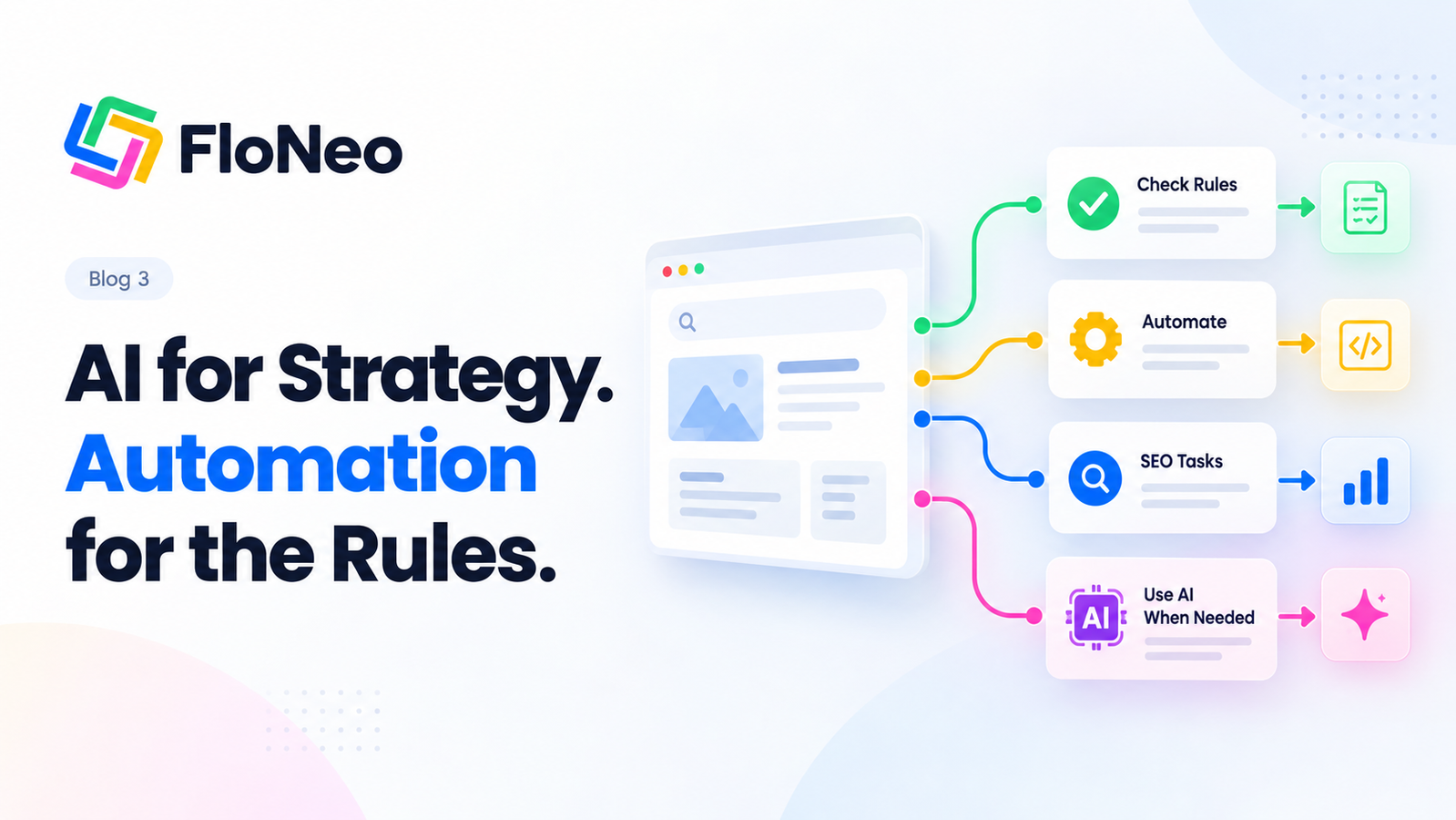
Not every SEO problem needs AI. The useful distinction is knowing what software can prove, what the user can control directly, and where intelligence genuinely earns its tokens.
Part 3 of 3 - The FloNeo Thesis
The first two articles in this series focused on whether an AI-built website is technically readable by search engines and why search readiness should be compiled into the website itself. This final article applies FloNeo's Low Token No Code (LTNC) philosophy to SEO: rules catch what rules can prove, direct controls change what the user already knows they want, AI helps with interpretation, and the human keeps the final decision.
Does This Task Actually Require Intelligence?
AI can write a title tag in seconds. It can suggest an internal link, rewrite a heading, generate schema, or produce a hundred page descriptions just as quickly.
But here is the question an AI app builder should ask before using AI for any of that:
Does this task actually require intelligence?
SEO is full of problems that do not need a language model to solve.
If a page has no title, that can be detected by a rule.
If a production URL is returning the wrong status code, a system can check it.
If a page is missing from the sitemap, software can know that.
If a canonical URL is inconsistent with the route, that can be validated.
This is where Low Token No Code SEO becomes more than an SEO feature. It becomes a product philosophy.
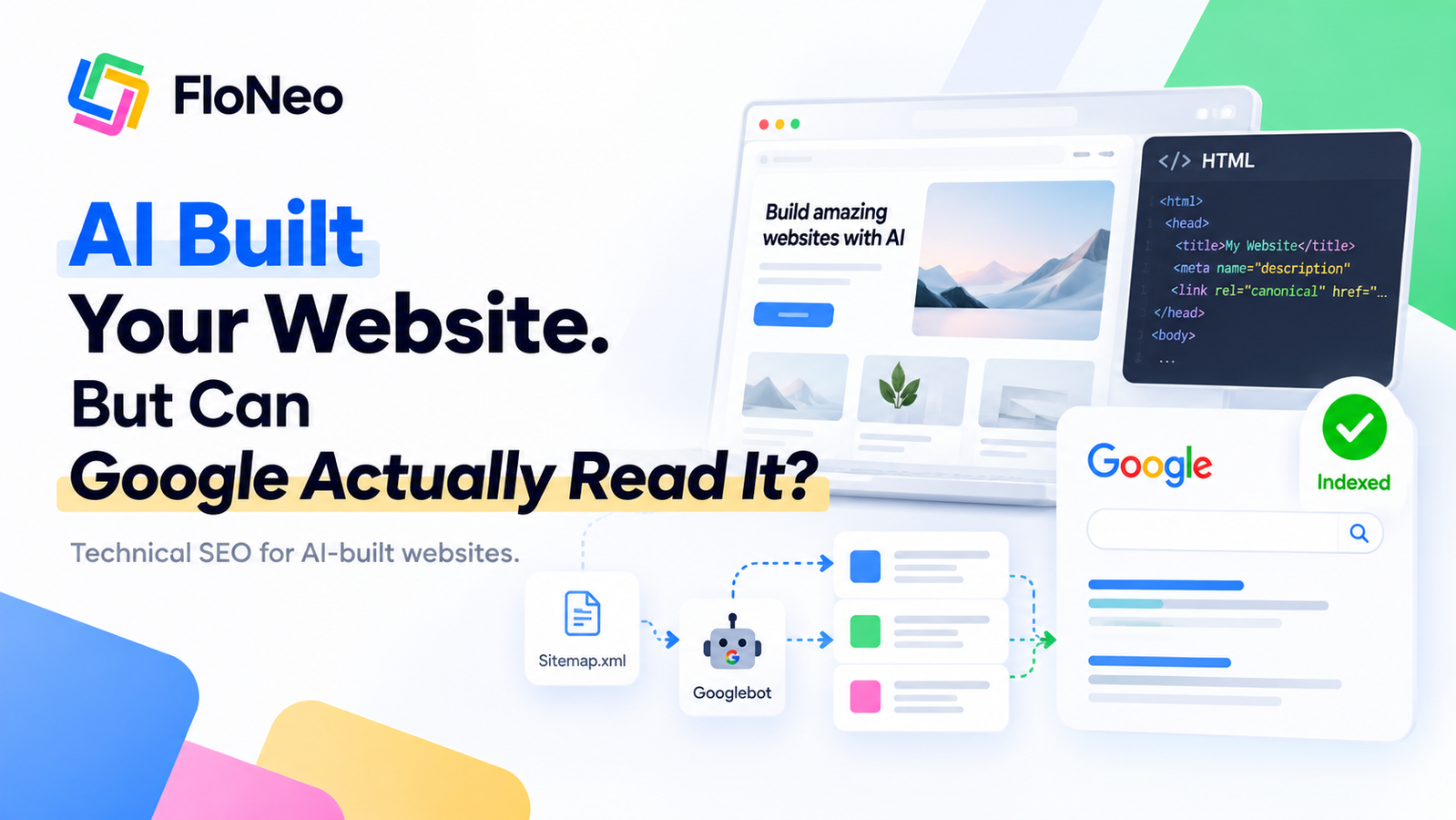
Google's own minimum technical requirements reinforce this distinction: Googlebot needs to be able to access the page, the page should return a successful HTTP response, and it needs indexable content. Those are technical conditions that can be tested, not open-ended questions that require a frontier model. [1]
Do Not Spend Intelligence Detecting What a Rule Can Prove
The AI-first approach to building often treats every change as a prompt.
Want to change a colour? Prompt it.
Want to move a button? Prompt it.
Want to fix a missing metadata field? Prompt it.
Want to check whether every public page has a canonical? Prompt it.
That is backwards.
If a fact is deterministic, the system should be able to detect it without asking a model to interpret anything.
Low Token No Code SEO starts with this principle: use the simplest mechanism capable of solving the problem.
| SEO problem | Best mechanism | Why |
|---|---|---|
| Missing title | Rule + direct control | Presence is deterministic |
| Missing canonical | Rule + direct control | The system knows the route |
| Incorrect status code | Automated check | HTTP behaviour is measurable |
| Missing sitemap entry | Deterministic generation | Routes already exist in the system |
| Invalid structured data | Validation | Syntax and required fields can be checked |
| Weak internal-link opportunity | AI assistance | Context and relevance require judgment |
| Search intent | AI assistance | Interpretation is involved |
| Rewriting page copy | AI + human review | Language quality is subjective |
| Thin or repetitive content | AI + rules | Detection can be assisted; judgment matters |
This is the difference between using AI everywhere and using AI where it is actually useful.
SEO Is a Perfect LTNC Problem
Technical SEO might sound like an area where you need more AI.
In practice, it demonstrates why you often need less.
A modern website already contains much of the information required to perform technical SEO checks.
The builder knows the routes.
It knows which pages are public.
It knows the page hierarchy.
It knows the content fields.
It knows which assets are attached to which pages.
So why should it regenerate or reinterpret that information every time?
A Low Token No Code SEO approach would turn that existing system knowledge into deterministic checks.
For example, imagine you publish a website with 20 pages.
The system can immediately determine:
- 18 pages have titles.
- 2 pages are missing titles.
- 19 pages have canonicals.
- 1 page does not.
- All public routes appear in the sitemap.
- One page is orphaned from the internal-link graph.
- A preview environment is correctly marked
noindex. - One image is missing useful alternative text.
- One page has structured data that fails validation.
None of those questions require a frontier model to answer.
The system already knows.
Google itself provides systematic mechanisms around sitemap submission, structured-data validation, and Search Console inspection. A sitemap can help Google discover URLs, but submission is still only a hint rather than a guarantee of crawling or indexing. [2][3]
Then Where Should AI Enter?
This does not mean AI has no role in SEO.
Quite the opposite.
AI becomes more valuable when the problem stops being purely deterministic.
Consider an internal link.
A rule can tell you that a page has no internal links.
But should the page about payroll compliance link to an article about automating payroll approvals?
That requires understanding the relationship between two pieces of content.
Or consider a page title.
A rule can tell you that the title is missing.
It cannot reliably decide whether:
Payroll Software for Growing Businesses
is better than:
Automate Payroll Without the Spreadsheet Chaos
for the particular search intent, audience, and positioning of that page.
That is where an AI co-builder can help.
Ask Neo could work at the interpretation layer:
"This page appears to target finance teams looking for payroll automation. Here are three title options aligned with the page's content and intent."
The user chooses.
The system applies the change.
No regeneration of the website.
No unnecessary token spend.
No handing over control.
That is Low Token No Code SEO in practice: deterministic where possible, intelligent where useful.
AI for Strategy. Automation for Hygiene.
This distinction can be applied across the entire SEO stack.
Use automation for things that should simply be true:
- Sitemaps should contain the right public URLs.
- Redirects should behave correctly.
- Canonicals should follow the route model.
- Structured data should match the underlying page information.
- Preview environments should not accidentally become indexable.
- Performance checks should flag known page-experience problems.
Google's structured-data guidance makes the same separation clear: valid structured data can make a page eligible for richer search appearances, but Google does not guarantee that a rich result will be shown. The markup also needs to represent the real content of the page. [3]
Use AI for things that require interpretation:
- Search intent.
- Content structure.
- Page positioning.
- Internal-link suggestions.
- Alternative wording.
- Content gaps.
- Ambiguous improvements.
The distinction matters because AI should not become another layer of unnecessary complexity between the user and their website.
The FloNeo Approach: Intelligence Where It's Necessary
This is the larger idea behind Low Token No Code SEO.
A website builder should not make the user repeatedly explain things the system already knows.
If the system knows a route is /pricing, it should not need a prompt to generate the sitemap entry.
If it knows a page is public, it should not need AI to determine whether that URL belongs in the sitemap.
If it knows a page has no title, it should simply flag the problem.
But if the user asks:
"How should I position this page for people comparing payroll software?"
that is different.
There is ambiguity.
There is intent.
There is language.
There is strategy.
That is where intelligence earns its tokens.
And it is not just about saving tokens.
It is about making the product more predictable.
The principle is simple:
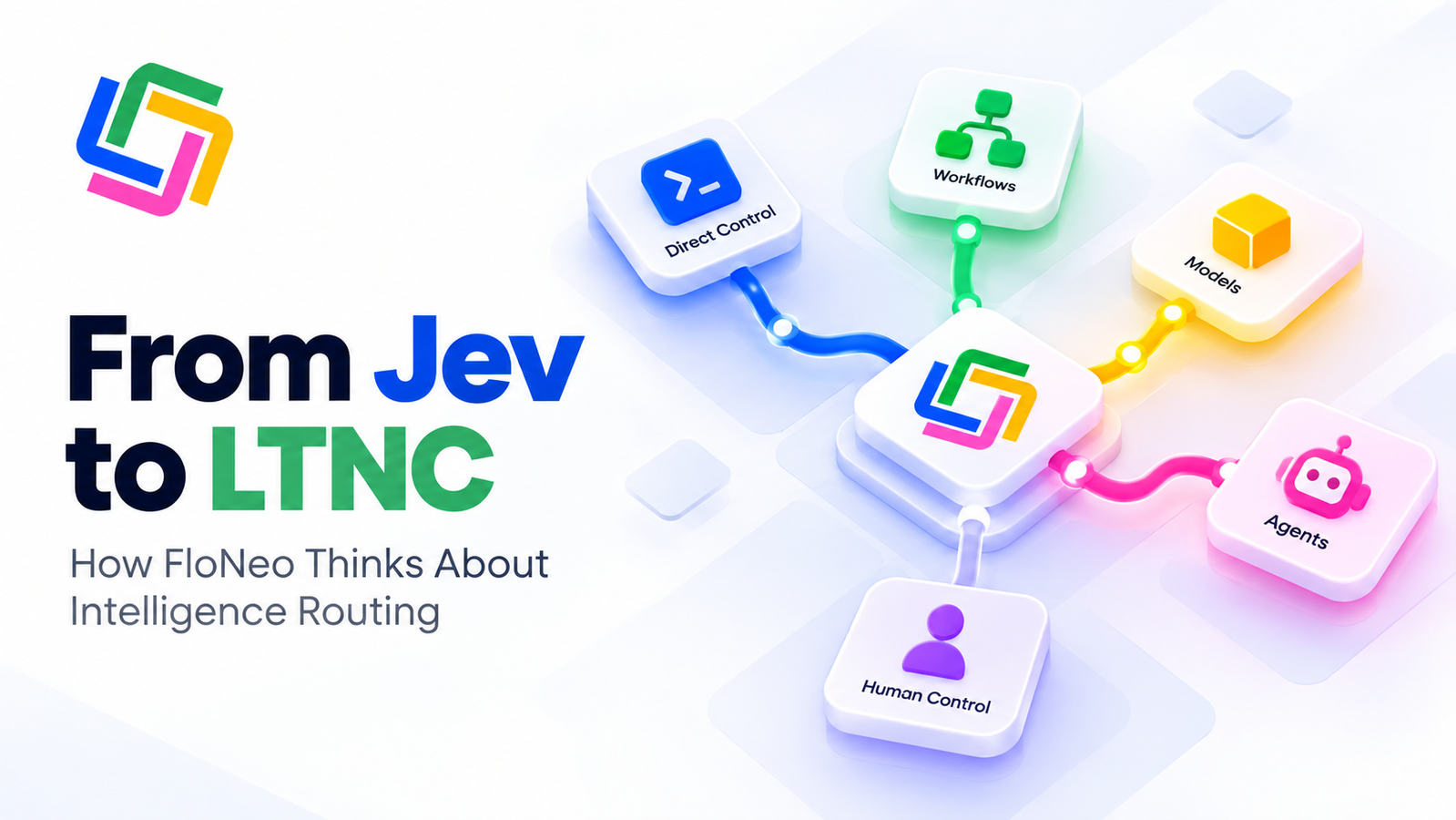
Rules catch what rules can prove.
Direct controls change what the user already knows they want.
AI helps with what requires interpretation.
The human stays in control of the final decision.
That is how an AI website builder can become less AI-dependent without becoming less intelligent.
SEO Should Be a System, Not a Collection of Prompts
The traditional model is to build the website first and then add SEO through plugins, audits, and manual fixes.
The AI-builder version risks becoming even messier:
Generate a page -> prompt an SEO fix -> regenerate something else -> prompt another fix -> keep iterating until the website hopefully becomes search-ready.
FloNeo's thesis is different.
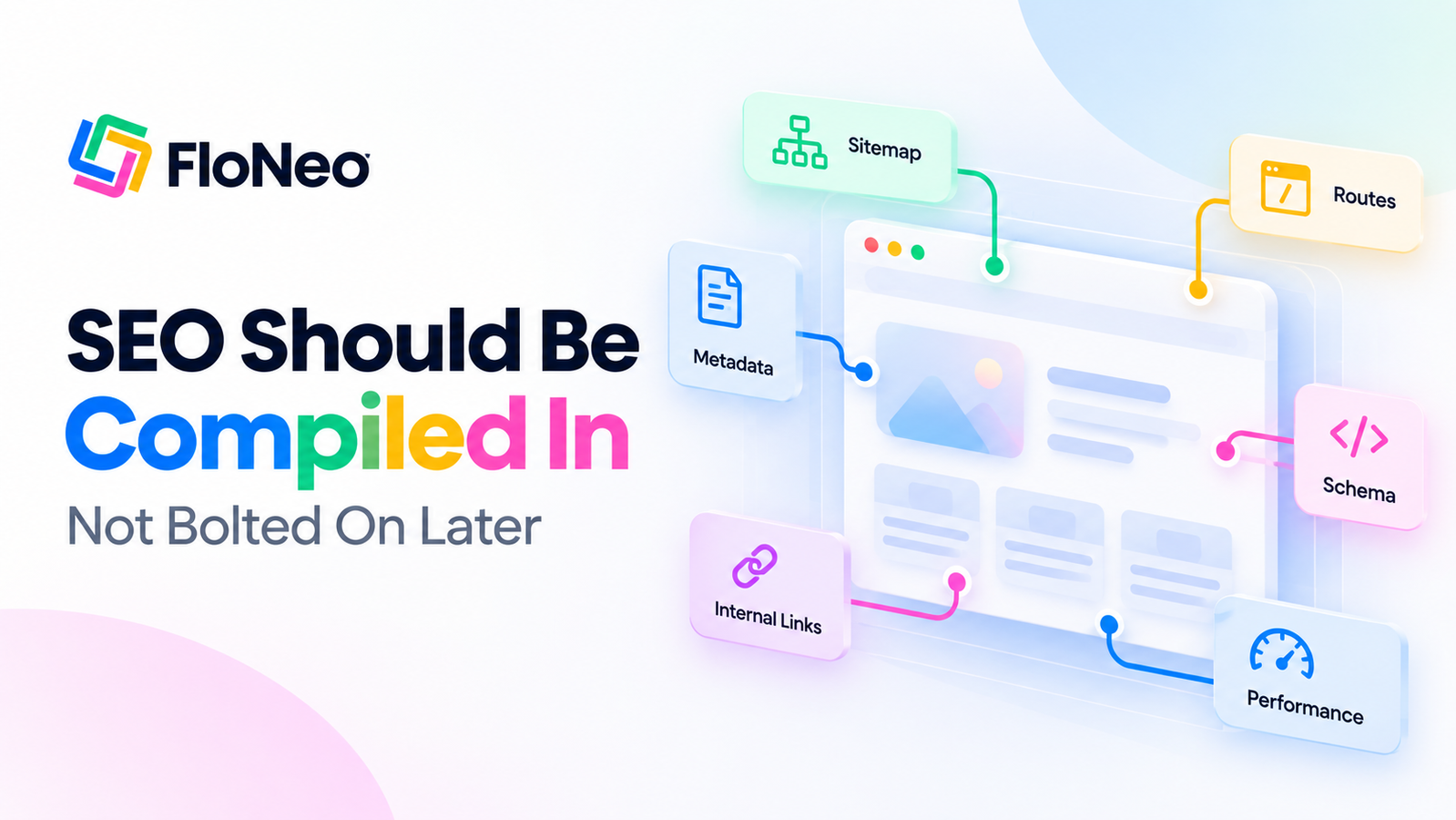
SEO should be part of the system being built.
Technical conditions should be generated from the underlying application structure.
Deterministic problems should be surfaced automatically.
Direct controls should make known changes immediately.
And Ask Neo should step in when the problem genuinely benefits from reasoning.
Google's current guidance emphasizes helpful, reliable, people-first content and a good overall page experience rather than optimizing one isolated signal. That fits this system approach: search readiness is not one magic AI feature. It is the result of many parts working correctly together. [4][5]
The same foundation now carries into Google's generative AI search experiences. Google says there are no separate technical requirements for AI Overviews or AI Mode beyond the normal Search requirements; a page must already be indexed and eligible to appear in Search with a snippet. [6]
That is ultimately what Low Token No Code SEO means.
Not less SEO.
Not less AI.
Less unnecessary AI.
Get First Access to FloNeo
FloNeo launches in November.
If you want to see what building a website with a Low Token No Code approach looks like - where AI helps with the parts that need judgment while the system handles what it already knows - register for first access.
Free registration. Be among the first to experience FloNeo when access opens.
Series Complete
| Part | Article | Core idea |
|---|---|---|
| 1 - Readability | AI Built Your Website. But Can Google Actually Read It? | A beautiful AI-built page still needs crawlable, renderable, indexable search infrastructure. |
| 2 - Architecture | SEO Should Be Compiled Into Your Website, Not Bolted On Later | Search readiness should be generated and validated as part of the build, not repaired afterwards. |
| 3 - LTNC SEO | How FloNeo Thinks About SEO: AI for Strategy, Automation for the Rules | Use automation for what rules can prove and AI for the parts that genuinely require interpretation. |
Editorial note: Replace the Part 1 and Part 2 placeholders with their live URLs after publication.
References & Related Reading
- Google Search Central. Google Search technical requirements.
- Google Search Central. Build and submit a sitemap.
- Google Search Central. General structured data guidelines.
- Google Search Central. Creating helpful, reliable, people-first content.
- Google Search Central. Understanding page experience in Google Search results.
- Google Search Central. AI features and your website.
- Google Search Central. Search Generative AI performance reports in Search Console.
- FloNeo. How FloNeo's 4-Layer Architecture Makes AI Prototyping Ultra-Affordable.