
We Tried to Build Apps From Models 25 Years Ago. AI Changes What Was Missing.
A 25-year-old software idea may explain the future of AI app building: preserve intent as a durable model, then let AI translate it into systems.
Aayush1 min read
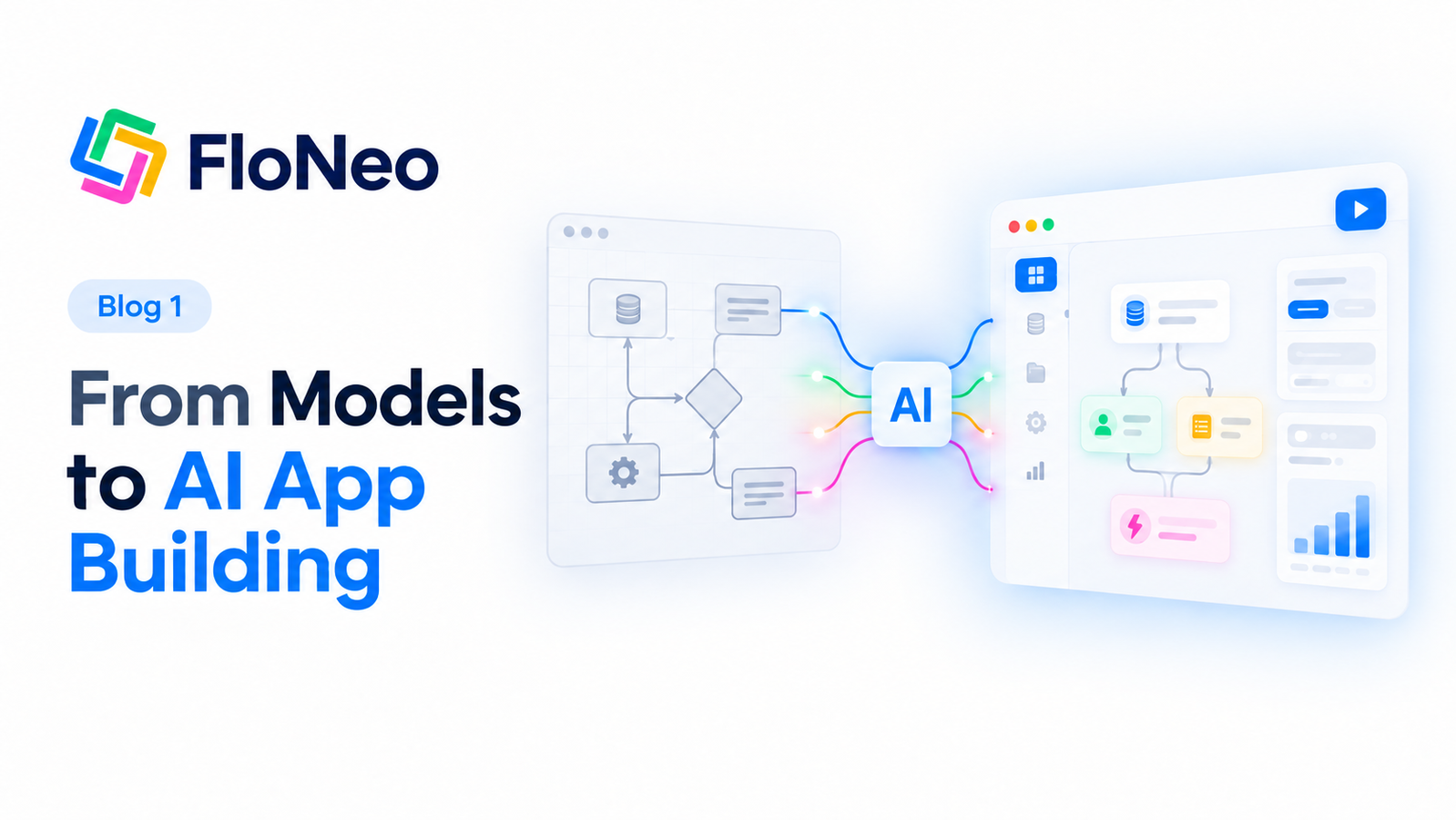
The future of AI app building may be based on a 25-year-old idea that arrived before the interface was ready.
Part 1 of 3 - The Historical Idea
In 2001, the software industry was already asking a question that sounds surprisingly modern today: What if we focus more on what an app should do than how it is built? The answer was Model-Driven Architecture. Twenty-five years later, AI may finally provide the interface that idea was missing.
What Was Model-Driven Architecture?
The idea came from the Object Management Group (OMG), the organization behind standards such as UML.
In late 2001, OMG established Model-Driven Architecture (MDA) as the base architecture for its standards. MDA proposed starting with a Platform-Independent Model (PIM) of an application's business functionality and behavior. That model could then be transformed into platform-specific models and implementations as technologies changed. [1][2]
Forget AI for a moment.
Imagine a business says:
"Customers should be able to place an order, managers should approve orders above ₹50,000, and finance should receive the approved order automatically."
That's the business requirement.
Traditionally, turning that requirement into software meant translating it through several layers:
Business intent -> requirements -> architecture -> code -> testing -> deployment
Every translation introduces room for interpretation.
MDA tried to solve part of this problem by creating a durable model of the application's business functionality and behavior. The ambition was simple:
Make the model stable. Let implementation change around it.
That sounds remarkably close to today's argument that an AI-built application should not depend on a pile of prompts or whichever model happened to generate the latest version.
| Traditional approach | Model-driven approach |
|---|---|
| Start with implementation | Start with a model |
| Technology shapes the design | Business behavior is modeled first |
| Code becomes the main artifact | The model remains a durable representation |
| Changing platforms can mean rework | The model can be mapped to different implementations |
Why Didn't Model-Driven Development Take Over?
MDA had a compelling idea, but the interface was difficult.
It required people to work with formal modeling concepts, modeling languages, and specialized tooling. UML could represent systems in considerable detail, but that also meant users had to learn how to express their ideas in the language of the modeling system.
The missing layer was translation.
A business user might know exactly what they wanted without knowing how to express it as a formal model. A developer could turn that model into software, but creating and maintaining the model itself introduced another layer of work.
A 2001 NIST paper identified a related challenge: connecting domain vocabulary and requirements to models and, ultimately, implementations - including traceability across those layers. [3]
In other words:
The industry had the model. What it didn't have was an easy way for humans to get their intent into that model.
And that is what has now changed with AI.
The Use of Natural Language With AI
AI works with natural language.
You do not need to know UML.
You do not need to know the database schema.
You do not need to decide which framework should handle the workflow before you can explain what you want.
You can say:
"I want an internal expense app where employees submit expenses, managers approve them, finance can see approved expenses, and anything above ₹1 lakh needs a second approval."
A capable AI system can then clarify the ambiguity:
- Who can approve expenses?
- Can managers approve their own expenses?
- What happens when an expense is rejected?
- Does the ₹1 lakh threshold apply to individual expenses or monthly totals?
Those answers can become structured:
- requirements;
- data relationships;
- workflows;
- permissions; and
- validation rules.
AI does not have to replace the model.
AI can become the bridge between human intent and the model.
That changes the potential future of application development.
From Prompt-to-Code to Intent-to-System
The first generation of AI app builders made something remarkable possible:
Prompt -> working application
But a prompt is a poor long-term source of truth.
As an application grows, its important decisions spread across:
- data structures;
- workflows;
- permissions;
- UI;
- integrations;
- tests; and
- business rules.
If those decisions exist primarily inside conversation history, every future interaction risks becoming another interpretation of what came before.
The emerging alternative is already visible in AI-native development.
Microsoft's 2026 work on Spec-Driven Development argues that a structured specification can become the shared source of truth linking business intent to architecture, implementation, tests, and validation. Instead of prompting first and aligning later, teams align first and use AI to execute against the specification. [4]
Microsoft Digital has described the same problem from its own engineering transformation: individual developers became faster with AI, but team productivity did not automatically improve. The response was to use living specifications to preserve business intent and alignment across the software lifecycle. [5]
The terminology is different from MDA.
The underlying instinct is familiar:
Don't make the latest implementation the only place where the application's meaning exists.
MDA (2001) vs AI-App Building (2026)
AI potentially makes model-driven thinking accessible without requiring every user to become a modeling expert.
The result does not have to be a giant formal UML diagram.
It could be a living application model containing the things that actually define the system.
| 2001 | 2026 |
|---|---|
| Human defines formal model | Human describes intent in natural language |
| UML and modeling tools | AI interprets and structures intent |
| Model drives implementation | Structured intent guides AI generation |
| Platform-independent model | App model/specification can remain durable |
| Specialist modeling skills required | Natural language lowers the entry barrier |
Taking AI-App Development From Here
The next major question in AI app development may be:
What does the application remember about what I meant after the prompt is gone?
That is the problem the next generation of builders has to solve.
A useful future workflow could look like this:
Intent -> Clarify -> Plan -> Structured App Model -> Generate -> Validate -> Directly Edit -> Reconcile
The user can describe something ambiguous.
AI can reason about it.
The system can turn the decision into structure.
And the user should be able to see and change that structure directly instead of starting another conversation every time something needs to move.
That is also the direction FloNeo is designed around.
Ask Neo can help interpret intent and work through what needs to change.
But the application does not have to disappear behind the conversation.
Its UI, data, and workflows remain things the user can directly see and control.
FloNeo's published 4-layer architecture article describes the same product philosophy from another angle: keep application structure modular, apply AI to the context that matters, and change only what needs to change.
The future may be AI finally making models usable.
And so the bottom line stands:
A prompt can start your app. It shouldn't become your app.
Next in the Series
Part 2: AI-App Building: The Prompt vs The Source of Truth
The next article looks at what happens when an AI-built application survives beyond the prototype stage and asks a harder question: where should the truth about the app actually live?
Editorial note: Add the live Part 2 URL after publication. Do not publish a guessed URL.
References
- Object Management Group. MDA Specifications.
- Object Management Group. Model Driven Architecture (MDA).
- NIST. Modeling Technology for a Model-Intensive Enterprise, July 2001.
- Microsoft for Developers. Spec-Driven Development: A Spec-First Approach to AI-Native Engineering, 10 June 2026.
- Microsoft Digital. Engineering the Frontier Firm: Sharing our AI-native approach to software development, 3 September 2026.
- FloNeo. How FloNeo's 4-Layer Architecture Makes AI Prototyping Ultra-Affordable.