
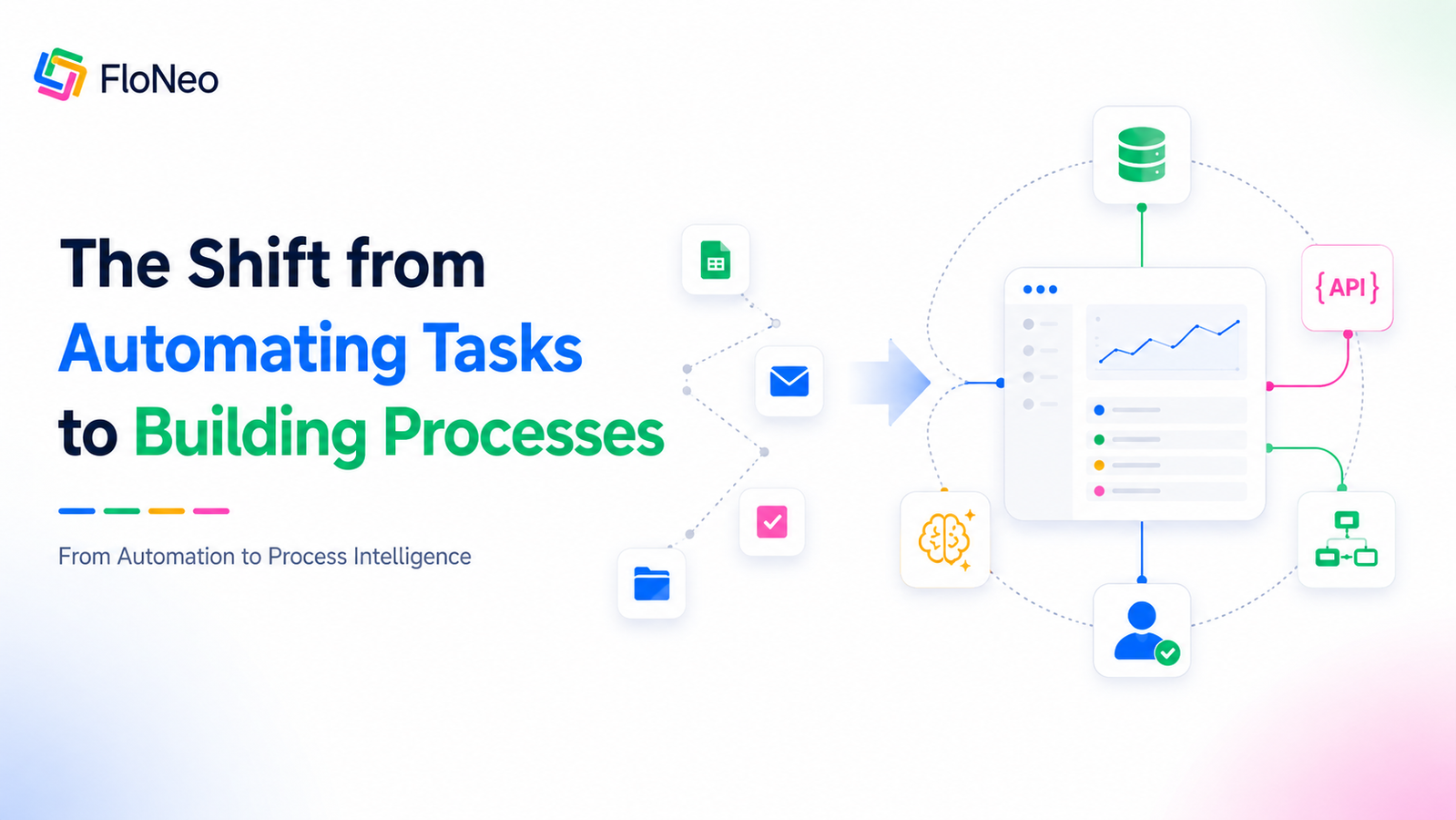
The Shift from Automating Tasks to Building Processes
AI can generate an app quickly. The bigger advantage is building a process where data, workflows, APIs, humans, and AI each do the right job.
Aayush4 min read
Trust the process? For AI-built business software, the more useful version may be: build the process.
Part 3 of 3 - The FloNeo Thesis
AI app builders have made it dramatically easier to create software. Describe an application in natural language and AI can generate interfaces, logic, data structures, and workflows. But the industry is moving beyond the initial generation moment. The more important question is whether the application actually reflects how the business works - and whether people can still see, control, and evolve the process behind it.
"Trust the Process" - but First, Build the Process
You may have heard athletes, businesses, and creative professionals repeat the phrase:
"Trust the process."
It applies surprisingly well to AI app building.
But for us, perhaps it sounds more like:
"Build the process."
What happens after an application is generated?
Does it actually reflect how the business works?
Can people see and control the process behind it?
What happens when a workflow encounters an exception?
Where should AI make a decision?
Where should a simple rule, workflow, API, or human handle the job instead?
At FloNeo, the goal is to give users more control and transparency after they generate an application.
After all:
The application is where people interact with the process. The process is where the business happens.
What This Looks Like in FloNeo
FloNeo is built around two key ideas:
- Low Token No Code (LTNC)
- Direct visual control over what is generated
An application can be generated using natural language.
But once it exists, users should be able to see, understand, and modify the UI, database, and workflows.
That is a more practical model of BPA AI app builder technology:
Build the process, then use the right tool at each step - not AI everywhere.
Consider a simple lead-routing application.
It might need to:
Capture a lead -> check its attributes -> retrieve additional information -> determine the right salesperson -> handle ambiguous cases -> update the record -> notify the team
Here is what assigning the right tools can look like:
| Process step | What should handle it? | Why |
|---|---|---|
| Capture lead details | UI + database | Structured information needs a reliable source of truth |
| Check location or company size | Workflow / rules | The conditions are known |
| Retrieve company information | API | The information lives in another system |
| Interpret unclear lead intent | AI | This requires contextual reasoning |
| Handle a high-value exception | Human | Judgment and accountability matter |
| Assign salesperson | Workflow | Once the decision is known, execution is deterministic |
| Notify salesperson | Workflow / automation | The action is predictable |
The important thing is not that AI appears somewhere in the process.
It is that AI appears where it adds value.
A rule does not need an agent.
An API call does not need an agent.
A standard notification does not need an agent.
But when the process encounters something that cannot be handled by a predefined rule, AI can step in.
The Process Doesn't End When AI Generates the App
This is where many AI app-builder conversations stop.
The application gets generated.
Everyone celebrates the speed.
But real businesses do not stay still.
Approval thresholds change.
A new field is required.
A sales team changes its routing rules.
A new exception appears.
An API gets replaced.
A process that was once manual becomes predictable enough to automate.
The real test of an AI-built application is therefore not only how quickly it was generated.
It is:
How easily can the business change it afterward?
FloNeo's direct-editing philosophy matters here.
Instead of making users return to a prompt for every modification, FloNeo is designed around direct interaction with the application itself.
Visual editing can handle changes to the interface.
Direct control over data and workflows allows the underlying application to evolve alongside the business.
AI for Generation. Direct Control for Change.
This is where FloNeo's LTNC philosophy goes beyond a lower-token approach.
The principle is simple:
Use AI when intelligence is needed. Use direct controls when it isn't.
Imagine a business owner wants to change a lead-routing rule from:
Companies with more than 500 employees -> Enterprise sales
to:
Companies with more than 1,000 employees -> Enterprise sales
There is no reason to ask an AI agent to reinterpret the entire application.
It is a business rule.
The user should be able to change the rule directly.
Similarly, if a new field needs to be added to a customer record or a workflow needs another deterministic branch, the change should not require rebuilding the application through another round of prompting.
This is what makes direct control important in an AI-built application.
So, Where Does AI Belong in the Process?
The same principle applies to more complex business processes.
Take an insurance-claims application.
A claim might move through:
Submission -> document collection -> validation -> assessment -> exception handling -> approval -> settlement
Some parts are highly structured.
Others are not.
A workflow can check whether required documents are present.
An API can retrieve policy information.
Rules can determine whether a claim falls below a predefined threshold.
But an unusual claim might require interpreting documents, understanding context, or identifying something that does not fit the normal pattern.
That is where AI becomes useful.
If AI encounters a case that requires accountability or a decision beyond its scope, the process can route it to a human.
The result is not simply an "AI claims app."
It is:
A claims process in which AI has a defined role.
That distinction is at the heart of FloNeo's approach.
From App Builder to Process Builder
This also changes what we should expect from an AI app builder.
The old promise was:
Describe an app -> AI generates an app.
The more useful promise is:
Describe the business -> build the process -> generate the application -> control and evolve it directly.
That requires the application to bring its core components together.
- UI gives people a way to interact with the process.
- Database gives the process a source of truth.
- Workflows determine what happens next.
- APIs connect the process to external systems.
- AI handles ambiguity and reasoning.
- Humans handle judgment, exceptions, and accountability.
FloNeo's relevance lies in bringing these pieces into the application-building experience rather than treating AI as the only mechanism for creating or changing software.
That is what makes the process visible.
And visibility matters because:
You cannot improve what you cannot see.
This also ties back to FloNeo's published 4-layer architecture article, which explains why modular applications, focused AI work, and incremental changes are more controllable than repeatedly regenerating a monolithic app. [1]
As They Say: Trust the Process
We return to where we started.
Trust the process.
Or, more precisely for AI-built software:
Build the process.
Now that agents can handle tasks that once required human judgment, it is tempting to place an agent anywhere there is friction.
But the next generation of business applications will not be defined by how many AI agents they contain.
They will be defined by how well people, data, workflows, systems, and AI work together.
That is the opportunity behind BPA AI app builder technology.
FloNeo's LTNC philosophy takes the idea seriously:
- use AI to accelerate creation;
- keep the underlying application visible;
- give users direct control; and
- introduce AI where the process genuinely requires intelligence.
Because the goal is not to automate every task.
It is to build a better process - and then give every step the right tool to do its job.
Series Complete
| Part | Article | Core idea |
|---|---|---|
| 1 - History | History Is Repeating Itself: AI Agents Shouldn't Make RPA's Biggest Mistake | Smarter automation does not repair a badly designed process. |
| 2 - Process Layer | The Next AI Gold Rush Isn't Agents. It's the Process Layer They Run On. | The durable enterprise layer coordinates state, work, systems, agents, and people. |
| 3 - FloNeo Thesis | The Shift from Automating Tasks to Building Processes | Use AI where reasoning adds value and direct controls where the rule is already known. |
Editorial note: Replace Part 1 and Part 2 placeholders with their real live URLs after publication.
References & Related Reading
- FloNeo. How FloNeo's 4-Layer Architecture Makes AI Prototyping Ultra-Affordable.
- Series background: Part 1 draws on Michael Hammer, Gartner, Deloitte, and UiPath; Part 2 draws on UiPath, Microsoft Agent Framework, IBM, and McKinsey. See those articles' reference sections for the primary sources.