
The Future of Building Apps: Describe the Intent. Control the System.
AI can generate version one. The real future is an app you can understand, edit, validate, and evolve without surrendering control to the prompt.
Aayush4 min read
The next AI app builder should not make you choose between intelligence and control.
Part 3 of 3 - The FloNeo Thesis
The first generation of AI app builders proved that a prompt can create a first draft. The next generation has a harder job: turn intent into a system that remains visible, structured, editable, and understandable as it evolves.
From Prompting to a Building Loop
Simply prompting and getting a first draft of your application is now the bare minimum that an AI app builder can do.
The harder problem begins after that first generation.
Because applications don't stay still.
A button moves.
A database field changes.
A new approval condition gets added.
And every time something changes, the builder needs to understand what already exists before deciding what to change.
A prompt is excellent at expressing intent.
But it isn't necessarily a good place to preserve everything that intent eventually becomes.
That's why the future of app building needs to move from a series of isolated prompts to a continuous building loop:
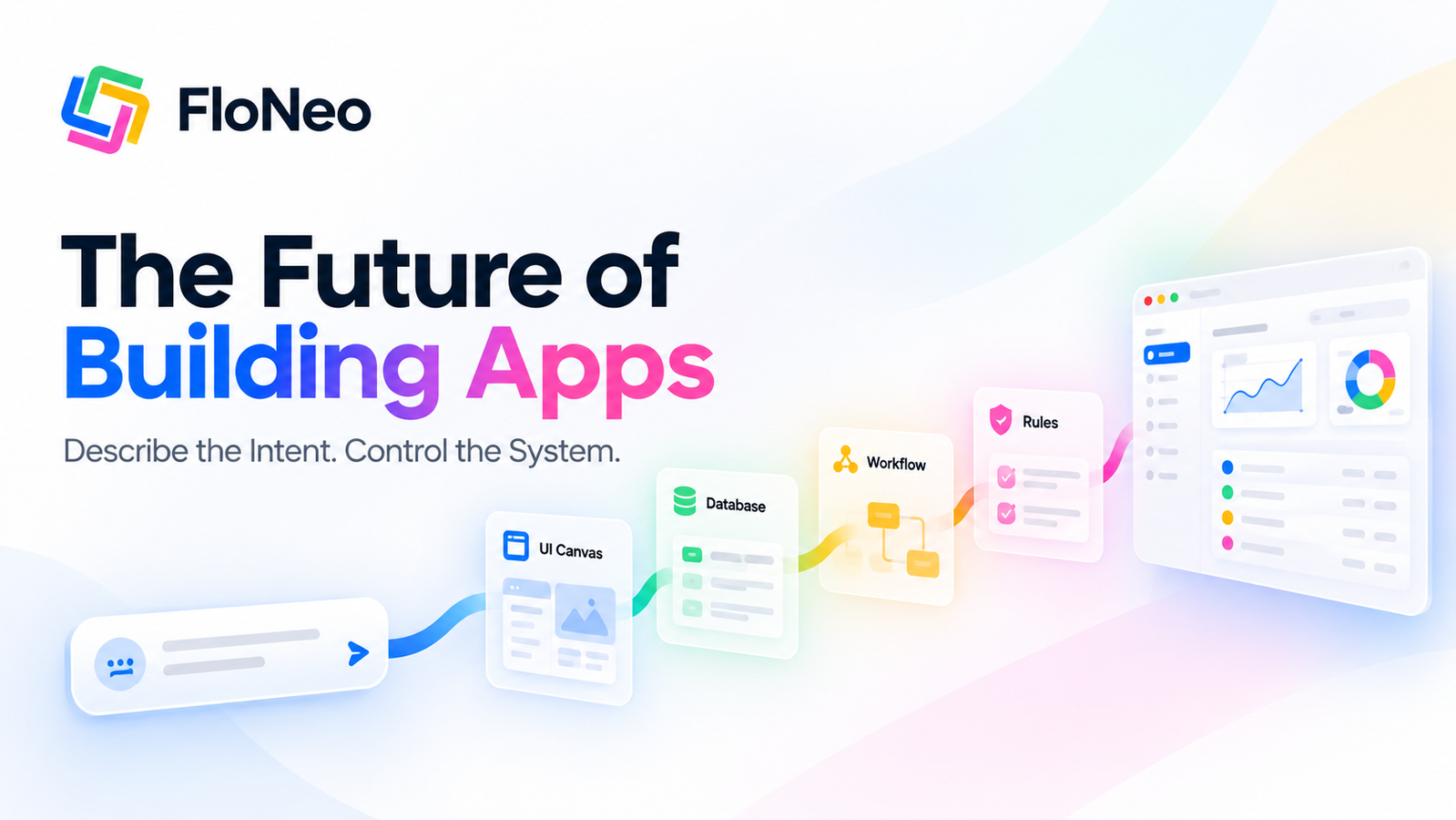
Intent -> Clarify -> Plan -> Generate -> Inspect -> Control -> Validate -> Evolve
In this model, AI isn't rebuilding the application from scratch every time you ask for something new.
It is working with an application that already has structure, context, and decisions behind it.
And that is how the AI app builders of the not-so-far future will work.
How FloNeo Turns Intent Into a System
The shift from prompt-to-app to intent-to-system is not just a prediction about where app building is going.
It is the thinking behind how FloNeo is being built.
The idea is simple:
AI should help translate what you mean into a working application without making the application itself disappear behind the AI.
1. Ask Neo
Not every request is precise enough to build immediately.
For example:
"Add an approval process."
That raises questions.
Who approves it?
At what stage?
What happens when it is rejected?
Which users can approve it?
Does the existing workflow change?
This is where Ask Neo comes in.
Instead of treating every prompt as an instruction to immediately generate something, Ask Neo works as a co-builder that can understand your goal, ask questions where needed, and help establish what you actually want to build.
The objective isn't to have a longer conversation with AI.
It is to reduce the gap between what you mean and what gets built.
2. Visible Intent
Once the goal is clear, the next step shouldn't be a black box.
FloNeo's approach is to make the application's structure understandable rather than leaving the reasoning behind a pile of chat messages.
For an approval workflow, that could mean thinking in terms of:
| What you want | What the system needs |
|---|---|
| Add customer approval | Approval state and logic |
| Restrict who can approve | Relevant permissions |
| Notify finance | Notification workflow |
| Prevent activation | Activation condition |
The point is simple.
Intent needs somewhere durable to go.
3. FloNeo Builds the System - Not Just the Screen
FloNeo isn't built around the idea that the generated screen is the application.
The application has structure behind it.
Canvas. Database. Workflows. Rules. Permissions.
And those layers remain part of what you can understand and work with.
That's the difference between generating something that looks like an app and building a system you can actually continue to develop.
4. AI Plus Direct Visual Controls - Use Both
FloNeo doesn't make you choose between AI and control.
It gives you both, depending on what the task actually requires.
Imagine you want to move a button three pixels to the left.
Here, you already know what you want.
You don't need an AI agent to interpret that decision for you.
The good old drag and drop works just as well.
The same goes for:
- changing spacing;
- changing colours;
- adjusting sizes; or
- modifying other visual elements.
But consider a request like:
"Make the onboarding flow work differently for enterprise customers."
That's different.
There are rules to interpret, dependencies to consider, and potentially multiple parts of the application to change.
That's where AI becomes useful.
5. LTNC Helps Save Tokens - and Effort
If every change requires AI to reason from scratch, even simple application changes can become unnecessarily expensive and cumbersome.
FloNeo's Low Token No Code (LTNC) approach is built around avoiding that unnecessary work.
A visual change shouldn't require a new round of AI generation.
A small, known modification shouldn't require the entire application to be reinterpreted.
The principle is simple:
Use intelligence when intelligence is needed. Don't spend it when the answer is already clear.
That is not anti-AI.
It is a more deliberate way to use AI.
6. Change the System Without Starting Over
As an application evolves, its requirements will change.
A customer who originally needed one approval step may later need two.
A workflow may need a new condition.
A data field may need to behave differently.
The answer shouldn't always be to regenerate the application and hope everything else survives intact.
FloNeo's approach is built around a more controlled model of change:
- Understand what needs to change.
- Make that change at the appropriate layer.
- Preserve the parts that don't.
Don't regenerate the app. Reconcile the change.
That distinction becomes more important as applications become larger and more interconnected.
The System Becomes the Source of Truth
This is ultimately what separates the next generation of app builders from simple prompt-to-app generation.
Your prompts may change.
Your AI model may change.
Your implementation may change.
But the underlying intent and system should remain understandable.
The future of AI app building is therefore not about eliminating prompts.
It is about giving those prompts somewhere durable to go:
- into a plan;
- into structured data;
- into workflows;
- into permissions;
- into the interface;
- into validation; and
- ultimately, into a system that both humans and AI can understand.
That is the future FloNeo is being built for.
Describe the intent. Build the system. Keep the control.
Series Complete
| Part | Article | Core idea |
|---|---|---|
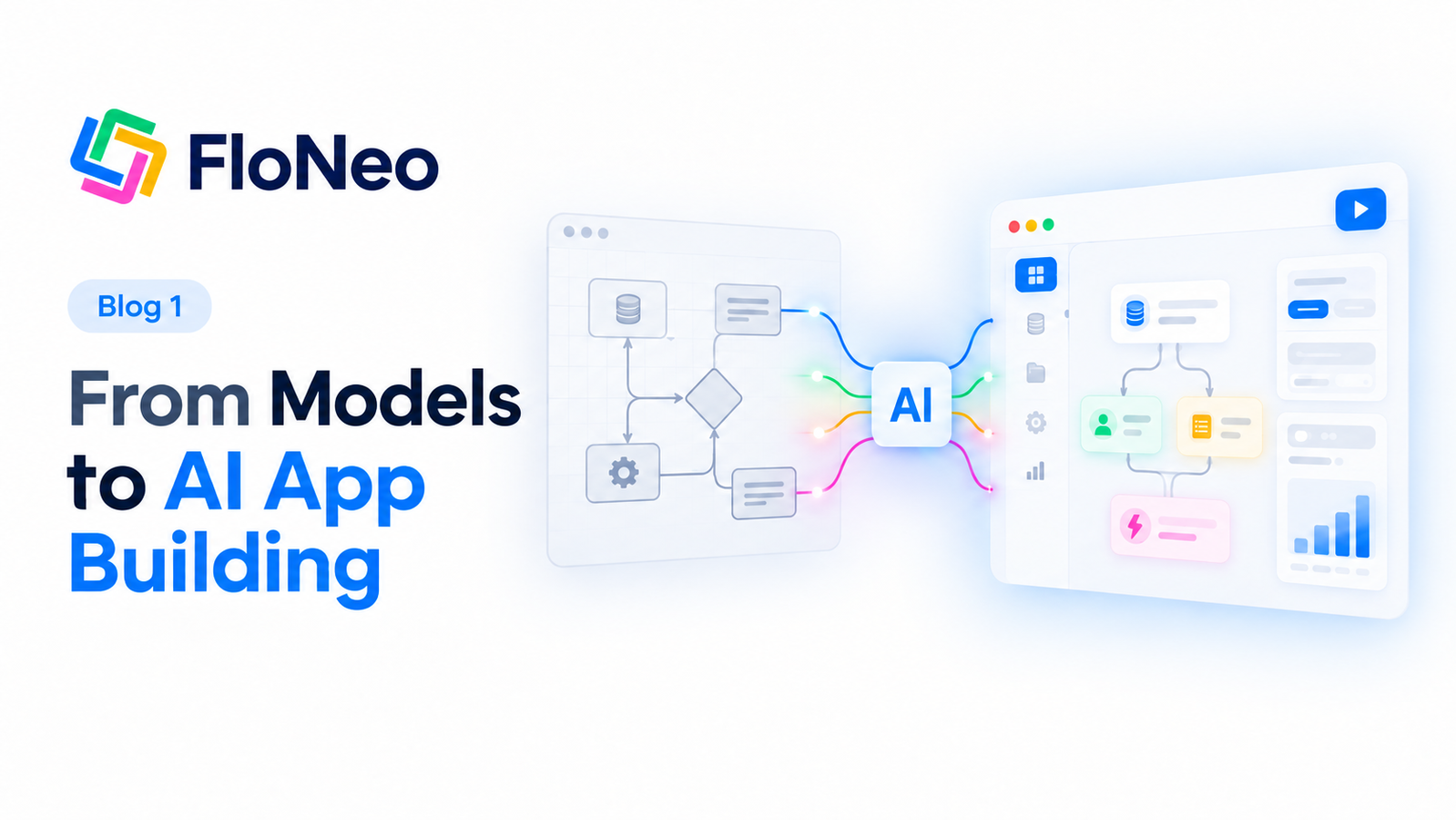
| 1 - The old idea returns | We Tried to Build Apps From Models 25 Years Ago. AI Changes What Was Missing. | Natural language may finally make model-driven application thinking accessible. |
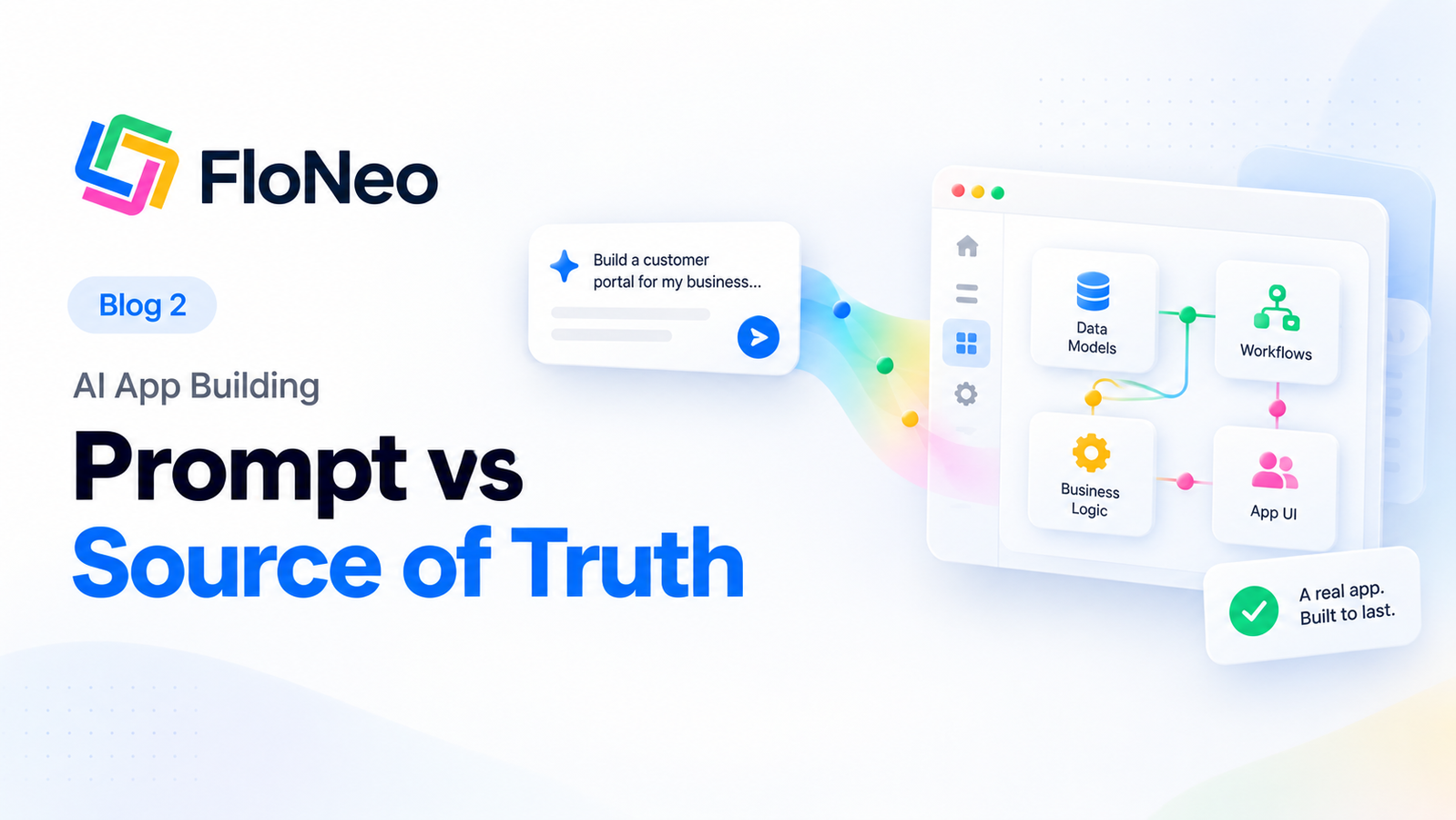
| 2 - The source-of-truth problem | AI-App Building: The Prompt vs The Source of Truth | Conversation is useful for expressing intent, but serious applications need durable structured truth. |
| 3 - The FloNeo thesis | The Future of Building Apps: Describe the Intent. Control the System. | Ask Neo, visible structure, direct controls, LTNC, and controlled change turn intent into a system users can keep evolving. |
Editorial note: Replace Part 1 and Part 2 placeholders with their real live URLs after publication.
Related Reading
- FloNeo: How FloNeo's 4-Layer Architecture Makes AI Prototyping Ultra-Affordable
- Series Part 1: We Tried to Build Apps From Models 25 Years Ago. AI Changes What Was Missing.
Add live URL after publication. - Series Part 2: AI-App Building: The Prompt vs The Source of Truth
Add live URL after publication.