
The Best AI Agent Knows When Not to Use AI
More AI is not automatically better. The smartest agent knows when reasoning adds value and when direct control is faster and cheaper.
Aayush5 min read
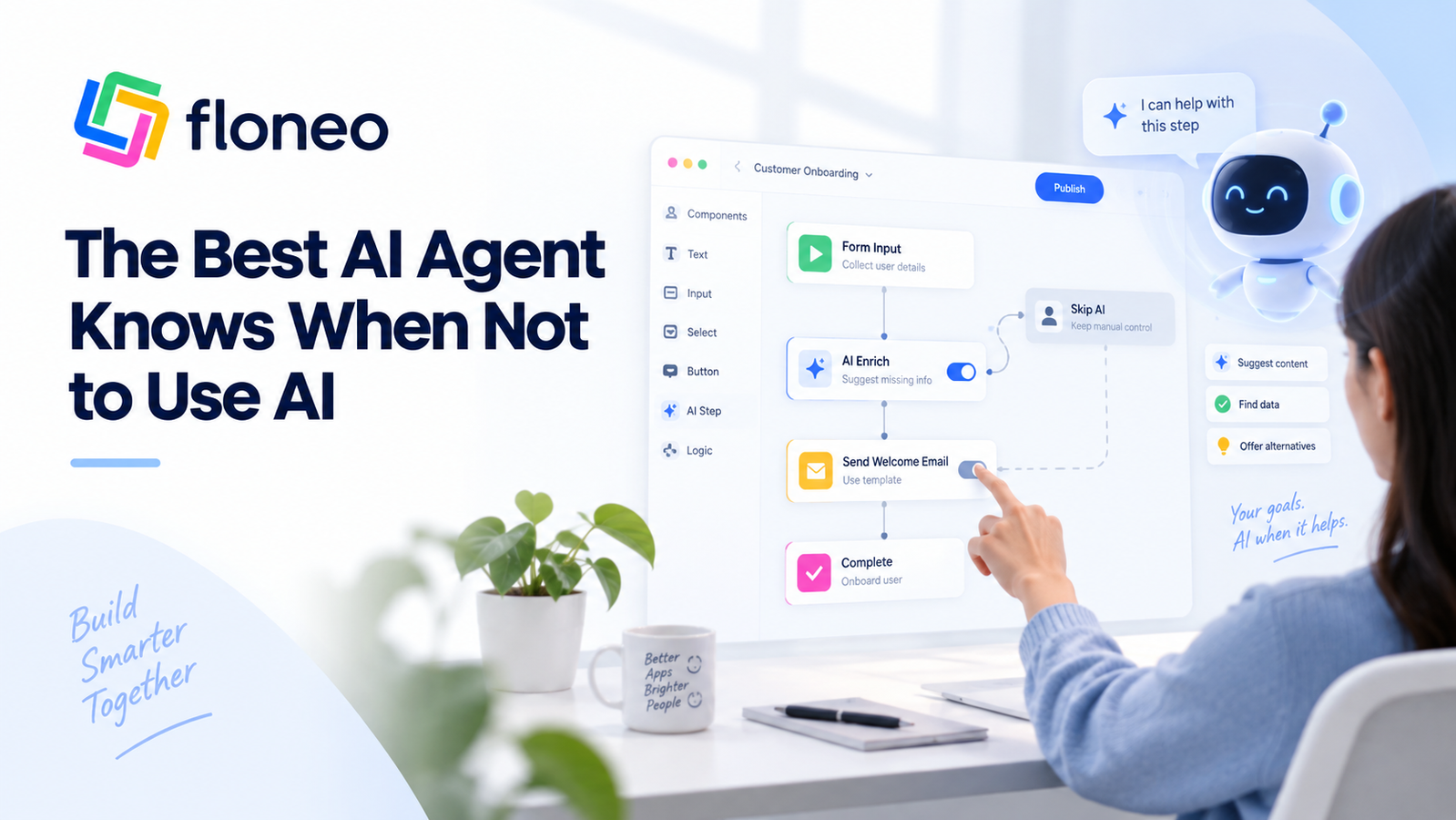
There is a strange assumption creeping into the AI world: If AI can do something, AI should do it. Want to move a button? Ask the agent. Want to rename a field? Ask the agent. Want to change the colour of a card? Ask the agent. But that’s not true. Not everything needs AI.
Consider two requests:
Make the checkout flow work for international customers.
Move the checkout button 20 pixels lower.
The first requires thinking. The second doesn't. If the user already knows what they want, making them explain it to an AI is an unnecessary middleman. Anthropic's guidance on building effective agents makes a similar point: agents are most useful when a task requires flexibility and model-driven decision-making, while simpler, predictable workflows can remain deterministic. So, the focus should really be on - “Where does AI actually add value?”
The Hidden Cost of “AI for Everything”
Using AI for everything comes at a price. Every time an AI agent gets involved, something has to happen.
- It has to interpret the request.
- It may need to inspect context.
- It may reason through possible actions.
- It may call tools.
- It may generate an output.
- And you may still need to check whether it did what you meant.
There is also a real economic reason to care. Agentic systems can involve multiple model calls and longer workflows, and Gartner predicts that AI inference costs per agentic workflow will increase more than fivefold through 2028 as AI products take on more complex, multistep work.
The ideal (and logical) approach should be
Use AI when intelligence is needed. Don't use AI when it isn't.
| If the task is... | The better approach is... |
|---|---|
| Move a component | Direct editing |
| Change text | Direct editing |
| Add a known field | Direct editing |
| Change a known rule | Direct configuration |
| Decide how a workflow should work | AI reasoning |
| Understand an ambiguous request | AI reasoning |
| Make changes across several connected parts | Agentic action |
This Is Where LTNC Comes From
This is the idea behind Low Token No Code AI agent design. The goal isn't to remove AI from app building. It is to stop treating AI as the default interface for everything.
FloNeo's approach is built around a simple distinction: describe and generate when you need help creating something; once the result exists, edit what you already understand directly. Its product documentation explicitly positions visual editing as a way to make changes without another AI generation or unnecessary credit usage.
Think of building an app in three situations.
1. You know exactly what to do
Say, you want to rename a button. Don't ask AI. Just change it yourself.
2. You know what you want, but not how to get there
You want to redesign a checkout experience but aren't sure which screens, fields, or workflows need to change.
Ask Neo.
It can reason about the problem and help you work through it.
3. You know the outcome, but it involves many connected changes
You want to introduce a new customer approval process across the app.
Now the AI has a bigger job: understand the request, identify the relevant parts, plan the changes, and execute them within the appropriate boundaries.
This is where an agent earns its place.
From AI-Powered to AI-Optimised
This is ultimately what Low Token No Code AI agent thinking is trying to solve. It’s designed to use fewer tokens, yes. But it also helps build a better relationship between human control and AI reasoning.
Our benchmark for a good agent is: Can the agent recognise when it shouldn't act?
Microsoft's current agent architecture guidance makes a similar distinction between dynamic, AI-driven flows and deterministic ones. Its workflow guidance describes the practical middle ground: keep the overall process controlled while using agents for the parts that actually benefit from reasoning.
That is a much more useful definition of intelligence. A good assistant doesn't interrupt you every time you pick up a pen. It knows when to help.It knows when to wait. And it knows when you already have the answer.
References & Further Reading
- Anthropic. Building effective agents.
- Gartner. AI inference costs per agentic workflow will increase more than fivefold through 2028.
- Microsoft Learn. Workflows: the intelligence spectrum.
- FloNeo. How FloNeo's 4-Layer Architecture Makes AI Prototyping Ultra-Affordable.
Related FloNeo Reading
Editorial note: Replace cross-links to the other Week 4 articles with their live URLs after publication. Do not publish guessed URLs.