
The AI Partner We Were Promised in 1960 Is Finally Arriving
The original vision of computing was partnership, not replacement. See why AI co-builders may finally make that 1960 idea practical.
Aayush5 min read
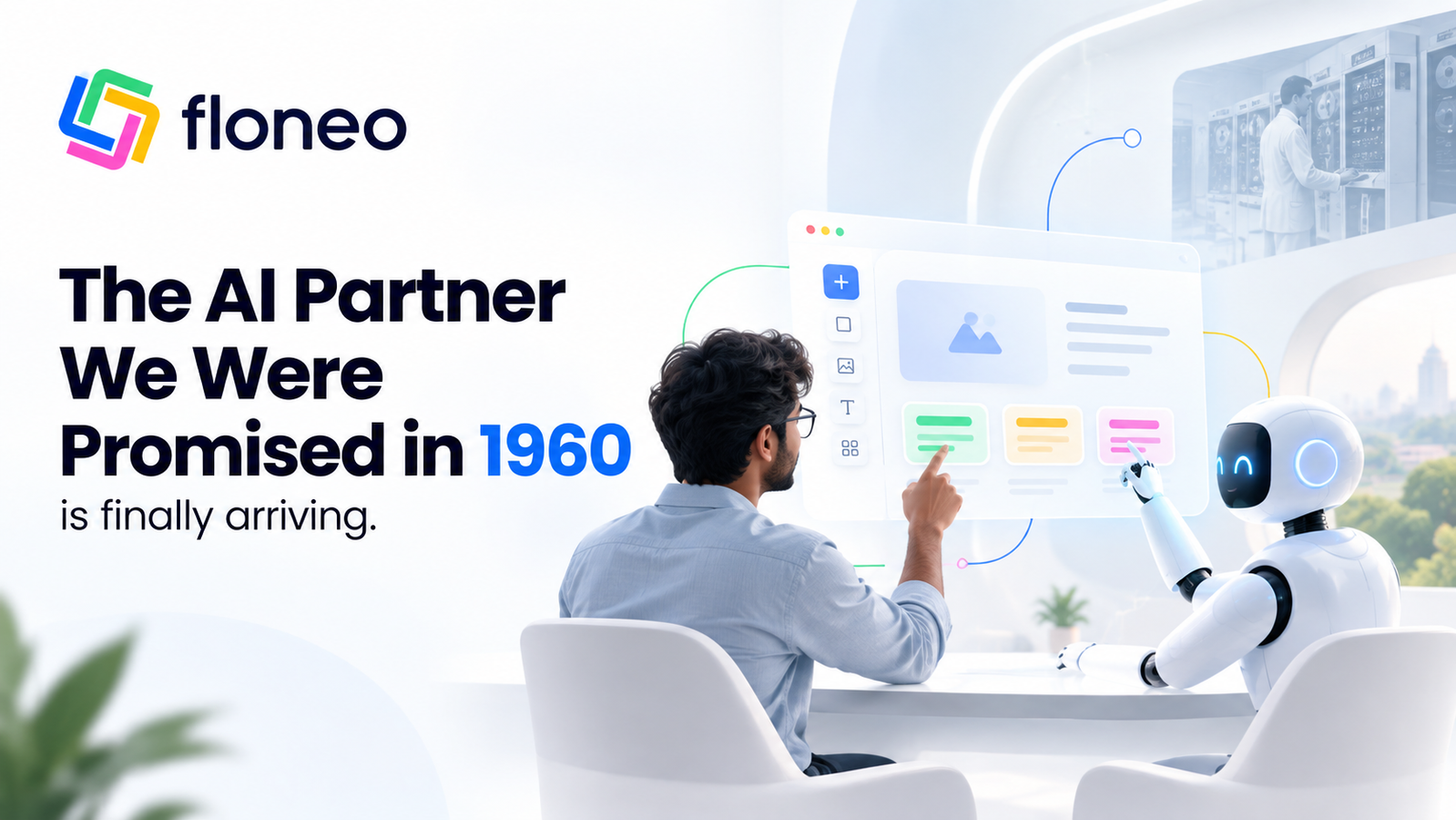
For decades, we have imagined AI as a replacement for human work. But what if we got the original idea wrong? In 1960, computer scientist J.C.R. Licklider imagined something very different: man-computer symbiosis. Humans and computers would work closely together, each contributing what the other did best. Humans would set goals and make judgments; computers would handle the work they were better suited to perform.
Two years later, Douglas Engelbart took the idea further with Augmenting Human Intellect. His goal wasn't to make computers replace human intelligence. It was to help people understand complex problems faster, develop better solutions, and tackle problems that previously seemed too difficult.
More than six decades later, AI may finally be giving us the technology to build what they envisioned. Not an AI that replaces the builder. But AI that builds with them.
Automation Wasn’t The Original Dream
The original ideas were quite logical: computers will handle the routinizable work while humans remain responsible for goals, hypotheses, criteria and evaluation. The computer wasn't supposed to make every decision. It was supposed to make human thinking more effective. Within that context, the next big direction should be going from chatbots to co-workers.
The first wave of generative AI largely gave us a conversational interface.
Ask a question. Get an answer.
Ask a follow-up. Start again.
Agentic AI is changing that model.
Agents can increasingly use tools, maintain state, work across multiple steps and act on behalf of users. Google, for example, has been pushing agentic capabilities from search and coding toward systems that can reason and take action across tasks.
Microsoft's Foundry platform now includes procedural memory designed to help agents remember how work gets done, not merely what was said. An agent can learn successful execution patterns, retrieve them for similar tasks and reuse them instead of reconstructing the process every time.
That changes the nature of the relationship.
There's a difference between an AI that remembers your last prompt and one that understands:
- how your application is structured
- which decisions you've already made
- which patterns you prefer
- what should not be changed
- and how you usually approach a particular problem. The second starts looking less like a chatbot and more like a persistent AI co-builder.
So How Will The Two Work Together?
AI-human collaboration can work in 3 modes: I do it, AI does it for me and I do it with AI.
Today's AI app builders can turn natural-language instructions into working applications at remarkable speed. But mere generation can get you stuck in a prompt-response loop. Anything you need, you must prompt again.
Your application has structure, history, design decisions, workflows and rules. Why should the AI have to rediscover all of that every time? A better AI app builder should understand the project, not just the prompt.
| Task | Best approach |
|---|---|
| Move a component or change a property | You do it |
| Think through an ambiguous change | Do it with me |
| Execute a bounded multi-step task | Do it for me |
That is much closer to Licklider's idea of symbiosis.
That’s What We’re Building with Ask Neo
This is how Ask Neo fits into FloNeo. Ask Neo isn't meant to be another chatbot sitting beside the application. It is the AI co-builder layer: a partner that understands the project, carries context forward, helps reason through changes and acts when useful.
The relationship can move between three modes:
You do it
Use FloNeo's visual controls when the change is obvious and deterministic.
Do it with me
Ask Neo helps interpret the goal, identify what will be affected, and propose the right approach.
Do it for me
When a task spans multiple components, Neo can handle a bounded sequence of changes while keeping the builder in control.
The important part is that the human chooses the level of delegation.
The AI doesn't have to take over simply because it can.
This Is What Human-AI Collaboration Could Actually Look Like
Microsoft's September 2026 Work Trend Index found that 32% of India's AI users are already "Frontier Professionals", people actively redesigning work around AI agents. Yet the same research shows that human judgment remains central: 63% prioritize quality control of AI output, while 59% rank critical thinking as a top skill.
So the question has now moved from;
"What can AI do?"
to:
"What should AI do, what should I do, and where should we work together?"
The next step isn't giving AI unlimited control. It's giving it the right role. The best AI co-builder will know what to remember, what to suggest, what to execute, what to ask permission for—and when to get out of the way.
That's not AI replacing the builder.
It's something more useful.
AI with the builder.
References & Further Reading
- J.C.R. Licklider. Man-Computer Symbiosis.
- Doug Engelbart Institute. Augmenting Human Intellect: A Conceptual Framework.
- Google. Google I/O 2026: agentic capabilities and Antigravity.
- Microsoft Foundry. Making agent memory more reliable, transparent, and production-ready.
- Microsoft. India's AI advantage is human: Work Trend Index 2026.
- FloNeo. How FloNeo's 4-Layer Architecture Makes AI Prototyping Ultra-Affordable.
Related FloNeo Reading
Editorial note: Replace cross-links to the other Week 4 articles with their live URLs after publication. Do not publish guessed URLs.