
History Is Repeating Itself: AI Agents Shouldn't Make RPA's Biggest Mistake
A 1990 warning about automation explains one of AI agents' biggest risks today: making a broken business process move faster.
Aayush4 min read
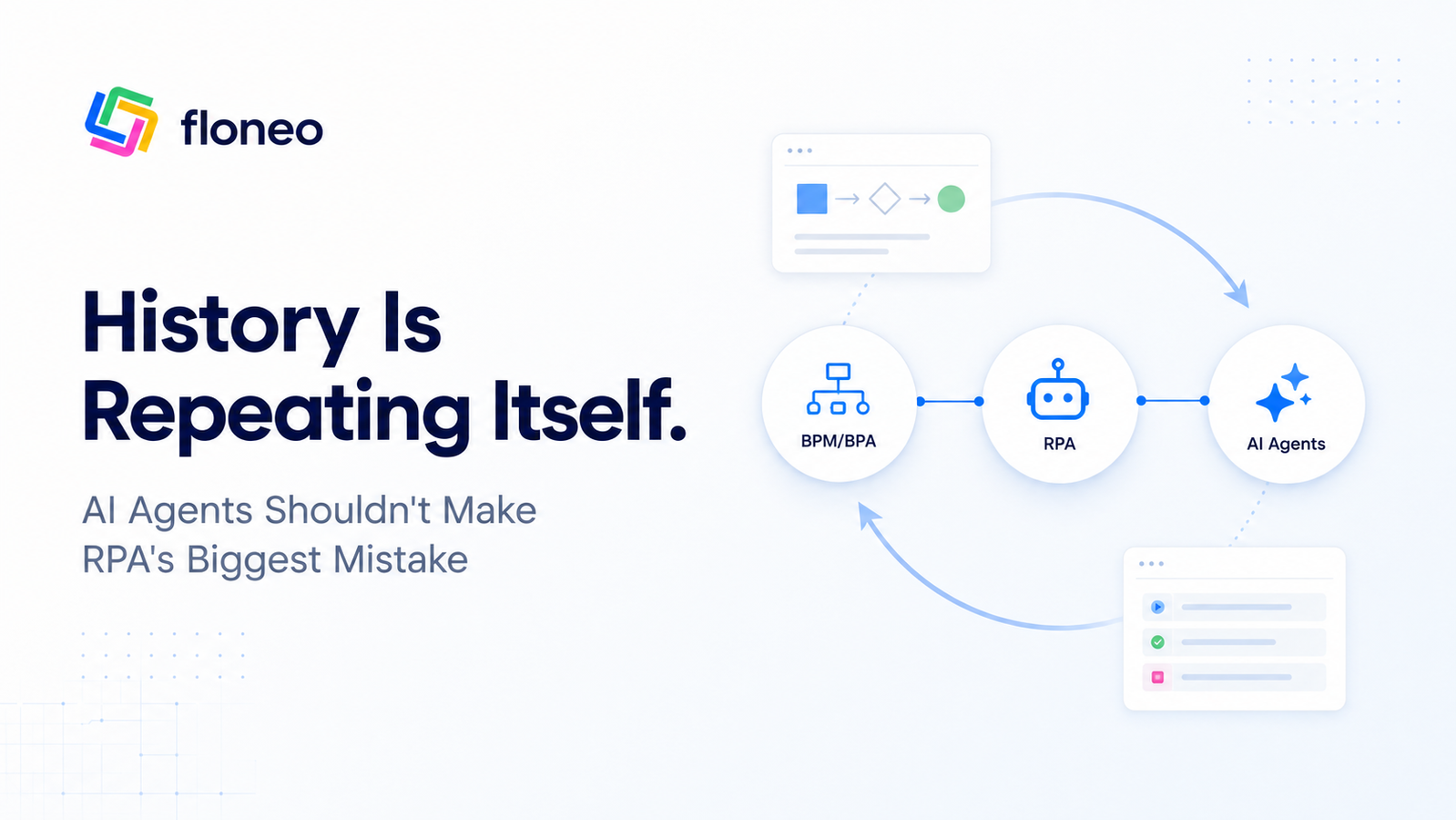
Enterprise automation has gone through several waves.
| Era | What technology promised | The risk |
|---|---|---|
| BPM / BPA | Digitise and coordinate business processes | Digitising inefficient processes |
| RPA | Automate repetitive computer tasks | Automating tasks without transforming the process |
| AI agents | Reason, decide, and act across systems | Giving autonomy to processes that were never redesigned |
RPA is particularly effective at structured, repetitive UI work. Gartner's 2026 research still describes RPA as a cost-effective and reliable technology for automating UI interactions in task-based workflows. [2]
The problem begins when task automation is mistaken for process transformation.
Traditional RPA generally works best when the instructions are known:
- Open the application.
- Find the record.
- Copy the value.
- Paste it into another system.
- Submit.
AI agents can operate in a much less predictable environment. They can interpret information, choose between actions, work with tools, and handle some exceptions.
But intelligence at the task level does not automatically create intelligence at the process level.
An AI agent could potentially read documents, assess information, route cases, and recommend decisions.
But what if the process itself contains three unnecessary approvals?
What if the same information is collected twice?
What if half the exceptions exist only because an old policy was never revisited?
What's the Way to Go Then?
Hammer's 1990 argument gives us a simple direction:
Companies should use technology to redesign work, rather than simply mechanise existing ways of doing it.
In his view, many business rules and workflows were inherited from conditions that no longer existed. [1]
That idea has surprising relevance in the agentic era.
Today, a company might look at a workflow and ask:
"Where can we put an AI agent?"
Instead, a better first question is:
"What should this workflow look like if we were designing it today?"
That changes the exercise completely.
Before automating a process, businesses should ask:
- Which steps actually create value?
- Which steps exist because of historical constraints?
- Where are humans genuinely needed?
- Where are decisions deterministic?
- Where does judgment add value?
- Which handoffs can disappear?
- What information should move automatically?
- What requires approval or accountability?
Sometimes the best automation is the step you remove completely.
The Market Is Moving Toward the Process Layer
In February 2026, Gartner published research explicitly titled "Understand Your Processes Before Investing in Agentic Automation," reflecting the growing need to determine what kind of process orchestration is required before deploying agents. [3]
Deloitte's agentic-AI research makes a similar argument: leading organisations are redesigning end-to-end processes around the strengths of agents rather than simply layering agents onto existing workflows. [4]
UiPath recently introduced Maestro Flow, a developer-oriented orchestration canvas designed to let coding agents build, run, observe, and govern complete business processes as a single artifact. Its underlying Maestro runtime coordinates processes involving agents, people, enterprise systems, and existing automations while maintaining process state and auditability. [5][6]
The industry is moving from:
"What can this agent do?"
Toward:
"How does this agent operate as part of a real business process?"
The Future Is Hybrid, Not "AI Everywhere"
The next stage of automation will not necessarily eliminate the technologies that came before it.
Instead, the strongest processes will use each technology where it makes sense.
| Need | Best-fit approach |
|---|---|
| Predictable UI task | RPA |
| Direct system-to-system action | API |
| Ambiguous reasoning or interpretation | AI agent |
| Accountability or sensitive judgment | Human |
| Coordinating all of the above | Process / workflow layer |
This is what makes agentic BPA - Business Process Automation interesting.
The goal is not to replace every bot with an agent. It is to give humans, agents, RPA, APIs, data, and applications a coherent place within the same process.
The Process May Become the Real AI Moat
The key thing to remember is that the business process is harder to replace.
Consider how an organisation handles:
- customer onboarding;
- claims;
- procurement;
- lead routing;
- order exceptions;
- approvals.
Those processes contain the organisation's rules, data relationships, decisions, handoffs, and institutional knowledge.
The winning organisations will not simply have the smartest agents.
They will know where those agents belong, what they are allowed to do, what they should hand back to humans, and how their actions fit into the larger workflow.
What This Means for Building Business Applications
This is where a process-first approach becomes important for application builders like FloNeo.
Making the pieces underneath an app visible and directly controllable changes how teams think about automation.
Instead of asking AI to generate an entire application and then treating the result as fixed, teams can think in terms of a living process:
UI + data + workflows + rules + AI / human actions
AI belongs where intelligence is needed.
Visual workflows belong where the rule is already known.
People remain part of the process where judgment and accountability matter.
FloNeo's core philosophy remains:
Technology should not preserve a bad process simply because it can automate it. It should give us the ability to build a better one.
This also connects to FloNeo's earlier architecture work. How FloNeo's 4-Layer Architecture Makes AI Prototyping Ultra-Affordable explains why modular structure, controlled context, and incremental change matter when AI becomes part of an application-building system.
Don't Just Automate the Task. Build the Process.
The automation industry has spent decades making machines better at executing work.
Now AI is making machines better at reasoning about work.
But neither answers the most important question:
Should the work happen this way at all?
That question belongs at the process layer.
History is repeating itself.
The technology is once again powerful enough to make bad processes move faster.
The opportunity this time is to do something different.
Don't automate a broken task with a smarter agent. Build the process so humans, AI, data, and workflows know exactly where they belong.
Next in the Series
Part 2: The Next AI Gold Rush Isn't Agents. It's the Process Layer They Run On.
Part 2 looks at why the orchestration layer - the layer that maintains state, routes work, coordinates agents and people, and records outcomes - may become the durable layer of enterprise AI.
Editorial note: Add the live Part 2 URL after publication. Do not publish a guessed URL.
References
- Harvard Business Review. Reengineering Work: Don't Automate, Obliterate, July-August 1990.
- Gartner. Magic Quadrant for Robotic Process Automation, 24 June 2026.
- Gartner. Understand Your Processes Before Investing in Agentic Automation, 10 February 2026.
- Deloitte Insights. The agentic reality check: Preparing for a silicon-based workforce.
- UiPath. Maestro Flow: a developer canvas that keeps agent-built work legible, 19 August 2026.
- UiPath. UiPath Introduces UiPath Maestro Flow, 19 August 2026.
- FloNeo. How FloNeo's 4-Layer Architecture Makes AI Prototyping Ultra-Affordable.