
AI-App Building: The Prompt vs The Source of Truth
Prompts are excellent for expressing intent but poor at preserving a serious application's decisions. The next AI builders need a source of truth beyond chat.
Aayush1 min read
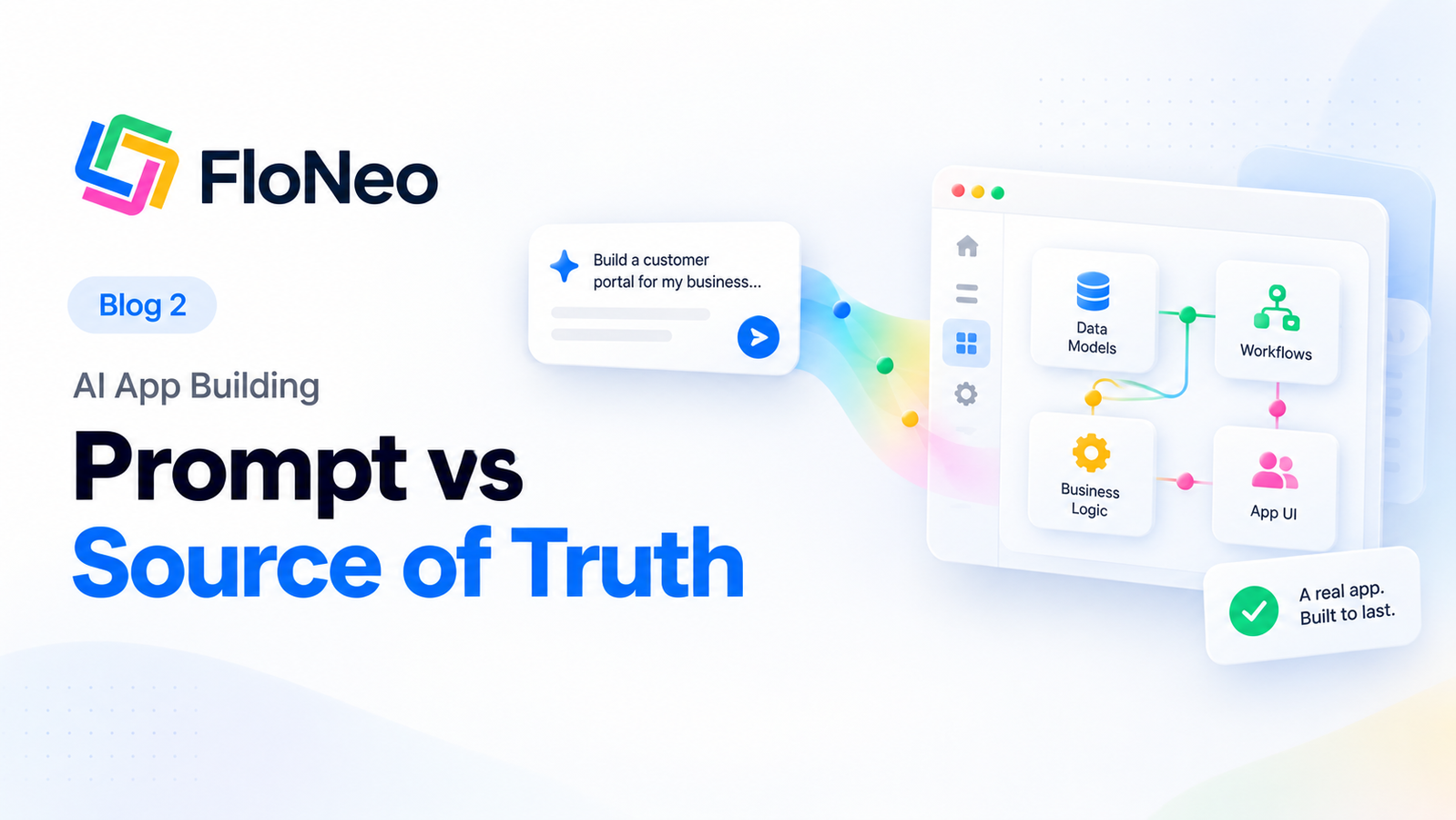
Your entire app cannot live inside a conversation.
Part 2 of 3 - The Source of Truth
The first generation of AI app builders made prompt-to-app generation feel almost magical. That interaction is excellent for getting started. But the longer an application lives, the more dangerous it becomes to treat conversation history as the place where the application's meaning is stored.
Prompt-First Development Works - Until the App Grows Up
You describe what you want.
The AI generates an interface.
You ask for changes.
It changes the interface.
You keep prompting until something looks right.
For a prototype, this can be remarkably effective.
Now imagine building the same way six months later.
Your application has:
- 40 screens;
- a database;
- multiple user roles;
- payment logic;
- approval workflows; and
- dozens of business rules.
Then someone asks:
"Why does this approval workflow work this way?"
Where is the answer?
In the database?
The workflow?
The code?
A product document?
Or somewhere inside a 200-message conversation from three months ago?
That is the problem prompt-first development eventually runs into.
The prompt is a great way to express intent. It is a terrible place to store the complete truth about an application.
Prompts Aren't the Same as Specifications
The problem is not simply that AI may forget a conversation.
The deeper problem is that conversation is not a structured representation of the application.
Microsoft's June 2026 work on Spec-Driven Development argues that prompt-first workflows can break down as complexity increases because requirements, constraints, acceptance criteria, and edge cases living in scattered prompts do not provide a durable source of truth. The proposed alternative is a structured specification shared by humans and AI. [1]
There is an important difference between a prompt and a specification.
A prompt might say:
"Build an expense management app with manager approvals."
A specification needs to answer the decisions hiding inside that sentence:
- Who counts as a manager?
- Can managers approve their own expenses?
- What happens when an expense is rejected?
- Which expenses require additional approval?
- Who can view approved expenses?
- What happens if an approver is unavailable?
- What does "approved" actually mean?
The longer an application lives, the more of these decisions accumulate.
A conversation records what was said.
It does not necessarily record what was finally decided.
Microsoft Is Changing the Workflow
Microsoft's own engineering teams have been experimenting with what happens when AI becomes part of the software-development lifecycle instead of merely becoming a faster code generator.
In September 2026, Microsoft Digital described its move toward spec-driven development after discovering that improving individual developer productivity did not automatically produce equivalent team productivity. The organisation shifted toward a living specification that preserves business intent and acceptance criteria before and throughout implementation. [2]
The workflow is increasingly structured around stages such as:
Define intent -> Specify -> Clarify -> Plan -> Implement -> Validate
That introduces structured thinking before and around generation.
It gives teams something they can inspect when the question changes from:
"Can AI build this?"
into:
"Did AI build what we actually agreed to build?"
How Are AI-App Builders Responding?
Lovable: Plan Before Implementation
Lovable's Plan mode gives users a place to work through questions, explore ideas, and map features before code is written. Its 2026 product updates describe more detailed planning before implementation, including plans that users can inspect and refine. Lovable also introduced on-demand automated testing across frontend and backend behavior. [3]
The important change is not merely that Lovable added another feature.
It is that planning became a product surface.
The system does not have to jump directly from prompt to code.
There is now a visible layer in between.
Replit: Planning Becomes Part of the Build
Replit Agent 4 takes a different approach.
Replit moved from a sequential plan-then-build model toward plan-while-building. Plans can create tasks that execute in isolated environments while the main project continues. Results do not touch the main project until the user explicitly approves them. [4]
Replit also replaced its older Design Mode with a Design Canvas that brings live previews, visual exploration, and direct manipulation into the same building environment. [4]
The common thread is clear:
The interface around AI is becoming more structured.
This Is Bigger Than Just "Planning"
It would be easy to look at these changes and conclude that AI builders simply need better planning features.
The deeper shift is about where the application's truth lives.
Every time an agent receives an instruction, it interprets it.
If the only durable context is conversation history, interpretation happens repeatedly.
That creates room for loss in translation.
At the same time, prompts are not going anywhere.
They remain one of the easiest ways to tell an AI what you want.
The change is what happens after you say it.
What a Serious Application Needs to Preserve
| What needs to survive | Why |
|---|---|
| Requirements | What the application is supposed to accomplish |
| Decisions | What was agreed when ambiguity existed |
| Constraints | What AI must not change |
| Data model | What information the application depends on |
| Workflows | How business processes actually work |
| Permissions | Who can do what |
| Acceptance criteria | What "correct" means |
| Tests | Whether implementation still behaves correctly |
That information needs to live somewhere more durable than the latest message in a chat thread.
The Winning Interface May Sit Between Chat and the App
Going forward, the winning interface may not simply be a bigger chat box.
It may be the layer sitting between conversation and application:
Intent -> Structured Decisions -> App Model -> Implementation -> Validation
That is where:
- intent becomes structured;
- decisions become visible;
- constraints become enforceable;
- workflows become inspectable;
- acceptance criteria become testable; and
- AI has something more durable to work from than its own conversation history.
This also changes the user's relationship with the application.
The user should not need to ask AI to explain the entire system back to them every time they return.
They should be able to see the application itself.
Where FloNeo Fits
FloNeo's direction is based on the same distinction:
The prompt is an entry point. The application remains the thing you control.
Ask Neo can help interpret what the user wants.
But once the application exists, the user should be able to see and work directly with:
- UI;
- database;
- workflows;
- properties; and
- application structure.
This is also where LTNC - Low Token No Code becomes important.
If the user already knows exactly what needs to change, the application should not require another reasoning loop simply to express a decision that is already clear.
Use AI where intelligence adds value.
Use direct controls where the source of truth is already visible.
FloNeo's 4-layer architecture article explains the architectural version of the same principle: reduce unnecessary context, structure applications modularly, route work intelligently, and patch only what needs to change.
The future of app building may therefore be less about perfecting the prompt and more about what the system does with intent after the prompt is gone.
A prompt tells AI what you want. A source of truth preserves what the application actually is.
Next in the Series
Part 3: The Future of Building Apps: Describe the Intent. Control the System.
Part 3 brings the argument together around the future interaction model: prompts as the front door, visible application structure as the source of truth, and AI + direct manipulation working inside the same system.
Editorial note: Add the live Part 1 and Part 3 URLs when published. Do not publish guessed URLs.
References
- Microsoft for Developers. Spec-Driven Development: A Spec-First Approach to AI-Native Engineering, 10 June 2026.
- Microsoft Digital. Engineering the Frontier Firm: Sharing our AI-native approach to software development, 3 September 2026.
- Lovable. Build more. Manage less., 28 January 2026.
- Replit. What's changed from Replit Agent 3 to Agent 4, 19 March 2026.
- FloNeo. How FloNeo's 4-Layer Architecture Makes AI Prototyping Ultra-Affordable.