
The Next AI App Builder Won't Win With More Prompts. It Will Win With Better Control.
Our five-tool benchmark points to the same conclusion: users need smart guidance, direct editing, clear readiness and reliable publishing - not more prompting.
Azhab NS
Users do not want to have another conversation with the AI every time they already know exactly what they want.
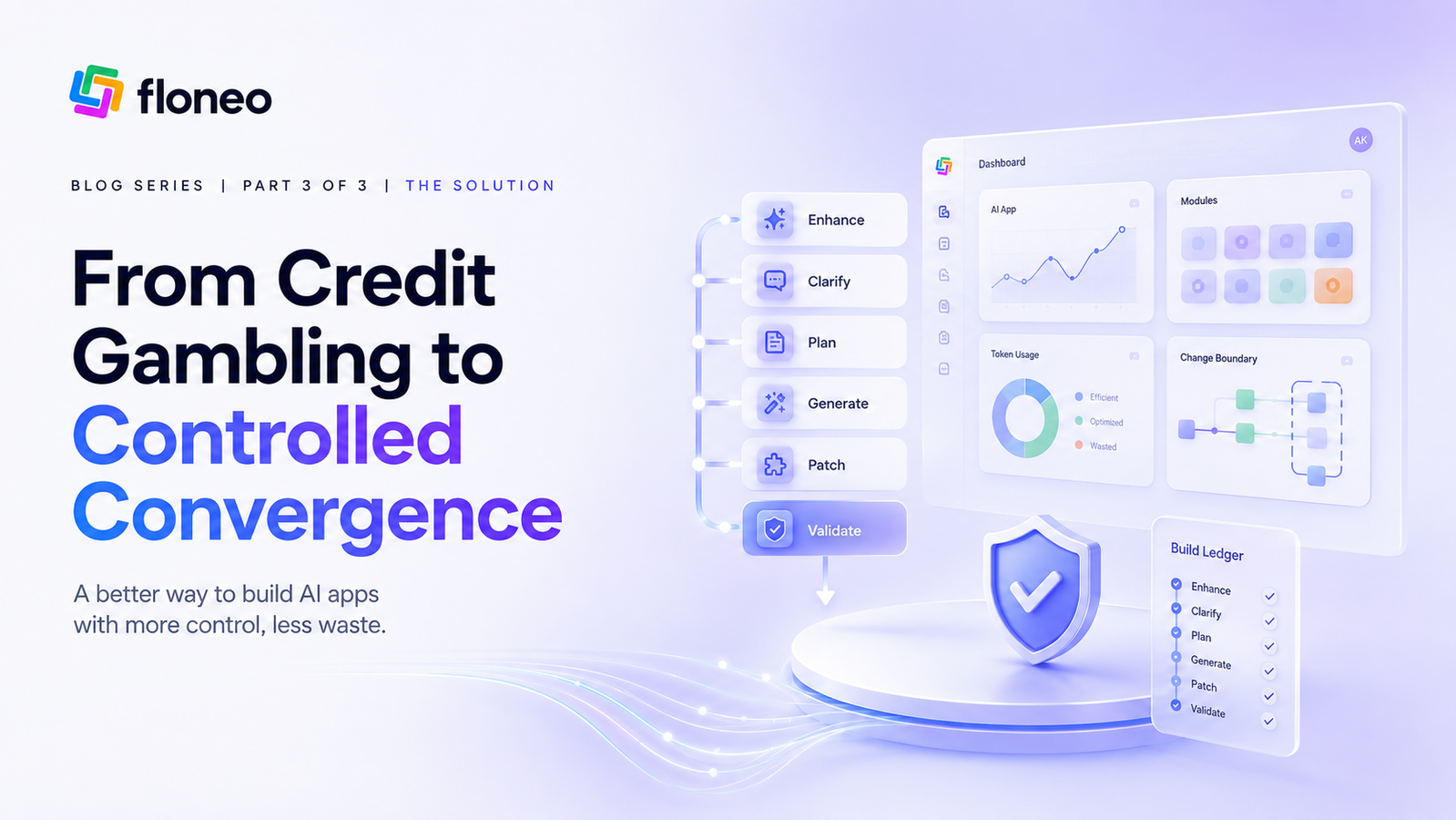
Part 3 of 3: The Product Thesis
Part 1 showed what happened when five AI app builders received the same prompt. Part 2 showed why a polished result can still hide an unfinished product. The final question is the useful one: what should a better AI app-building experience actually do differently?
The category does not need another prompt box
Every product in our test could take a short request and move toward a visual application.
That is no longer the interesting part.
The category has already established a baseline:
- prompt to UI;
- responsive-layout ambition;
- placeholder content;
- iterative chat edits;
- preview-first building;
- polished visuals;
- deployment ambition;
- editable code or structure.
So "we generate apps with AI" is not a strong position anymore.
The better question is:
What happens between the user's idea and a dependable published result?
That is where the products in our test behaved very differently.
We do not want to copy one competitor
The competitive review gave us a clearer answer than a feature wishlist.
Take the strongest behaviour from each experience.
From Emergent: guided discovery without interrogation
Emergent had the most comfortable questioning flow in the test.
The important detail was not simply that it asked questions.
It offered auto-answer.
That changes the feeling of the product.
A builder should surface important ambiguity without forcing the user to become a requirements analyst.
The rule for FloNeo is:
Ask smart questions, but always give the user a fast path through them.
Questions should exist because the answer changes the build, not because the agent wants to keep talking.
From Lovable: a visible plan before the expensive work
Lovable's strongest product behaviour was formal plan approval before generation.
That creates a control point.
The user can see the direction before the system commits to it.
For FloNeo, the planning layer should make the important structure visible:
- pages;
- components;
- entities;
- data;
- roles;
- workflows;
- integrations;
- assumptions;
- publish target.
The user should be able to approve, edit or remove scope.
The rule is:
Do not spend heavily on a build the user has not agreed to.
From Base44: speed plus direct visual editing
Base44 was the fastest product in our controlled test and one of the strongest first-look UIs.
But the most important behaviour for FloNeo was the visual editing.
Text and font changes could be made without returning to the prompt.
That sounds small.
It is actually central to LTNC - Low Token No Code.
If the user already knows:
- move this;
- change this text;
- reduce spacing;
- change the font;
- resize the component;
then asking an LLM to reinterpret the request is waste.
The rule is:
AI should create the first draft. Known edits should become direct manipulation.
This is how output stays editable without turning every correction into token consumption.
From Replit: developer control and code visibility
Replit was the least preferred experience for this simple test, mainly because publishing failed and the environment felt heavier than the task required.
But its developer depth was the strongest.
Real code.
Logs.
Git.
Checkpoints.
Database.
Authentication.
Security controls.
That matters because no-code should not become a dead end.
FloNeo should feel non-technical when the user wants a non-technical experience, but it also needs depth when a project grows.
The rule is:
Hide unnecessary complexity. Do not remove the escape hatch.
From the failures: publishing has to be part of the product
Kimi's blank preview and Replit's publish failure taught the same lesson in different ways.
The user does not experience "generation," "dependency resolution," "preview" and "deployment" as separate products.
They experience one promise:
"Build this for me."
So publishing cannot be treated as an external last-mile problem.
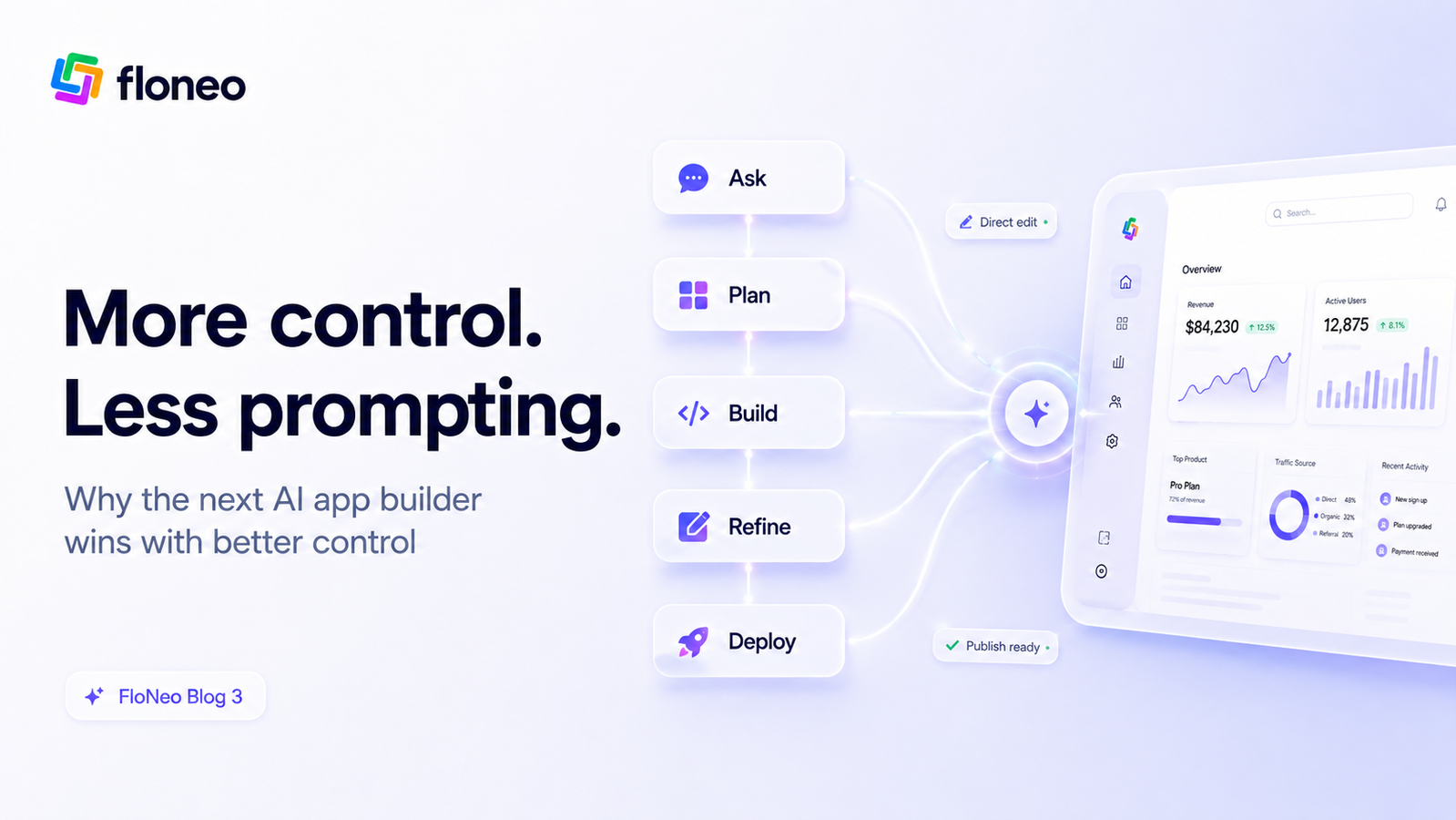
FloNeo's target flow from the review is deliberately simple:
Ask -> Plan -> Build -> Refine -> Deploy
The publish state should be clear.
The user should know:
- what is ready;
- what failed;
- what is still simulated;
- what requires action;
- whether deployment is healthy.
The rule is:
Deployment is part of the build, not a handoff after the build.
The eight visible FloNeo V2 principles
The competitive review distilled the product direction into eight principles.
1. Ask smart questions
Clarify the decisions that change the result.
Do not ask for information that the system can safely infer.
Always offer auto-answer where possible.
2. Show the plan
Let the user approve the direction before generation.
Planning is not a delay.
It is a control surface.
3. Generate fast
Speed matters.
But the review also gave us the rule:
Speed should not reduce reliability.
A two-minute build is useful only if it does not create a 30-minute repair.
4. Edit visually
Text, font, spacing, components and other supported UI properties should be editable without another prompt.
This is where LTNC becomes visible to the user.
5. Publish reliably
Deployment must be part of the product experience.
A successful build with failed publishing is unfinished.
6. Show token usage
Cost should be visible before it becomes a surprise.
The user needs to know what an action is likely to consume and what it actually consumed.
7. Keep the output editable
AI output should become normal FloNeo canvas elements, not a fragile artefact that can only be changed by prompting the model again.
8. Show readiness
Separate:
- visual completion;
- functional completion;
- publish completion.
A beautiful preview should never silently imply production readiness.
The scanner adds the deeper layer
The eight principles describe what the user sees.
The handwritten evaluation framework adds what the product has to prove underneath.
That gives FloNeo two connected layers.
Experience layer
Ask -> Plan -> Build -> Refine -> Deploy
Dependability layer
Reliability -> Accuracy -> Performance -> Cost
Put together, the product standard becomes much more complete.
Reliability: do not make "publish" the end of the story
The internal notes define reliability through:
- uptime guarantees;
- dependency updates;
- failover and redundancy.
Those should not all be forced into the same promise for every use case.
A personal portfolio and a mission-critical workflow do not need the same infrastructure.
But the platform should make the class of reliability visible.
For any serious published application, the user should know:
- what availability is expected;
- how dependencies are updated;
- how failures are detected;
- whether rollback exists;
- what backup and redundancy apply;
- what responsibility still sits with the customer or external provider.
The Kimi dependency failure in our benchmark is the smallest possible example of why this matters.
The generated application inherits a technical life after generation.
Accuracy: clarification is only useful if it leads to correct behaviour
The notes call out:
- logic precision;
- prompt precision;
- output accuracy;
- customer delight score.
This suggests a better way to think about quality.
Prompt precision
Did NEO understand the requirement?
Logic precision
Did the generated workflow enforce the rule?
Output accuracy
Did the UI, states and behaviour match the approved plan?
Expectation match
Does the user agree that the application became what they intended?
These are different checks.
They should not be collapsed into "generation successful."
For a simple portfolio, expectation match may be mostly visual.
For a CRM or operational app, logic precision can matter more than visual polish.
The product should adapt the validation to the type of application being built.
Performance: generation speed is only half the metric
The benchmark measured first-build time:
- Base44 ~2 minutes;
- Lovable ~5;
- Replit ~6;
- Emergent ~7;
- Kimi ~10.
Those numbers are useful.
But the scanner reminds us to measure:
- development speed;
- heavy concurrent usage.
That leads to two separate performance questions.
Build performance
How long from idea to approved, published result?
Runtime performance
How does the application behave with the expected data volume, workflows and concurrent users?
The first is an AI-builder metric.
The second is a software metric.
FloNeo needs both.
Cost: low token should mean predictable work, not simply fewer tokens
The recommended positioning from the competitive review is:
LTNC - Low Token No Code
Generate with AI.
Refine visually.
Deploy with confidence.
The cost model is where that position becomes credible.
The notes require:
- predictable cost;
- visibility of cost burning.
FloNeo's earlier architecture article, How FloNeo's 4-Layer Architecture Makes AI Prototyping Ultra-Affordable, explains how the engine can reduce unnecessary AI work through compression, modular structure, model routing and incremental patching.
The competitive benchmark adds the interface requirements:
- show the plan;
- show the token impact;
- keep direct edits off the AI meter where possible;
- keep the output editable;
- show readiness;
- publish reliably.
This is the complete LTNC idea.
Not "use the cheapest model."
Not "use the fewest tokens."
Use AI only where intelligence adds value, and keep the rest under direct user control.
A better readiness screen
One simple way to make all of this real is to stop showing "Published" as a binary success state.
A useful readiness screen could separate:
| Area | What the user should know |
|---|---|
| Plan | Approved / changes pending |
| UI | Visual direction approved / unresolved states |
| Logic | Workflows tested / failures remaining |
| Reliability | Dependency and recovery status for the selected deployment class |
| Performance | Test profile and known limits |
| Cost | Estimated vs actual AI usage |
| Publish | Deployment healthy / degraded / failed |
| Developer depth | What can be inspected, exported or extended |
That would directly attack one of the biggest market problems from our review:
low transparency about what is truly functional versus visually simulated.
The design rule
The competitive review ended with one sentence that captures the product philosophy better than a long feature list:
The AI should create the first draft. The user should remain in control of the final product.
That is the difference between an agent that keeps generating and a builder that helps someone build.
It is also the clearest way to explain why FloNeo should not compete only on "AI app generation."
That market claim is already crowded.
The differentiation is the controlled journey:
- smart questions without question fatigue;
- visible planning;
- low-token generation;
- direct canvas editing;
- developer depth when needed;
- transparent token cost;
- honest readiness;
- dependable publishing.
Generate with AI. Refine visually. Deploy with confidence.
That is where LTNC becomes more than a pricing idea.
It becomes a product philosophy.
References and Source Notes
- FloNeo internal competitive review, August 2026. Same-prompt benchmark of Emergent, Lovable, Base44, Kimi Websites and Replit Agent, including the synthesis: guided discovery + auto-answer, visible planning + design choice, speed + visual editing, developer control + code visibility, reliable publishing and token visibility.
- FloNeo internal evaluation notes, 8 August 2026. Feature criteria plus reliability, accuracy, performance and cost-model requirements.
- FloNeo. How FloNeo's 4-Layer Architecture Makes AI Prototyping Ultra-Affordable.