
From Credit Gambling to Controlled Convergence with FloNeo
See how FloNeo turns a risky prompt-and-retry build process into a structured path with scoped changes, visible spend, and validation.
Azhab NS
How FloNeo is being designed to turn a prompt into a structured, editable, and verifiable application without making every correction another bet.
Part 3 of 3: The Solution
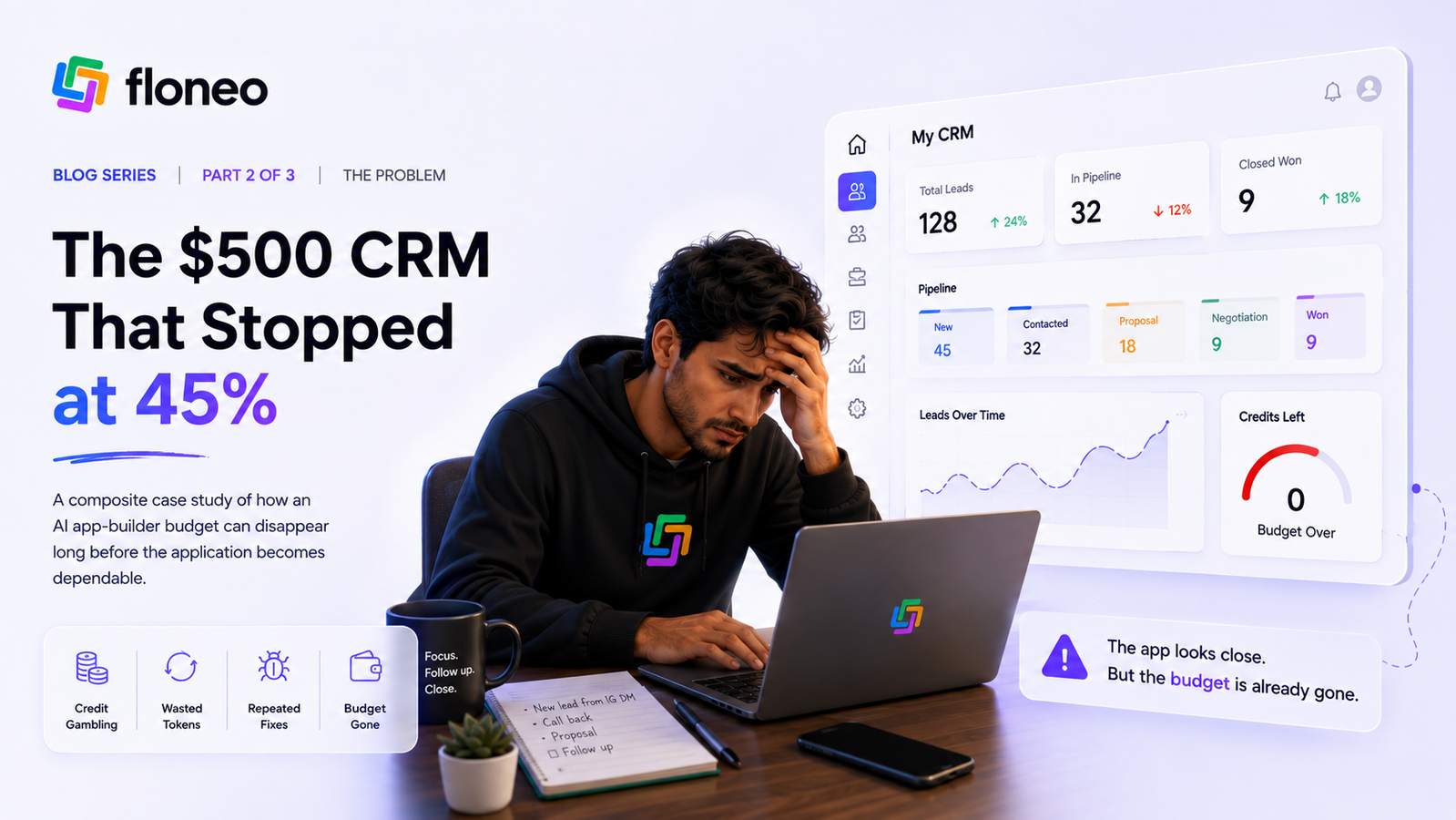
Part 1, How FloNeo's 4-Layer Architecture Makes AI Prototyping Ultra-Affordable, introduced FloNeo's four-layer architecture for reducing unnecessary AI work.Part 2, The $500 CRM That Stopped at 45%, followed Arun, a freelance consultant trying to build a CRM for leads arriving through WhatsApp, Instagram, email, referrals, and calls. His problem was not a lack of prompts. It was that every correction cost money while the distance to a dependable application remained unclear.
This final article connects the two: what changes when an AI app builder is designed to reduce uncertainty before it spends credits?
The solution is not a better first prompt
Arun's CRM did not fail because his opening prompt was badly written.
He knew what he wanted in normal human terms:
- one place for every lead;
- a visible pipeline;
- follow-up reminders;
- quotation status;
- notes;
- CSV import;
- basic reporting; and
- an assistant role he could use later.
The problem was what happened between that sentence and the generated application.
Important decisions were left implicit. Visual changes and structural changes went through the same generation loop. Later prompts had to work through a larger codebase. Fixes could touch parts of the application that were already working. The budget kept shrinking without a reliable measure of how much closer the CRM was to being usable.
That is the problem FloNeo's Low Token No Code (LTNC) direction is intended to address.
The target is not one-shot perfection.
The target is controlled convergence.
What controlled convergence means
A generated application rarely moves from 0% to 100% in one clean jump.
It converges.
The first build establishes the structure. The next decisions correct assumptions. Visual changes bring the interface closer to the user's intent. Backend rules make the application dependable. Validation closes the remaining gaps.
The question is whether that convergence is controlled or expensive guesswork.
For FloNeo, a paid AI action should do at least one of three things:
- Increase approved functionality.
- Resolve a documented uncertainty.
- Verify a defined quality requirement.
If a change can be handled more reliably through a direct visual edit, a deterministic rule, an existing component, or a validation check, it should not automatically become another broad AI generation.
The unit of value should be validated progress, not prompt volume.
A useful credit system should make four things visible:
- what is changing;
- why AI is required;
- what the expected cost range is; and
- whether the result moved the application closer to its acceptance criteria.
That is the practical idea behind Token Insurance.
It is not "unlimited AI." It is an architecture designed to prevent avoidable AI work.
How Arun's CRM should move from sentence to system
1. Enhance the request
Arun starts with a normal sentence:
"Build a CRM for my freelance business so I can track leads, follow-ups, quotations, and reminders."
FloNeo should not immediately turn that sentence into code.
The first job is to turn it into a structured brief.
That brief can identify:
- who will use the CRM;
- where leads currently come from;
- the main screens Arun expects;
- the information each lead needs;
- what must happen after a follow-up date;
- whether quotations are stored or only tracked;
- what success looks like for the first usable version.
This is where the Compression Layer from Part 1 becomes useful.
The system can separate stable project context from the current request, remove repeated explanation, and carry forward only the information required for the next task.
The goal is simple: understand more before generating more.
2. Clarify the expensive ambiguities
Some missing decisions are cheap.
The colour of a button can be changed later.
Others are expensive because they affect the data model, permissions, workflows, or backend.
Before generating Arun's CRM, NEO should ask about questions such as:
- What are the pipeline stages?
- Can the same person appear as a lead twice?
- What happens when a contact arrives through both Instagram and email?
- Who owns a lead?
- Can an assistant see quotation values?
- Who can delete records?
- When should follow-up reminders appear?
- What should happen when a reminder is missed?
- How should CSV columns map into the CRM?
- What reports actually matter to Arun?
- Does Arun want cloud deployment, export, or another deployment option?
These are not clarification questions for the sake of conversation.
They are decisions that can become expensive if the system guesses incorrectly.
In Part 2, Arun paid repeatedly to correct assumptions that should have been surfaced earlier.
Controlled convergence moves those decisions forward.
3. Show the plan before consuming the main build budget
Before implementation, Arun should be able to see what the AI app builder believes it is about to create.
For example:
Pages
- Dashboard
- Leads
- Lead Detail
- Pipeline
- Tasks
- Reports
- Settings
Core entities
- Lead
- Contact
- Task
- Pipeline Stage
- Quotation
- User
- Role
- Activity
Workflows
- Create lead
- Move lead through pipeline
- Create follow-up
- Trigger overdue state
- Import leads from CSV
- Assign lead to user
- Update quotation status
Permissions
- Admin: full access
- Assistant: restricted actions
- Record ownership rules
Arun can approve the plan, remove scope, or correct a misunderstanding before the expensive part begins.
This changes the economics of an AI CRM builder.
Instead of discovering scope through generated screens, the user agrees on the structure first.
4. Generate a modular application, not one large code dump
A CRM is not one thing.
It is a collection of connected objects and rules.
FloNeo's modular layer should make those objects addressable:
Lead
Contact
Task
PipelineStage
Quotation
DashboardWidget
User
Role
Permission
ImportMapping
Activity
That matters because later changes can then target the object they actually affect.
If Arun changes a follow-up rule, the system should not need to reconsider the entire application.
If he changes who can delete a lead, the request belongs to the permission model.
If he changes the order of two fields on the lead form, that is a UI change.
This is the difference between treating an application as a single generated artefact and treating it as a structured source of truth.
5. Put the first draft on a visual canvas
The first generated version will not match Arun's taste perfectly.
That is normal.
He may want:
- less spacing;
- smaller buttons;
- a different sidebar;
- a cleaner lead card;
- fewer dashboard widgets;
- another font size;
- different colours;
- a mobile layout adjustment.
Those changes should not require Arun to type:
"Make the dashboard slightly more minimal."
Then wait for a model to reinterpret the page.
Then pay for the generation.
Then check whether something else changed.
FloNeo's visual app builder is meant to give the user direct control over supported UI properties.
A reasoning model should not be paid to behave like a mouse.
Visual editing is one of the clearest places where an LTNC architecture can save tokens without reducing capability.
6. Patch logic at the smallest useful boundary
Now Arun asks:
"My assistant should be able to update a lead, but not delete it or see quotation values."
That is not a design request.
It touches:
- the Assistant role;
- lead permissions;
- quotation visibility;
- API access;
- possibly queries and UI states.
A broad regeneration has a large blast radius.
FloNeo's incremental generation and patching layer should first identify the affected objects, propose the dependency changes, and then change only that boundary where possible.
The same principle applies when Arun asks:
"If a follow-up is overdue, show it on the dashboard and notify me."
That request should connect the Task entity, due-date rule, dashboard query, and notification workflow.
It should not rebuild the CRM.
Small request, small patch.
That is how the application converges without repeatedly paying to recreate approved work.
7. Validate before publish
A CRM that looks finished is not necessarily finished.
Before Arun relies on it for the leads that pay his bills, the system needs evidence.
FloNeo should validate the approved requirements across:
- UI states;
- workflow paths;
- persistence;
- role permissions;
- duplicate rules;
- import mapping;
- error handling;
- responsive behaviour;
- supported deployment requirements.
For Arun, that could include tests such as:
| CRM requirement | Structured rule | Validation example |
|---|---|---|
| A lead belongs to a user | Lead.ownerUserId relationship | Assistant cannot access a restricted lead |
| Pipeline stages follow an order | Stage entity + transition rules | Invalid stage transition is blocked |
| CSV import avoids duplicates | Import mapping + deduplication policy | Duplicate email is rejected or merged according to rule |
| Follow-up dates drive work | Task entity + due-date workflow | Overdue follow-up appears on dashboard |
| Assistant has limited access | Role + permission rules | Assistant can edit a lead but cannot delete it |
| Quotation values are restricted | Field/data access rule | Restricted role does not receive quotation value |
Failures should return to the relevant object.
They should not restart the build.
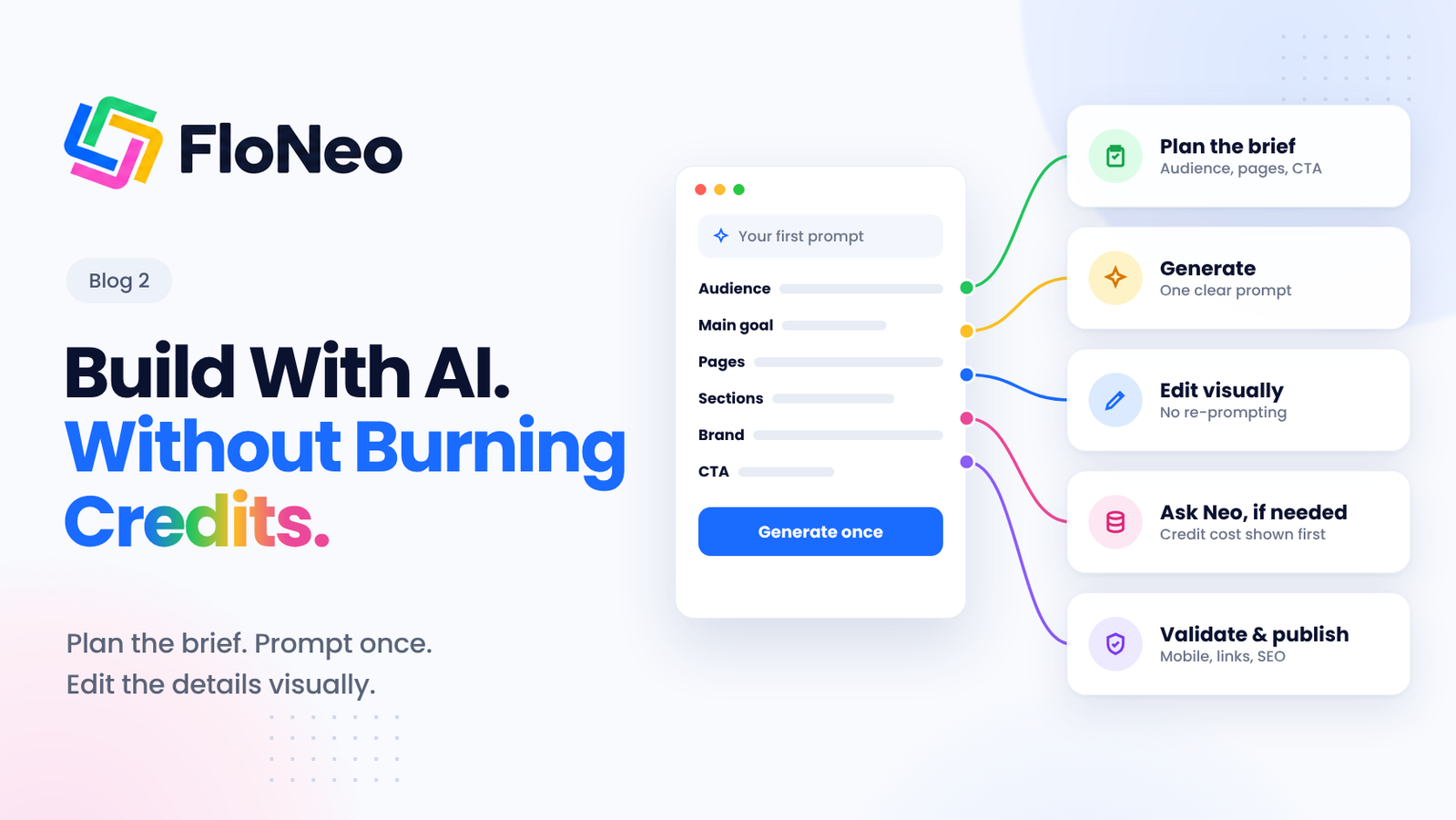
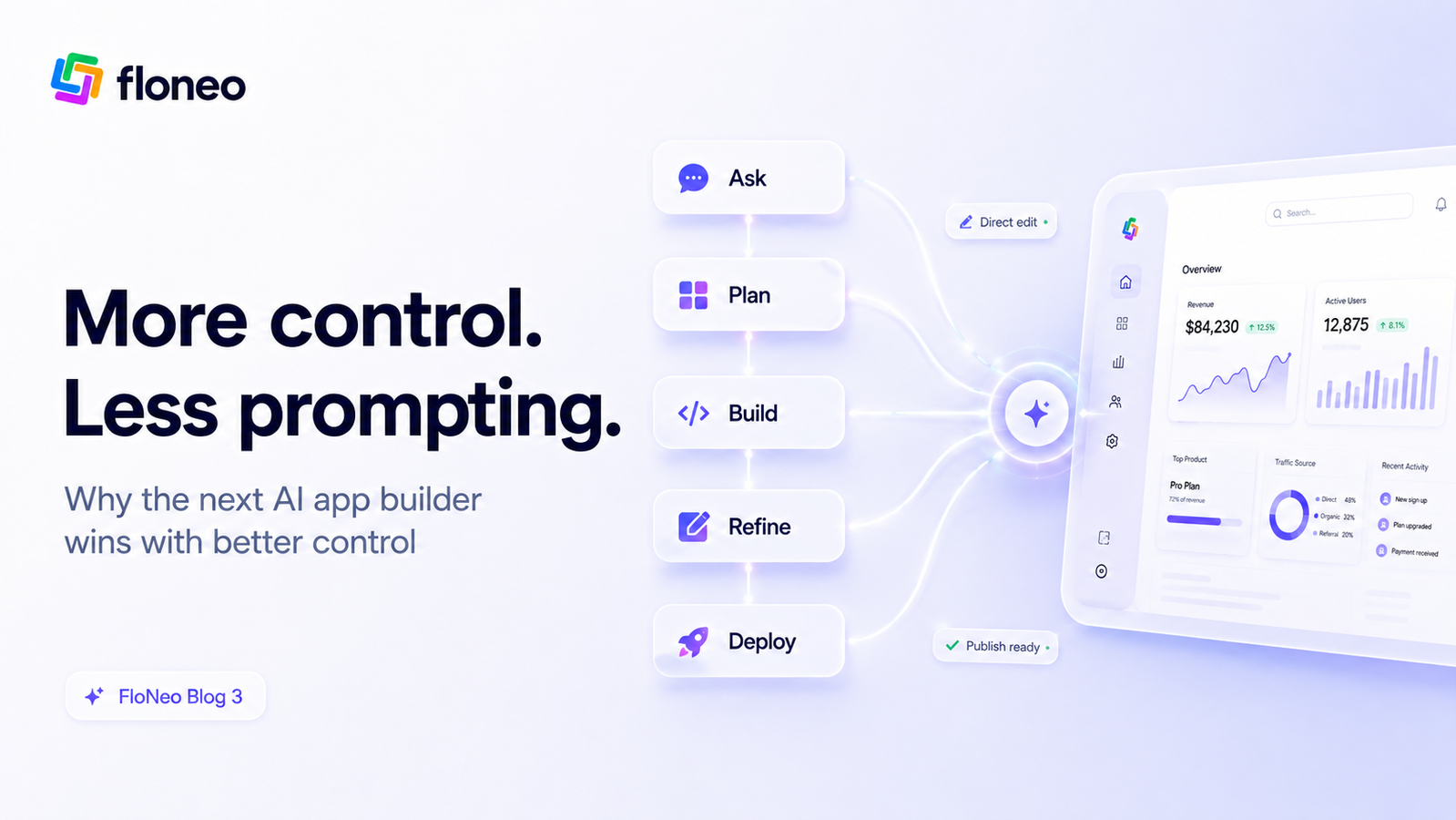
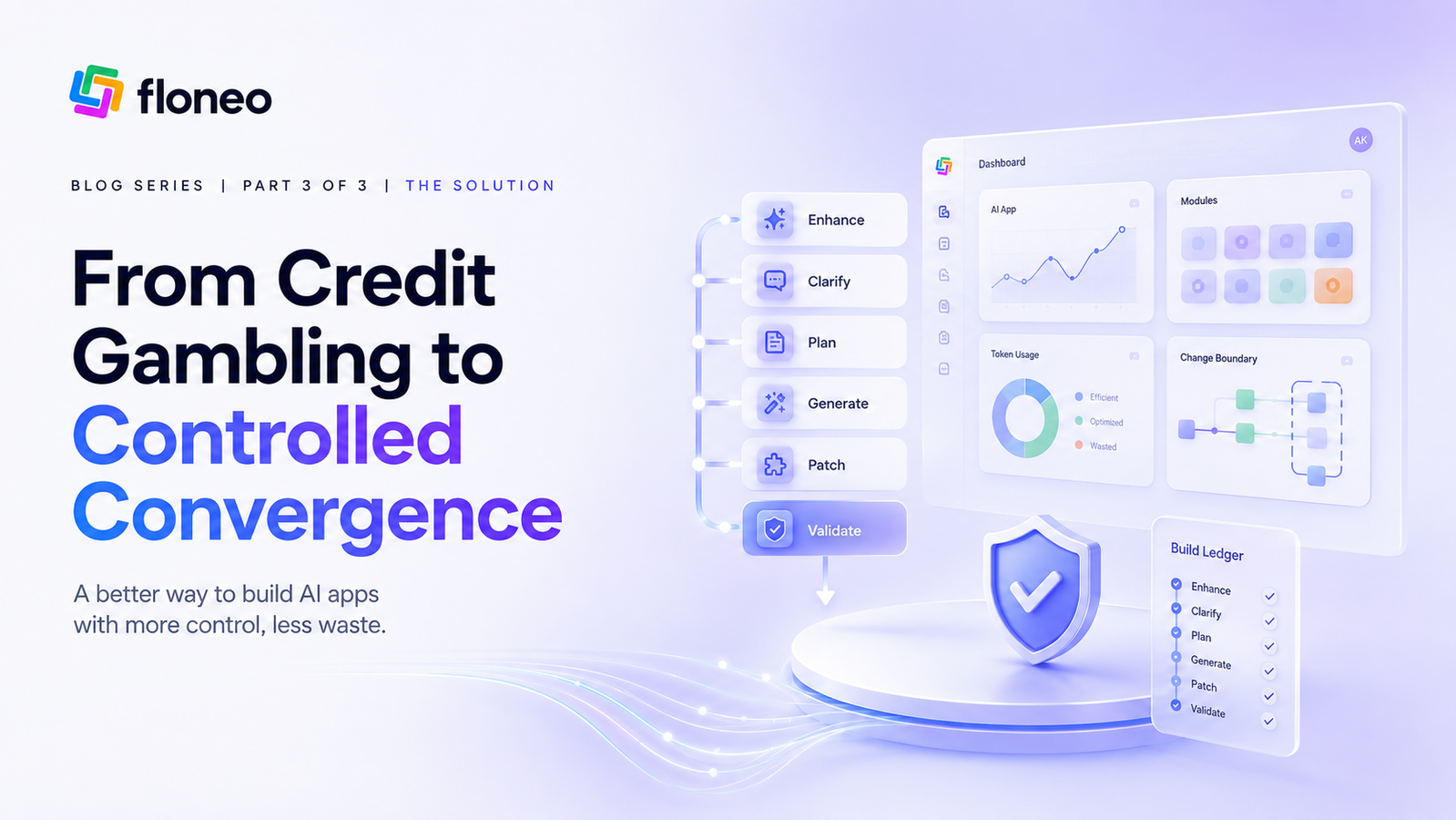
Enhance > Clarify > Plan > Generate > Edit > Patch > Validate
The visible journey and the engine underneath it solve different parts of the same problem.
| User-facing stage | Engine behaviour | Waste it prevents |
|---|---|---|
| Enhance | Compress the prompt and separate stable context from the current request | Repeated explanations and oversized context |
| Clarify | Identify missing decisions and risk-bearing assumptions | Paying later to correct silent guesses |
| Plan | Build a modular application structure and estimate the work | Starting generation before "done" is defined |
| Generate | Route each task to the appropriate model/tool | Using expensive capability where it is unnecessary |
| Edit | Keep supported visual changes on the canvas | Spending AI credits on direct UI manipulation |
| Patch | Update the smallest relevant application boundary | Full rewrites for local changes |
| Validate | Test the approved behaviours before release | Mistaking a convincing preview for a dependable product |
A good confirmation flow without a modular architecture only delays the same regeneration problem.
A modular architecture without clarification can efficiently build the wrong thing.
FloNeo needs both.
What happens to Arun's $500?
The point of this example is not to announce FloNeo pricing.
The figures below are a governance model, not a quote, current plan, or delivery guarantee.
The question is simply: if Arun has a fixed $500 constraint, how should the system protect it?
| Budget reserve | Purpose | Release condition |
|---|---|---|
| $50 / 10% | Clarification, acceptance criteria, schema preview, cost range | Arun approves what will be built |
| $225 / 45% | Initial structured generation across the approved CRM scope | Core screens, entities, and workflows render successfully |
| $100 / 20% | Backend modules, permissions, import mapping, integrations | Data and role tests pass |
| $75 / 15% | Validation, edge cases, responsive checks, deployment preparation | Release checklist is complete |
| $50 / 10% | Contingency for approved scope changes or integration issues | Reserve remains visible until needed |
The important difference is not the percentages.
It is that the budget is allocated before it disappears.
Arun can see what has been reserved, what has been spent, what evidence released that spend, and what remains.
Compare that with the sequence in The $500 CRM That Stopped at 45%, where the next top-up was triggered by dissatisfaction with the last generation.
One model behaves like a plan.
The other behaves like a slot machine.
Expectation coverage becomes a checkpoint, not a feeling
In Part 2, "45%" represented Arun's subjective sense of how close the CRM was to what he wanted.
A controlled build should replace that feeling with evidence.
| Checkpoint | Illustrative coverage | Evidence required |
|---|---|---|
| Approved plan | 20% | Screens, entities, roles, workflows, and acceptance criteria confirmed |
| Structured first build | 60% | Core CRM flow works with test data |
| Canvas refinement | 75% | Layout and visual direction match the approved design |
| Backend and permissions | 90% | Persistence, role rules, import mapping, and validations pass |
| Release validation | 95%+ | Critical paths, edge cases, and deployment checks pass |
These percentages are planning markers, not a universal formula.
The key change is that Arun can point to evidence.
The project no longer moves forward just because the newest screen looks convincing.
Token Insurance should be visible inside the product
"Token Insurance" only matters if the user can see the controls that create it.
01. Preflight estimate
Before execution, show:
- the task;
- the model/tool class;
- the expected credit range;
- the application objects likely to be affected.
Know before spend.
02. Change boundary
Show which:
- components;
- entities;
- workflows;
- permissions; and
- files
the request is allowed to modify.
Limit the blast radius.
03. Model routing
A text edit, UI adjustment, schema decision, and complex logic change should not automatically use the same model.
FloNeo's architecture should choose deterministic tools, smaller models, or more capable models according to the task.
This is the Model Arbitration & Routing layer described in Part 1.
Pay for the capability needed.
04. Live credit ledger
A user should be able to answer:
- What consumed credits?
- Which task caused it?
- What changed?
- Did it pass validation?
- Was the result kept or rolled back?
A shrinking number in the corner is not enough.
Trace every credit.
05. Version and rollback
Approved states should be recoverable.
If a patch fails, Arun should be able to restore the last good state without spending AI credits to reconstruct the past.
Recover without regeneration.
06. Validation gates
Before publish, the platform should check the behaviours that matter for the specific application.
For the CRM, that means testing workflow, data, permissions, and release-critical behaviour.
Prove before release.
No more code soup
The backend cannot be discovered after the interface is finished.
A CRM is a stateful business system.
Its value comes from rules such as:
- who owns the lead;
- which stage it is in;
- what happens next;
- who can see it;
- who can modify it;
- what counts as a duplicate;
- what should trigger a reminder;
- which data appears in a report.
FloNeo's structured source of truth should define those relationships before the interface starts pretending everything is finished.
Where FloNeo provides managed modules, those modules should be used rather than asking an LLM to reinvent common behaviour such as authentication, data access, file handling, or standard workflows.
Where custom code is required, it should be isolated, reviewable, testable, and exportable.
That is a much less glamorous idea than "one prompt builds everything."
It is also how dependable software is built.
What FloNeo should never claim
Controlled convergence is useful precisely because it does not require pretending uncertainty has disappeared.
Not every application belongs inside a $500 budget
Complex integrations, regulated data, unusual algorithms, and high-scale workloads can require specialist engineering.
A visual builder does not remove security responsibility
Production systems still need appropriate testing, secrets management, monitoring, backups, and review.
Token Insurance cannot guarantee a perfect first result
Its purpose is to reduce preventable waste and make the remaining uncertainty visible.
AI is not the source of truth
The approved structure, rules, versions, and validation evidence should be the source of truth.
A prototype is not automatically a product
A polished preview can still have unfinished backend behaviour. FloNeo should show which release gates remain instead of hiding them behind a good-looking screen.
These boundaries are not weak marketing.
They are what make the rest of the promise credible.
Stack Overflow's 2025 Developer Survey found that more respondents distrusted AI output accuracy than trusted it. Veracode's 2025 GenAI Code Security Report also found security failures across a substantial portion of its tested generated-code samples. [3][4]
That does not mean AI-generated software should not be used.
It means AI app building needs controls.
FloNeo is not selling more attempts
The end goal is simple.
FloNeo is being built to provide a controlled route from intent to validated software.
For Arun, that means his budget is not consumed by asking the same AI to reinterpret the same CRM again and again.
The work is separated:
- decisions are clarified;
- the application is structured;
- generation is scoped;
- visual refinement happens directly;
- logic changes are patched;
- model choice matches the task;
- spend remains visible;
- working states are preserved;
- progress is tied to evidence.
The result may still involve compromise.
The difference is that Arun knows what he is compromising, why it costs what it costs, and what remains before he can depend on the CRM.
That is the practical promise behind Token Insurance:
not zero cost;
not zero uncertainty;
not magic.
Less waste.
Smaller change boundaries.
More direct control.
Better evidence.
A budget that behaves like a build plan instead of a bet.
Series complete
Part 1: The architecture
How FloNeo's 4-Layer Architecture Makes AI Prototyping Ultra-Affordable
How FloNeo uses compression, modular structure, model routing, and incremental patching to reduce unnecessary AI generation.
Part 2: The problem
The $500 CRM That Stopped at 45%
A composite case study showing what happens when an AI app-building budget is spent through repeated corrections without a controlled path to completion.
Part 3: The solution
From Credit Gambling to Controlled Convergence with FloNeo
How those architectural ideas become a build process designed around measurable progress rather than repeated attempts.
References and Method Notes
The $500 allocation and expectation checkpoints in this article are illustrative governance examples. They are not FloNeo pricing, a delivery quote, or a guaranteed outcome. Product capabilities described here reflect the FloNeo architecture and product direction presented in this series and should be checked against the released product version at the time of publication.
- FloNeo. How FloNeo's 4-Layer Architecture Makes AI Prototyping Ultra-Affordable. Published 3 August 2026.
- FloNeo. The $500 CRM That Stopped at 45%. Published 5 August 2026.
- Stack Overflow. 2025 Developer Survey: AI. Reports developer trust and distrust levels for AI-tool output accuracy. https://survey.stackoverflow.co/2025/ai/
- Veracode. 2025 GenAI Code Security Report. Reports security-test failures in generated-code samples evaluated in its study. https://www.veracode.com/resources/analyst-reports/2025-genai-code-security-report/
- Bolt Support. Maximize token efficiency. Recommends focused prompts, direct controls where possible, incremental functionality, and version history as ways to reduce unnecessary token use. https://support.bolt.new/best-practices/maximizing-token-efficiency
- Lovable Documentation. Credits and usage. Documents variable Build-mode credit consumption and credit top-up mechanics. https://docs.lovable.dev/introduction/credits-and-usage