
FloNeo vs Lovable, Bolt, Wix, Framer & ChatGPT: What Makes Us So Different
Generating version one is easy now. See how Lovable, Bolt, Framer, Wix, ChatGPT and FloNeo differ once you start refining what AI built.
Aayush2 min read
Generating version one is no longer the hard part. Refining it - with control, and without surprise credit bills - is where AI website builders really differ.
Part 1 of 3 - The Comparison
Lovable, Bolt, Framer, Wix and ChatGPT can all help you get a first draft. This post looks at what happens next, and where FloNeo's Low Token No Code approach fits.
AI can build your first website in minutes. But what happens when the headline feels wrong, the colours don't match your brand, or you want to change a section without rebuilding half the page?
That's where choosing an AI website builder gets interesting.
OpenAI's October 7 launch of GPT-6 Intelligent UI has made the question even more relevant. [1] ChatGPT can now create interactive experiences inside conversations, while Lovable, Bolt, Framer and Wix combine AI generation with their own editing tools. The first draft is no longer the whole story.
For anyone considering an AI website builder comparison, the more important question is this: which platform helps you build quickly while keeping control of what you've created? That's exactly what we're going to explore in this blog.
The Problem Isn't Generating a Website. It's Refining One.
AI has made it easier to turn an idea into a website. Yet real projects rarely finish with the first generation. You might need to replace an image, adjust spacing, rewrite a headline, improve the mobile layout or rethink the page structure. These changes don't all require the same approach. Some are precise and predictable. Others require interpretation and reasoning.
The distinction matters because every instruction sent to an AI builder can involve processing project context, interpreting the request and generating changes. Bolt's own documentation explains that reading and syncing project files account for much of its token usage, particularly as projects grow. [2] Meanwhile, some Lovable customers have reported repeated troubleshooting and unexpectedly high credit consumption in public reviews. [3]
These are documented user experiences, not proof that every project encounters the same problems. But they highlight an important consideration: building quickly is useful only if refining the result remains manageable.
How the Various AI-Website Builders Compare
An honest AI website builder comparison should look beyond feature lists. Public user discussions reveal where different workflows can create friction.
| Platform | Positives | Drawbacks |
|---|---|---|
| Lovable | Rapid AI-assisted website and full-stack app creation. Visual Edits allow direct changes to text, sizing and styling. [4] | Credit consumption can add up during repeated iterations and troubleshooting. Complex projects may require careful prompting and debugging. |
| Bolt.new | Browser-based website and app development with code access, AI assistance and visual editing. Multiple visual changes can be grouped together. [5] | Token usage increases with project context, making larger projects potentially more expensive to iterate on. Visual edits can still consume model tokens when saved. [2][5] |
| Framer | Strong design capabilities, responsive layouts, CMS, hosting and SEO tools. Its visual canvas offers detailed design control. [6] | Users unfamiliar with design tools may face a learning curve when refining layouts and responsive behaviour. |
| Wix Harmony | Combines AI-assisted creation with manual editing and a broad ecosystem of website and business features. [7] | Its extensive feature set can introduce complexity for users who want a simpler, more focused website-building workflow. |
| ChatGPT | GPT-6 Intelligent UI can generate interactive experiences, including forms, calculators and other tools directly within conversations. [1] | Generating an interactive experience in a conversation is not the same as managing a complete website, including its domain, publishing, content updates and SEO. |
How Does FloNeo Change Things
FloNeo is approaching website creation through a different product philosophy: Low Token No Code (LTNC). Traditional no-code tools reduce the need to write code. LTNC goes a step ahead: don't involve AI when a direct, predictable edit can do the job.
Imagine you're building a landing page for your freelance business. The initial generation creates your hero section, services and contact form. You then decide the headline needs changing, the button should use your brand colour and the hero image needs replacing.
These are known changes. You shouldn't need AI to interpret what you already know.
Now imagine you want to restructure the entire page for two different customer groups. That is a different task. AI can help you think through the content hierarchy and propose a new structure.
This is the distinction FloNeo wants to make central to website building: if you know the exact change, edit it. If you know the outcome but not the implementation, ask AI.
The workflow is straightforward:
- Generate: Describe your website and use AI to create the initial structure.
- Inspect: Review the result and identify what needs changing.
- Refine visually: Make supported adjustments directly instead of describing every detail to AI again.
- Use AI selectively: Bring AI back when a change requires interpretation, restructuring or reasoning.
- Keep improving: Treat the website as something you continue to control, not a one-time AI output.
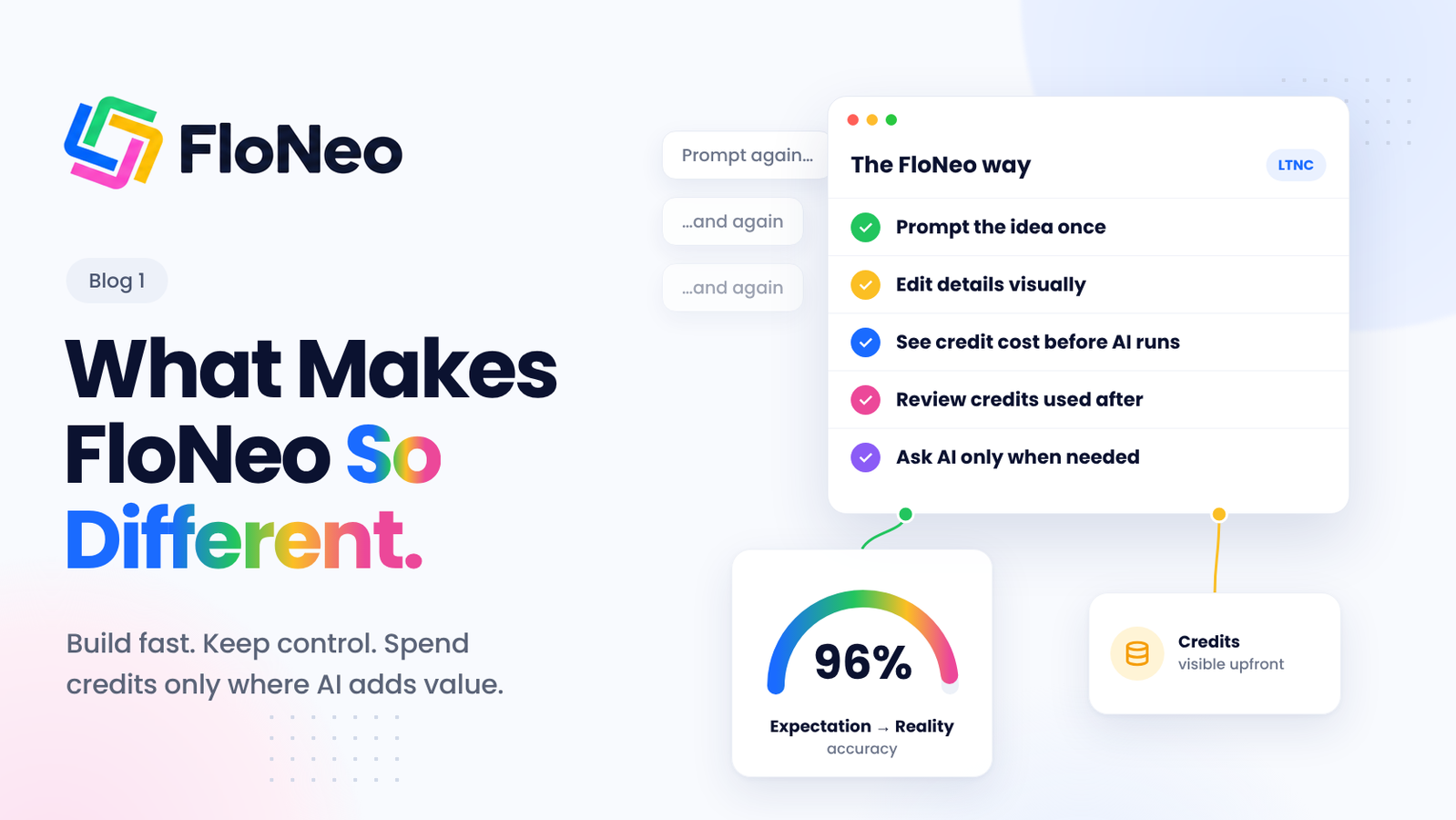
Two things sit quietly underneath that workflow. First, what you describe is what you get: FloNeo is built for a 96% expectation-to-reality accuracy, so the first version is designed to land close to what you pictured rather than kick off a long loop of corrections. Second, you can see what AI will cost: FloNeo shows the expected credit cost before an AI action runs and lets you review the credits used afterwards, so token spend never turns into a black box. [8]
| What matters after generation | How FloNeo handles it |
|---|---|
| Does the result match what I asked for? | 96% expectation-to-reality accuracy |
| What will this AI action cost? | Expected credit cost shown before it runs |
| What did I actually spend? | Credits used can be reviewed afterwards |
| Small, known changes | Direct visual editing - no new AI generation |
| Changes that need reasoning | AI, used selectively |
How FloNeo Compares With the Alternatives
An AI website builder comparison should help you identify the right workflow, not crown a universal winner.
| If your priority is... | Consider... |
|---|---|
| AI-assisted software development | Lovable |
| Browser-based development with code access | Bolt.new |
| Design-led websites and visual publishing | Framer |
| An established website and business platform | Wix |
| Quick interactive experiences inside conversations | ChatGPT |
| AI-generated websites with a philosophy centred on direct visual editing and greater human control | FloNeo |
Lovable does offer Visual Edits. Bolt lets users batch support visual changes before sending them to a model. Framer and Wix also combine AI with manual editing. FloNeo's emphasis lies on making AI generation, direct control and reduced avoidable AI usage part of one coherent workflow.
What Should You Look For Before Choosing?
Before committing to any AI website builder, ask five practical questions:
- Can I make routine changes without repeatedly prompting AI?
- Do I understand how the platform measures and limits usage?
- Can I refine the design and review mobile responsiveness?
- Does the platform support the publishing, content and SEO requirements I need?
- Can I continue maintaining the website after the initial generation?
In FloNeo, the second question has a visible answer: the expected credit cost appears before AI runs, and your usage stays reviewable after it does.
A generated website isn't automatically ready to publish or guaranteed to rank on Google. Content quality, technical accessibility, mobile usability and ongoing maintenance still matter. [9]
The right platform should make these tasks manageable rather than leaving you with a promising prototype and an unclear path forward.
Build Fast. Keep Control.
The next phase of AI website building isn't just about generating more with fewer words. It's about giving people more control over what AI creates. FloNeo's LTNC philosophy starts with a simple idea: use AI when intelligence adds value, and use direct controls when the change is already clear.
You don't need AI to guess a headline you've already written. You need a practical way to change it. AI gets you to version one. Visual control is how you make it yours.
FloNeo launches on November 1, 2026. Join the waitlist to get early access and explore a more controlled way to build websites.
Next in the Series
Part 2: How to Build a Website With AI Without Burning Through Credits (Sample Prompt Included)
Part 2 turns the philosophy into a practical workflow: plan the brief, generate once, refine visually and bring AI back only when the change needs reasoning.
Editorial note: Replace this placeholder with the live Part 2 URL after publication.
References
- OpenAI. GPT-6 for everyone (7 October 2026).
- Bolt. Tokens.
- Trustpilot. Lovable reviews.
- Lovable. Visual edit.
- Bolt. Visual edits.
- Framer. Framer.
- Wix. Wix launches Wix Harmony, the AI website builder that merges human and artificial intelligence.
- FloNeo. FloNeo - Describe, Generate, Edit, Own.
- Google Search Central. Google Search technical requirements.
- FloNeo. The Next AI App Builder Won't Win With More Prompts. It Will Win With Better Control.