
Easy to Build, Easier to Change: 5 Real-Life Database Examples with FloNeo
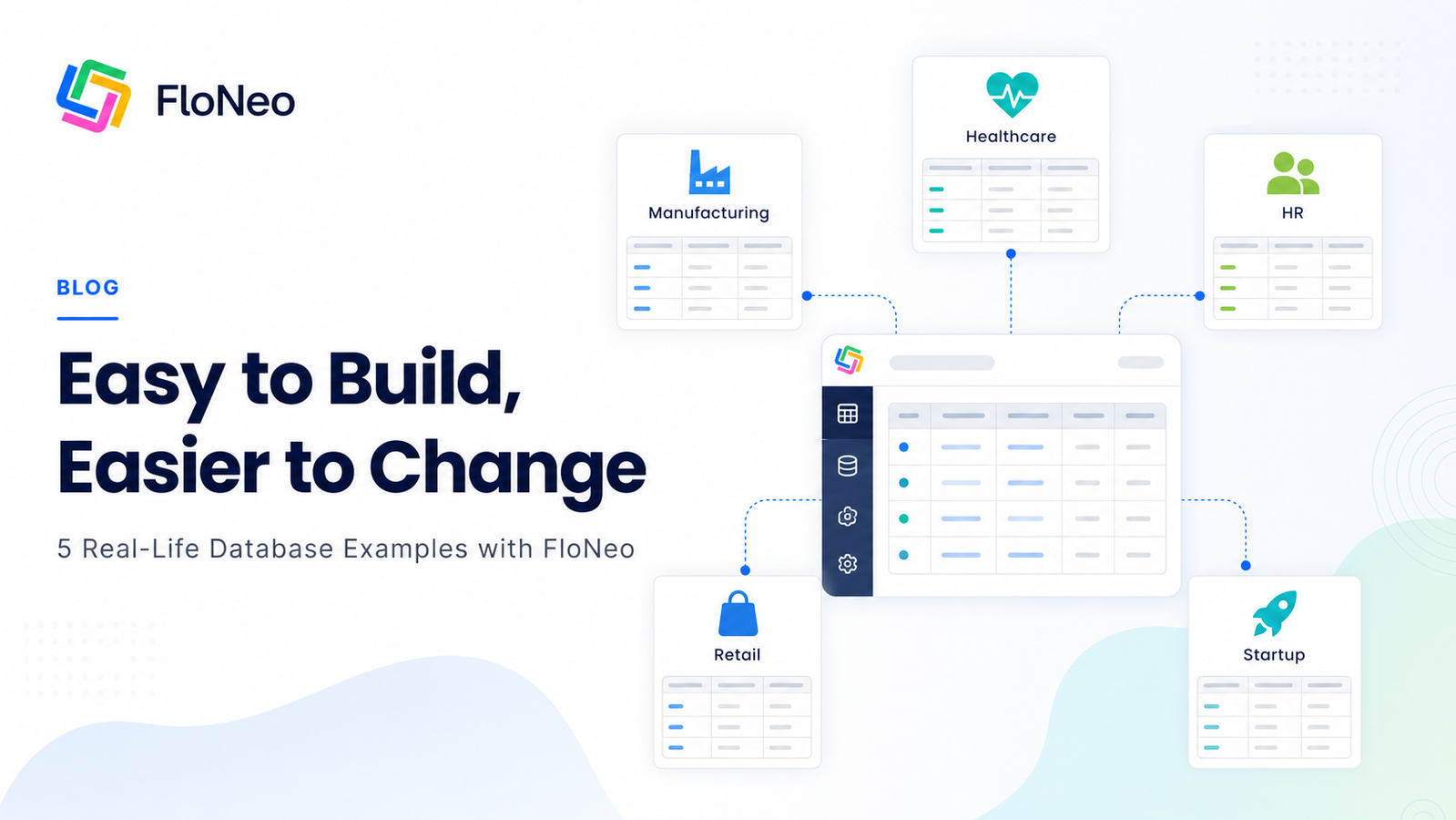
Five real situations show why database management is an everyday product task - not something that should send users back to AI or SQL for every change.
Aayush
Building the database is one moment. Managing it is an ongoing job.
Part 3 of 3 - The Use Cases
Part 1 explained the feature: AI for generation, UI for control. Part 2 compared how six different products approach the same database edit. This final article shows what that philosophy looks like once real organisations start changing their data.
The application is built. Then the business changes.
AI can now help generate the frontend, backend, database, and workflows of an application.
But generation is only the beginning.
Once people start using the application, the business keeps moving.
A new field needs to be tracked.
A new table becomes necessary.
Existing records need to be imported.
A team changes the way it categorises customers.
A policy introduces three new pieces of employee information.
These are normal product changes.
They should not automatically require:
- database-management expertise;
- SQL;
- migrations;
- another round of prompting.
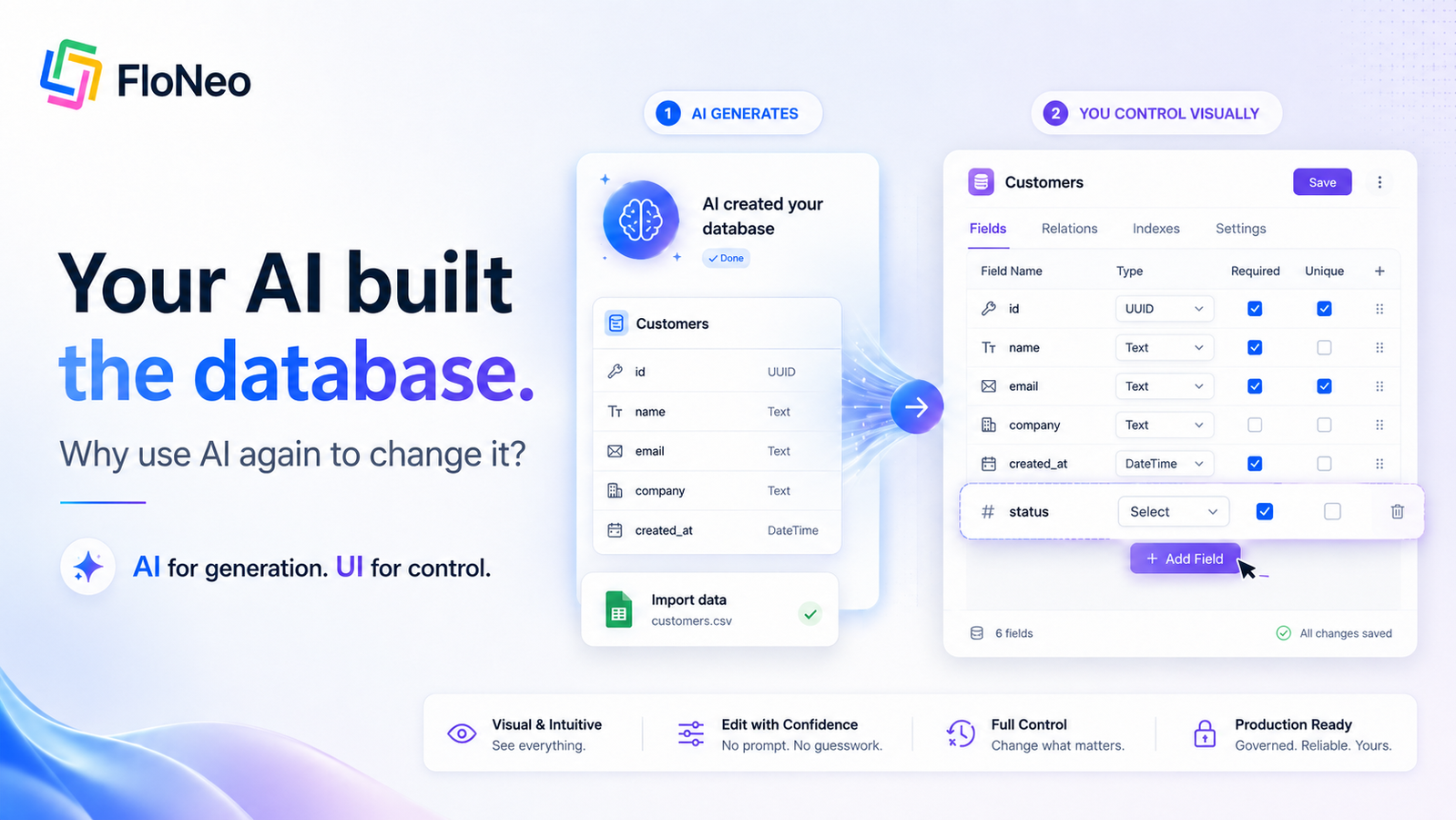
FloNeo's approach is to give users direct visual control over routine database management, while keeping AI available for the changes that actually require reasoning.
Here are five examples.
1. A clinic needs to track more patient information
A clinic has an appointment-management application with basic patient information:
- Name
- Age
- Phone Number
- Appointment Date
Later, the clinic decides it also needs:
- Blood Group
- Insurance Provider
- Preferred Doctor
The clinic already knows exactly what information it wants.
There is no database-design problem to solve.
The administrator can add those fields directly through the visual database interface.
A few months later, the clinic decides to maintain Lab Reports separately.
That change is larger, but still clear.
The team can create a Lab Reports table, define the required fields, and import existing records.
The application does not need to be rebuilt every time the clinic's information needs evolve.
Where AI is useful
If the clinic asks:
"How should Lab Reports relate to Patients, Appointments, and Doctors?"
AI can help reason through the structure.
Where direct UI is enough
If the decision is already made:
"Add Blood Group."
Use the visual control.
2. A manufacturer starts tracking energy consumption
A manufacturer already has an application for:
- machines;
- maintenance;
- spare parts.
Later, the company decides it also wants to track energy consumption for each machine.
The requirement is clear.
Create an Energy Consumption table with fields such as:
- Machine
- Date
- Units Consumed
- Cost
Save it.
If historical energy data already exists in Excel, import it.
The business has changed.
There is no need to turn the change into a complicated AI conversation simply because the database was originally AI-generated.
FloNeo lets the team make the change directly, visually, and without SQL.
Where AI is useful
"What is the best way to connect machine energy usage with maintenance events so we can identify unusual consumption?"
That requires reasoning.
Where direct UI is enough
"Create Energy Consumption and add Machine, Date, Units, and Cost."
The team already knows the answer.
3. An HR team needs new employee information
An HR application starts with:
- Name
- Department
- Designation
- Joining Date
A new policy now requires:
- Work Location
- Employment Type
- Emergency Contact
HR does not need AI to decide whether those three fields should exist.
The policy has already decided that.
The team can add them directly.
This is the simplest expression of the principle:
When the requirement is obvious, the control should be obvious too.
AI can still help when the problem becomes structural - for example, if the organisation wants to redesign employee, department, payroll, and reporting relationships.
But routine data capture should remain routine.
4. A retailer moves its product catalogue from Excel
A retailer has thousands of product records in spreadsheets:
- Product Name
- SKU
- Category
- Price
- Supplier
- Stock
The business wants that information inside its application.
Recreating those products one by one would make no sense.
Instead, the existing data can be imported and mapped to the relevant fields.
Once the data is inside the application, the team can continue to:
- add fields;
- update products;
- manage categories;
- correct records;
- import future batches.
AI can help build the application.
The business should still own and control its data afterwards.
Where AI is useful
"Our supplier, catalogue, inventory, and pricing data are inconsistent. How should we structure them?"
That is a modelling problem.
Where direct UI is enough
"Import this catalogue and map SKU to SKU, Price to Price, and Supplier to Supplier."
That is an execution task.
5. A startup keeps changing its business model
A startup begins with a simple application containing:
- Customers
- Orders
- Payments
Then it introduces subscriptions.
Later, it adds partners.
Then it changes pricing.
Then it starts tracking customer segments.
This is where the AI-versus-UI distinction becomes especially useful because some changes genuinely require reasoning and others do not.
A reasoning problem
"How should subscriptions relate to Customers, Orders, and Payments?"
AI can help think through the relationship.
A direct-change problem
Once the structure has been decided, the team may simply need to:
- add Subscription Type;
- add Renewal Date;
- create a Partners table;
- import an existing partner list;
- add Customer Segment.
Those are actions.
The team should not need another AI conversation simply because AI helped create the original application.
Five industries, the same pattern
| Scenario | AI is useful for | Visual database controls are useful for |
|---|---|---|
| Clinic | Deciding relationships between Patients, Appointments, Doctors, and Lab Reports | Adding known patient fields and creating an approved Lab Reports table |
| Manufacturing | Designing how energy data should connect to maintenance and machine analytics | Creating the energy table and importing historical readings |
| HR | Reworking a broader employee/department model | Adding policy-required employee fields |
| Retail | Designing a clean data model from inconsistent legacy sources | Importing, mapping, and maintaining catalogue data |
| Startup | Reasoning about new business-model relationships | Adding approved fields, tables, and existing lists |
Different industries.
Same interaction principle.
The basic idea behind LTNC
Low Token No Code is not about removing AI.
It is about using AI where it earns its place.
When the user asks:
"What should this database look like?"
AI is useful.
When the user says:
"I need this exact field."
The product should not force a reasoning loop.
That is why FloNeo treats database management as part of the visual builder.
The app builder's job does not end when the database is generated.
The after-generation experience is part of the product.
What the whole series says
Part 1 - The Feature
AI can generate the database. Routine changes should move to direct visual control.
Part 2 - The Comparison
Different AI app builders expose very different interaction models for the same database edit.
Part 3 - The Use Cases
Real businesses constantly change their data, so the database has to remain manageable after generation.
The common idea is simple:
AI can help build the database. FloNeo should help you control it.
That is the database-management side of AI for generation, UI for control.
And it follows the same architectural philosophy described in How FloNeo's 4-Layer Architecture Makes AI Prototyping Ultra-Affordable: reduce unnecessary AI work, preserve user control, and use intelligence where it actually adds value.
Internal-link note: Once Parts 1 and 2 are live, hyperlink both titles in this article and in the series summary. Do not publish guessed URLs.