
Human-in-the-Loop AI: Why Enterprise Automation Needs Governed Workflows
The Human-in-the-Loop Imperative
Why Enterprise AI Needs Governed Workflows, Not Blind Automation
|
AI-only automation is a demo. Governed AI with human intervention is enterprise infrastructure. |
Prepared for FloNeo | May 2026
A blog-ready article on Human-in-the-Loop (HITL) architecture, operational risk, enterprise AI governance, and how FloNeo LCNC acts as the orchestration layer between AI agents, workflow logic, human review, middleware, and core systems.
The biggest mistake enterprises are making with AI right now
They are trying to remove humans completely from critical workflows.
That sounds bold in a boardroom and looks impressive in a demo. But inside real operations, it creates a dangerous illusion: that intelligence alone is enough to run business processes end to end. It is not. Enterprise workflows are not clean lab environments. They are full of inconsistent documents, shifting rules, edge cases, missing context, legacy systems, compliance obligations, and humans who still carry accountability when something goes wrong.
This is why Human-in-the-Loop (HITL) architecture is becoming a core requirement for enterprise-grade AI systems. The point is not to slow AI down. The point is to decide where AI should move independently, where workflow logic should validate it, and where a person must intervene before the decision hits production systems.
|
Core idea: The future is not AI-only automation. The future is governed automation where AI handles scale, workflows enforce logic, systems stay connected, and humans handle exceptions. |
In practical terms, HITL is the difference between a chatbot making a claim and a governed workflow proving that claim before action. Tiny difference. Huge invoice. Sometimes literally.
Figure 1: Production workflows fail when AI outputs are allowed to bypass operational, policy, and system validation layers.
Why this matters: AI errors do not stay “technical” for long
When AI misreads an invoice, the issue is not just extraction accuracy. It may become a wrong payment, a delayed vendor settlement, a finance reconciliation problem, or a compliance exposure.
When AI approves or rejects a loan workflow incorrectly, the issue is not just model performance. It can affect customer experience, risk policy, auditability, and regulatory reporting.
When AI gives the wrong policy answer to a customer, the issue is not just hallucination. It becomes customer trust, legal liability, and brand risk.
The pattern is clear: automation is not the enemy. Ungoverned automation is.
Real-world warning signs
|
Case / signal |
What happened |
HITL lesson |
Ref. |
|
Air Canada chatbot |
A customer relied on incorrect bereavement fare guidance from the airline chatbot. A tribunal held Air Canada responsible for information provided through its chatbot. |
AI-facing customer or operational decisions still belong to the enterprise. A human escalation path matters when policy-sensitive answers are involved. |
[5] |
|
Knight Capital |
A software deployment/control failure in an automated trading system triggered millions of erroneous orders and a loss of more than $460 million in roughly 45 minutes; the SEC later imposed a $12 million penalty. |
Speed without kill-switches, reviews, and control limits turns small system errors into enterprise-scale damage. |
[6] |
|
Robodebt |
Australia’s Robodebt scheme became a major public-sector failure around automated debt decisions and governance, culminating in a Royal Commission report tabled in July 2023. |
Automated decisions affecting people need traceability, explainability, review rights, and accountability. |
[7] |
|
AI incidents trend |
Stanford HAI reported that AI-related incident reports reached 233 in 2024, a record high and 56.4% increase over 2023. |
As adoption increases, operational controls need to mature faster than experimentation. |
[4] |
What Human-in-the-Loop architecture actually means
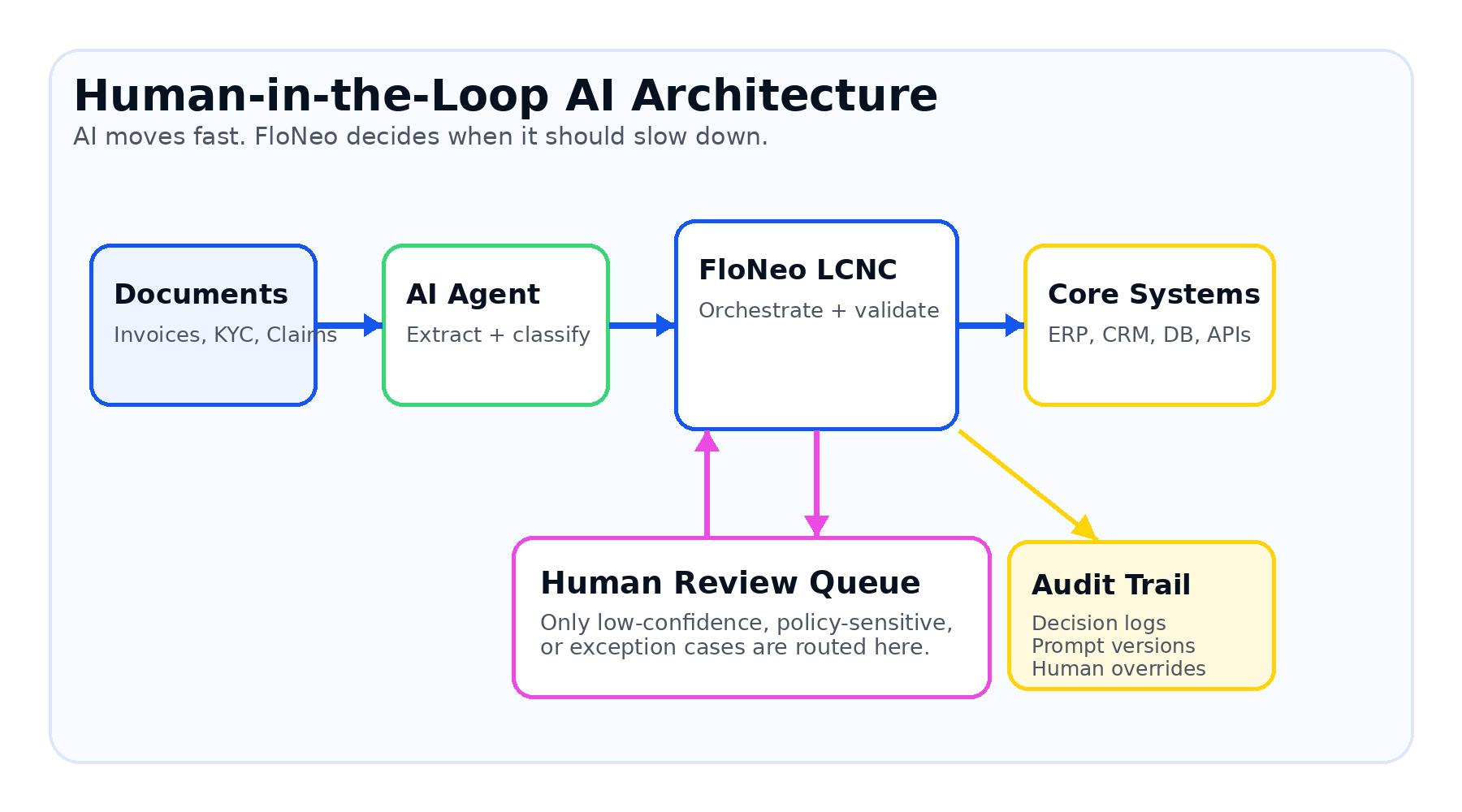
HITL does not mean every AI output waits for a person. That would be expensive theatre. Proper HITL means workflow-based escalation only when the system has a reason to pause.
Figure 2: FloNeo LCNC as the governed orchestration layer between AI agents, validation logic, human review, middleware and core systems.
A governed HITL workflow has five layers
|
1. AI extraction and classification |
AI extracts fields, summarizes documents, classifies intent and structures messy input into machine-readable data. |
|
2. Workflow validation |
Business rules check completeness, thresholds, routing conditions, policy requirements and required approvals. |
|
3. Confidence-based routing |
High-confidence cases continue automatically; uncertain, sensitive or contradictory cases move to a human review queue. |
|
4. Secure system execution |
Middleware and APIs update ERP, CRM, core DB, ticketing or communication systems only after validated execution. |
|
5. Audit and improvement loop |
Every AI decision, rule validation, human override and prompt version is logged for compliance and continuous improvement. |
Why FloNeo LCNC is built for this problem
FloNeo is not positioned as another AI layer floating above the business. It acts as a second-layer stack: a sidecar platform that sits beside existing enterprise systems, modernizes workflows, and avoids risky big-bang migration. The key advantage is orchestration: FloNeo gives AI agents a governed path into real business execution.
|
FloNeo capability |
Why it matters for HITL AI |
|
Visual workflow orchestration |
Teams can visually modify routing, approvals, exception branches and process steps instead of waiting for every change to become a development project. |
|
AI blocks + workflow engine |
AI can extract, summarize and structure data while FloNeo’s workflow engine validates business logic and routes outcomes. |
|
Secure connectors and middleware |
AI output becomes operational only after passing through controlled API integrations with CRM, ERP, core DB or external services. |
|
Human review queues |
Low-confidence and exception cases can be routed to the right operational user, not dumped into someone’s inbox like a digital crime scene. |
|
Auditability and governance |
Decision trails, approvals, prompt updates, rule changes and overrides can be logged for compliance review. |
|
Adaptability without rebuilding |
As products, regulations or SOPs change, teams can update prompts, modify workflow branches and add new validation logic faster. |
How this looks in real enterprise workflows
|
Use case |
HITL workflow design |
|
Accounts payable / invoice processing |
AI reads invoices, extracts vendor, GST/VAT, PO number, amount, line items and due date. FloNeo validates against vendor master, PO rules, duplicate checks and approval thresholds. Human review is triggered only for mismatches, low confidence, high value, missing fields or policy exceptions. |
|
Banking loan eligibility |
A customer request enters through the bank website. FloNeo routes the request to backend users, triggers eligibility checks through external systems, updates CRM and core DB through APIs, and sends customer communication after validation. |
|
KYC and compliance operations |
AI extracts IDs, trade licenses, beneficial ownership data and supporting documents. FloNeo checks completeness, routing rules and risk flags. Compliance users review only uncertain or high-risk cases, with a full audit trail. |
|
Insurance claims |
AI classifies the claim, extracts claim amount, incident details and policy references. FloNeo validates policy status, fraud flags and coverage logic. Human adjusters intervene for complex, high-value or contradictory claims. |
The confidence-threshold model: where humans should intervene
Enterprises often get HITL wrong by reviewing too much or too little. The right design uses confidence scores, business rules and risk class to decide what happens next.
Figure 5: A practical threshold model for routing AI decisions inside governed workflows.
What should trigger human review?
• AI confidence falls below the approved threshold.
• Required fields are missing, unreadable or contradictory.
• The transaction value exceeds the auto-approval limit.
• A rule conflict occurs between AI output and policy logic.
• The case involves regulated decisions: credit, KYC, fraud, claims, employment, legal or customer rights.
• A new document type, product, geography or compliance branch appears.
• The user overrides an AI recommendation or flags it as wrong.
A practical implementation blueprint for enterprise HITL AI
|
1. Define decision risk classes |
Separate low-risk data extraction from high-risk decisions. Not every AI output deserves the same autonomy. |
|
2. Create confidence thresholds |
Set default routing rules for auto-execute, human verify, reject or clarify. |
|
3. Map workflow branches visually |
Design the process in FloNeo: normal path, exception path, approval path, retry path and escalation path. |
|
4. Connect validation layers |
Use workflow rules, database checks and API calls to validate AI output before execution. |
|
5. Build human review dashboards |
Give operations users a clean queue with extracted data, source document, AI reasoning, rule failures and approve/reject controls. |
|
6. Log every action |
Track model output, prompt version, rule version, user approval, override reason and downstream system update. |
|
7. Improve continuously |
Use human corrections to update prompts, refine extraction rules, add validation branches and reduce future review volume. |
Common mistake to avoid
|
Do not make HITL a manual fallback hidden outside the workflow. If human review happens over email, Slack, or scattered spreadsheets, the enterprise loses auditability. Human intervention must be part of the architecture, not a side hustle. |
The governance angle is no longer optional
Governance frameworks are moving in the same direction. NIST’s AI Risk Management Framework explicitly references defined, assessed and documented human oversight processes. The EU AI Act places human oversight, accuracy, robustness and traceability within the obligation set for high-risk AI systems. McKinsey’s 2025 AI survey also notes that AI high performers are more likely to define when model outputs need human validation. In plain English: serious AI programs do not just ship models; they design controls around decisions. [1][2][3]
The strategic takeaway for enterprise leaders
Enterprises should not ask, “Can AI replace this team?” That question is lazy, and lazy questions produce expensive systems.
The better question is: “Which parts of this workflow should AI accelerate, which parts should rules validate, and which parts still require human judgment before execution?”
That is the shift from blind automation to controlled intelligence.
With FloNeo LCNC as the orchestration layer, enterprises can deploy AI inside governed workflows rather than isolated experiments. AI handles extraction, classification and summarization. FloNeo handles routing, validation, integration and governance. Humans handle judgment where the system needs context, authority or accountability.
This is the real enterprise AI operating model: not AI replacing operations, but AI amplifying operations through governed workflow infrastructure.
|
The future is not AI-only automation. The future is governed AI infrastructure - fast where it can be, careful where it must be. |
References
[1] NIST AI Risk Management Framework / AI RMF Core
[2] European Commission - AI Act overview and high-risk obligations
[3] McKinsey - The State of AI: Global Survey 2025
[4] Stanford HAI - 2025 AI Index Report: Responsible AI
[5] American Bar Association - Moffatt v. Air Canada chatbot liability summary
[6] U.S. SEC - Knight Capital Market Access Rule enforcement release
[7] Royal Commission into the Robodebt Scheme - Final Report
The Human-in-the-Loop Imperative
Why Enterprise AI Needs Governed Workflows, Not Blind Automation
|
AI-only automation is a demo. Governed AI with human intervention is enterprise infrastructure. |
Prepared for FloNeo | May 2026
A blog-ready article on Human-in-the-Loop (HITL) architecture, operational risk, enterprise AI governance, and how FloNeo LCNC acts as the orchestration layer between AI agents, workflow logic, human review, middleware, and core systems.
The biggest mistake enterprises are making with AI right now
They are trying to remove humans completely from critical workflows.
That sounds bold in a boardroom and looks impressive in a demo. But inside real operations, it creates a dangerous illusion: that intelligence alone is enough to run business processes end to end. It is not. Enterprise workflows are not clean lab environments. They are full of inconsistent documents, shifting rules, edge cases, missing context, legacy systems, compliance obligations, and humans who still carry accountability when something goes wrong.
This is why Human-in-the-Loop (HITL) architecture is becoming a core requirement for enterprise-grade AI systems. The point is not to slow AI down. The point is to decide where AI should move independently, where workflow logic should validate it, and where a person must intervene before the decision hits production systems.
|
Core idea: The future is not AI-only automation. The future is governed automation where AI handles scale, workflows enforce logic, systems stay connected, and humans handle exceptions. |
In practical terms, HITL is the difference between a chatbot making a claim and a governed workflow proving that claim before action. Tiny difference. Huge invoice. Sometimes literally.
Figure 1: Production workflows fail when AI outputs are allowed to bypass operational, policy, and system validation layers.
Why this matters: AI errors do not stay “technical” for long
When AI misreads an invoice, the issue is not just extraction accuracy. It may become a wrong payment, a delayed vendor settlement, a finance reconciliation problem, or a compliance exposure.
When AI approves or rejects a loan workflow incorrectly, the issue is not just model performance. It can affect customer experience, risk policy, auditability, and regulatory reporting.
When AI gives the wrong policy answer to a customer, the issue is not just hallucination. It becomes customer trust, legal liability, and brand risk.
The pattern is clear: automation is not the enemy. Ungoverned automation is.
Real-world warning signs
|
Case / signal |
What happened |
HITL lesson |
Ref. |
|
Air Canada chatbot |
A customer relied on incorrect bereavement fare guidance from the airline chatbot. A tribunal held Air Canada responsible for information provided through its chatbot. |
AI-facing customer or operational decisions still belong to the enterprise. A human escalation path matters when policy-sensitive answers are involved. |
[5] |
|
Knight Capital |
A software deployment/control failure in an automated trading system triggered millions of erroneous orders and a loss of more than $460 million in roughly 45 minutes; the SEC later imposed a $12 million penalty. |
Speed without kill-switches, reviews, and control limits turns small system errors into enterprise-scale damage. |
[6] |
|
Robodebt |
Australia’s Robodebt scheme became a major public-sector failure around automated debt decisions and governance, culminating in a Royal Commission report tabled in July 2023. |
Automated decisions affecting people need traceability, explainability, review rights, and accountability. |
[7] |
|
AI incidents trend |
Stanford HAI reported that AI-related incident reports reached 233 in 2024, a record high and 56.4% increase over 2023. |
As adoption increases, operational controls need to mature faster than experimentation. |
[4] |
What Human-in-the-Loop architecture actually means
HITL does not mean every AI output waits for a person. That would be expensive theatre. Proper HITL means workflow-based escalation only when the system has a reason to pause.
Figure 2: FloNeo LCNC as the governed orchestration layer between AI agents, validation logic, human review, middleware and core systems.
A governed HITL workflow has five layers
|
1. AI extraction and classification |
AI extracts fields, summarizes documents, classifies intent and structures messy input into machine-readable data. |
|
2. Workflow validation |
Business rules check completeness, thresholds, routing conditions, policy requirements and required approvals. |
|
3. Confidence-based routing |
High-confidence cases continue automatically; uncertain, sensitive or contradictory cases move to a human review queue. |
|
4. Secure system execution |
Middleware and APIs update ERP, CRM, core DB, ticketing or communication systems only after validated execution. |
|
5. Audit and improvement loop |
Every AI decision, rule validation, human override and prompt version is logged for compliance and continuous improvement. |
Why FloNeo LCNC is built for this problem
FloNeo is not positioned as another AI layer floating above the business. It acts as a second-layer stack: a sidecar platform that sits beside existing enterprise systems, modernizes workflows, and avoids risky big-bang migration. The key advantage is orchestration: FloNeo gives AI agents a governed path into real business execution.
|
FloNeo capability |
Why it matters for HITL AI |
|
Visual workflow orchestration |
Teams can visually modify routing, approvals, exception branches and process steps instead of waiting for every change to become a development project. |
|
AI blocks + workflow engine |
AI can extract, summarize and structure data while FloNeo’s workflow engine validates business logic and routes outcomes. |
|
Secure connectors and middleware |
AI output becomes operational only after passing through controlled API integrations with CRM, ERP, core DB or external services. |
|
Human review queues |
Low-confidence and exception cases can be routed to the right operational user, not dumped into someone’s inbox like a digital crime scene. |
|
Auditability and governance |
Decision trails, approvals, prompt updates, rule changes and overrides can be logged for compliance review. |
|
Adaptability without rebuilding |
As products, regulations or SOPs change, teams can update prompts, modify workflow branches and add new validation logic faster. |
How this looks in real enterprise workflows
|
Use case |
HITL workflow design |
|
Accounts payable / invoice processing |
AI reads invoices, extracts vendor, GST/VAT, PO number, amount, line items and due date. FloNeo validates against vendor master, PO rules, duplicate checks and approval thresholds. Human review is triggered only for mismatches, low confidence, high value, missing fields or policy exceptions. |
|
Banking loan eligibility |
A customer request enters through the bank website. FloNeo routes the request to backend users, triggers eligibility checks through external systems, updates CRM and core DB through APIs, and sends customer communication after validation. |
|
KYC and compliance operations |
AI extracts IDs, trade licenses, beneficial ownership data and supporting documents. FloNeo checks completeness, routing rules and risk flags. Compliance users review only uncertain or high-risk cases, with a full audit trail. |
|
Insurance claims |
AI classifies the claim, extracts claim amount, incident details and policy references. FloNeo validates policy status, fraud flags and coverage logic. Human adjusters intervene for complex, high-value or contradictory claims. |
The confidence-threshold model: where humans should intervene
Enterprises often get HITL wrong by reviewing too much or too little. The right design uses confidence scores, business rules and risk class to decide what happens next.
Figure 5: A practical threshold model for routing AI decisions inside governed workflows.
What should trigger human review?
• AI confidence falls below the approved threshold.
• Required fields are missing, unreadable or contradictory.
• The transaction value exceeds the auto-approval limit.
• A rule conflict occurs between AI output and policy logic.
• The case involves regulated decisions: credit, KYC, fraud, claims, employment, legal or customer rights.
• A new document type, product, geography or compliance branch appears.
• The user overrides an AI recommendation or flags it as wrong.
A practical implementation blueprint for enterprise HITL AI
|
1. Define decision risk classes |
Separate low-risk data extraction from high-risk decisions. Not every AI output deserves the same autonomy. |
|
2. Create confidence thresholds |
Set default routing rules for auto-execute, human verify, reject or clarify. |
|
3. Map workflow branches visually |
Design the process in FloNeo: normal path, exception path, approval path, retry path and escalation path. |
|
4. Connect validation layers |
Use workflow rules, database checks and API calls to validate AI output before execution. |
|
5. Build human review dashboards |
Give operations users a clean queue with extracted data, source document, AI reasoning, rule failures and approve/reject controls. |
|
6. Log every action |
Track model output, prompt version, rule version, user approval, override reason and downstream system update. |
|
7. Improve continuously |
Use human corrections to update prompts, refine extraction rules, add validation branches and reduce future review volume. |
Common mistake to avoid
|
Do not make HITL a manual fallback hidden outside the workflow. If human review happens over email, Slack, or scattered spreadsheets, the enterprise loses auditability. Human intervention must be part of the architecture, not a side hustle. |
The governance angle is no longer optional
Governance frameworks are moving in the same direction. NIST’s AI Risk Management Framework explicitly references defined, assessed and documented human oversight processes. The EU AI Act places human oversight, accuracy, robustness and traceability within the obligation set for high-risk AI systems. McKinsey’s 2025 AI survey also notes that AI high performers are more likely to define when model outputs need human validation. In plain English: serious AI programs do not just ship models; they design controls around decisions. [1][2][3]
The strategic takeaway for enterprise leaders
Enterprises should not ask, “Can AI replace this team?” That question is lazy, and lazy questions produce expensive systems.
The better question is: “Which parts of this workflow should AI accelerate, which parts should rules validate, and which parts still require human judgment before execution?”
That is the shift from blind automation to controlled intelligence.
With FloNeo LCNC as the orchestration layer, enterprises can deploy AI inside governed workflows rather than isolated experiments. AI handles extraction, classification and summarization. FloNeo handles routing, validation, integration and governance. Humans handle judgment where the system needs context, authority or accountability.
This is the real enterprise AI operating model: not AI replacing operations, but AI amplifying operations through governed workflow infrastructure.
|
The future is not AI-only automation. The future is governed AI infrastructure - fast where it can be, careful where it must be. |
References
[1] NIST AI Risk Management Framework / AI RMF Core
[2] European Commission - AI Act overview and high-risk obligations
[3] McKinsey - The State of AI: Global Survey 2025
[4] Stanford HAI - 2025 AI Index Report: Responsible AI
[5] American Bar Association - Moffatt v. Air Canada chatbot liability summary
[6] U.S. SEC - Knight Capital Market Access Rule enforcement release
[7] Royal Commission into the Robodebt Scheme - Final Report
Share this article